PDFGen Component
Properties Methods Events Config Settings Errors
The PDFGen component creates PDF documents from scratch.
Syntax
nsoftware.PDFSDK.PDFGen
Remarks
PDFGen is a versatile document generation component that can be used to create PDF documents in a highly customizable way.
Preparing the document for editing is as easy as calling CreateNew. Before calling this method, optionally configure baseline properties that you would like to apply to the new document, such as its page dimensions (SetLayout), page numbering (SetDocumentProperty), or PDF/A compliance requirements (EnforcePDFA). Then start composing the document by adding content. When finished, call Close to close the document and save the changes to either OutputFile, OutputData, or the stream set in SetOutputStream.
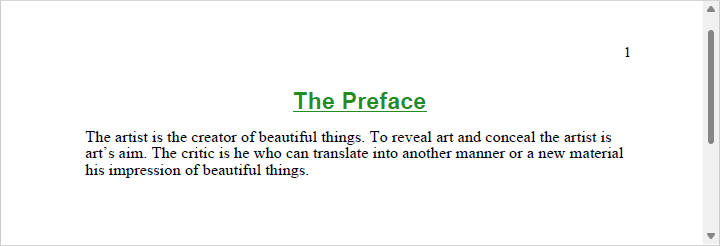
The example below configures page numbers in the right header, adds a centered title with bold and underline formatting, and finally adds a left-aligned paragraph.
PDFGen pdfgen = new PDFGen();
pdfgen.OutputFile = "output.pdf";
pdfgen.SetDocumentProperty("PageRightHeader", "%PAGENUMBER%");
pdfgen.CreateNew();

pdfgen.SetAlignment((int)HorizontalAlignments.haCenter, (int)VerticalAlignments.vaTop);
pdfgen.SetFont("Arial", "20", "bold underline", "forestgreen");
pdfgen.AddTextBlock("The Preface", false);
pdfgen.SetFont("Times New Roman", "14", "regular", "black");

pdfgen.AddBreak(0, 2);

pdfgen.SetAlignment((int)HorizontalAlignments.haLeft, (int)VerticalAlignments.vaTop);
pdfgen.AddParagraph("The artist is the creator of beautiful things. To reveal art and conceal the artist is art's aim. The critic is he who can translate into another manner or a new material his impression of beautiful things.");

pdfgen.Close();
Canvases and the Editing Process
Every editing operation performed by PDFGen goes through a canvas, which is an editing window with a set of rules and operations defined for it that is either:
- A text canvas, which can be thought of as a multi-line rich text editor;
- A drawing canvas, a rectangular random-access drawing area; or
- A table canvas, a rectangular grid of rows and columns.
The canvas types are distinct, meaning only one of them can be used at a time to create a specific piece of content. Canvases of different types can be grouped together or used as part of other canvases, which provides a powerful and flexible tool for creating content of various types and complexities. For example, a drawing canvas containing a graphic can be embedded into a text canvas containing the document body.
When CreateNew is called, the component automatically creates a page-wide text canvas (a "page canvas") so you can start adding content right away. This canvas takes into account the dimensions of the page and any margins configured. One-inch margins are set by default. Upon reaching the end of the page, the component closes the corresponding canvas, creates a new one for the next page (thus "turning the page" behind the scenes), and continues until all the content has been added.
You can always create your own canvases (and sub-canvases) should you need to add non-standard kinds of content that go beyond the traditional document layout, such as marginal notes, watermarks, or signatures.
Additionally, a canvas exists in one of three states:
- Open, where it is in the process of editing and the content can still be changed;
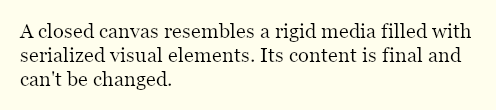
- Closed, where editing has been completed and the content has been finalized ("committed"); or
- Rendered, where the content has been serialized from its internal closed representation into a PDF graphics stream.
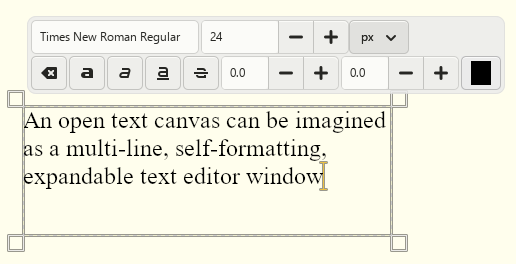
Changes made to an open canvas may influence how the content is represented in the document when the canvas is eventually rendered. For example, any text added to a center-aligned line in a text canvas will cause existing text to move leftward. Any text added to a drawing canvas - which is random access and does not offer the capability of formatting - will not affect any other content added to it previously.
A closed canvas resembles an opaque rectangle filled with visual elements. Once a canvas is closed, all such elements become locked and their dimensions are known, which enables their absolute positions and sizes to be calculated unambiguously as the component can be certain that they will not change.
During the editing process, PDFGen creates pieces of content, fills them in, closes them, and renders them onto the page. It adds content to the document sequentially like a typewriter: once added, content cannot be deleted. However, unlike a typewriter, content can be automatically formatted by the component on a later stage. For example, updating the dimensions of a text canvas may cause elements added to it previously to be rearranged, similar to how expanding a text area control in a browser form rearranges its content.
Text Canvases
A text canvas is a vertical series of lines, each comprised of a horizontal series of elements. It is analogous to a traditional text editor and is used for creating structured (mostly textual) content, which is added element by element, line by line. Pages, signature fields added via AddSignatureField, and table cells are all kinds of text canvases.Random access is not allowed in text canvases; instead, the component stacks elements in the current line and arranges them as they are added. This means that in general, the dimensions of a text canvas (its Width and Height) are not fixed and may expand horizontally and vertically.
If the current line is full and cannot accommodate a subsequent element (and the chosen constraints do not allow for it to be expanded), in most cases the component completes the current line, adds a new one, places the cursor at the beginning of the new line, and adds the element there. However, if the element's width exceeds MaxWidth, it will not fit in the new line either, so the OutOfSpace event fires to give your code a chance to forcefully expand the canvas or cancel the insertion of the element altogether.
Similarly, exceeding MaxHeight also causes the component to automatically wrap to the next default canvas (e.g., the next page or column) or trigger OutOfSpace. Subscribe to that event to recover from failed calls in a flexible way.
Drawing Canvases
A drawing canvas is analogous to a drawing board and is used for creating free-form vector content in two-dimensional Cartesian space. A drawing canvas provides random access: primitives can be placed anywhere within its bounds in any order, and all coordinates are specified relative to the bottom-left corner of the canvas.Content is built from path primitives, which include lines, curves, and closed shapes that can be stroked, filled, or used to define clipping regions. Common shapes such as rectangles, circles, and polygons are also supported directly, as is importing SVG path data via AddDrawing and placing bitmaps via AddBitmap.
The visual appearance of each primitive is controlled by the active Pen and Brush at the time the path is started. The pen governs the stroke (color, thickness, style, line cap, and line join) and the brush governs the fill (color and opacity). Use SetPen and SetBrush to configure these properties; they remain in effect until changed.
The dimensions of a drawing canvas are fixed at creation time. Content that exceeds these bounds is clipped. When committed to its parent canvas via EndDrawing, the drawing canvas can be scaled, skewed, and rotated as needed.
When committed to a text canvas, a drawing canvas is treated as an inline element and flows with surrounding content, just like text and bitmaps. When committed to another drawing canvas, it is positioned at explicit coordinates within that canvas.
Table Canvases
A table canvas is used for creating grid-based content organized into rows and columns. The column count is fixed at creation time; rows and cells are added sequentially, and the layout engine resolves all column widths and row heights when the table is committed to its parent canvas via EndTable.Each cell is itself a text canvas, so any content that can be added to a page can also be added to a cell, including paragraphs, bitmaps, and nested drawing canvases. Cells can span multiple columns or rows, which the layout engine automatically accounts for when distributing space.
Width constraints can be specified at both the table and cell level. When no preferred width is given, the layout engine distributes available space proportionally across columns based on their content. Row heights follow the same principle: the height of each row is determined by the tallest cell it contains, unless a fixed or minimum height is specified via StartTableRow.
The Pen and Brush active when a cell is opened determine its border style and background fill. Individual cell borders can be suppressed via a bitmask passed to StartTableCell, allowing any combination of top, right, bottom, and left borders to be hidden independently.
Property List
The following is the full list of the properties of the component with short descriptions. Click on the links for further details.
| Attachments | A collection of all attached files added to the document. |
| Brush | The current brush settings. |
| Canvas | The current canvas. |
| Font | The currently set font. |
| Layout | The current page layout. |
| OutputData | A byte array containing the PDF document after processing. |
| OutputFile | The path to a local file where the output is written. |
| Overwrite | Whether the component should overwrite files. |
| Pen | The current pen settings. |
Method List
The following is the full list of the methods of the component with short descriptions. Click on the links for further details.
| AddAttachment | Adds an attachment to the document. |
| AddBitmap | Adds a bitmap image to the current canvas. |
| AddBreak | Adds a number of breaks to the text canvas. |
| AddButton | Adds a button field to the form. |
| AddCheckBox | Adds a checkbox field to the form. |
| AddComboBox | Adds a combo box field to the form. |
| AddCopy | Adds a copy of a previously saved element to the text canvas. |
| AddDrawing | Adds a vector drawing described by an SVG path string to the current canvas. |
| AddHeading | Adds a heading to the text canvas. |
| AddLink | Adds a hyperlink to the text canvas. |
| AddListBox | Adds a list box field to the form. |
| AddListItem | Adds an item to a list, combo box, or list box. |
| AddParagraph | Adds a paragraph of text to the text canvas. |
| AddRadioButton | Adds a radio button to the form. |
| AddSignatureField | Adds a signature field to the form. |
| AddSpecial | Adds a special element to the text canvas. |
| AddTableCell | Adds a single-paragraph cell to the current table row. |
| AddTextBlock | Adds a block of text to the text canvas. |
| AddTextBox | Adds a text box field to the form. |
| AddTitle | Adds a title to the text canvas. |
| Cancel | Cancels the current canvas. |
| Close | Closes the new document. |
| Config | Sets or retrieves a configuration setting. |
| CreateNew | Creates a new PDF document. |
| DrawCircle | Draws an ellipse or circle on the drawing canvas. |
| DrawCopy | Draws a copy of a previously saved element onto the drawing canvas. |
| DrawCurveTo | Adds a cubic Bezier curve segment to the current path. |
| DrawLineTo | Adds a straight line segment to the current path. |
| DrawPolygon | Draws a polygon on the drawing canvas. |
| DrawRectangle | Draws a rectangle on the drawing canvas. |
| EndComboBox | Completes the combo box field. |
| EndContent | Completes the logical section. |
| EndDrawing | Finalizes the drawing canvas and commits it to the parent canvas. |
| EndEditing | Finalizes the text canvas and commits it to the parent canvas. |
| EndForm | Completes the form. |
| EndList | Completes the list. |
| EndListBox | Completes the list box field. |
| EndListItem | Completes the list item. |
| EndParagraph | Completes the paragraph. |
| EndPath | Completes the current path and applies it to the drawing canvas. |
| EndSignatureField | Completes the signature field. |
| EndTable | Finalizes the table canvas and commits it to the parent canvas. |
| EndTableCell | Completes the current table cell. |
| EndTableRow | Completes the current table row. |
| GetDocumentProperty | Returns the value of a document property. |
| GetFieldProperty | Returns the value of a field property. |
| GetPageProperty | Returns the value of a page property. |
| RemoveAttachment | Removes an attachment from the document. |
| Reset | Resets the component. |
| SaveStyle | Saves the current style parameters. |
| Scroll | Scrolls down the page by the given number of points. |
| SetAlignment | Sets the alignment for subsequent text insertion operations. |
| SetBrush | Sets the fill properties used when drawing shapes and cell backgrounds. |
| SetDocumentProperty | Sets the value of a document property. |
| SetFieldProperty | Sets the value of a field property. |
| SetFont | Sets the font properties to be applied to text. |
| SetLayout | Sets the layout for new pages. |
| SetMargin | Sets the margin for a typical element. |
| SetOutputStream | Sets the stream to write the processed document to. |
| SetPageProperty | Sets the value of a page property. |
| SetPen | Sets the stroke properties used when drawing lines, paths, and borders. |
| SetStyle | Loads a previously saved style. |
| StartComboBox | Begins a new combo box field for editing. |
| StartContent | Begins a new logical section. |
| StartDrawing | Initiates a new drawing canvas of the given dimensions. |
| StartEditing | Initiates a new text canvas for editing. |
| StartForm | Begins a new form. |
| StartList | Begins a new list for editing. |
| StartListBox | Begins a new list box field for editing. |
| StartListItem | Begins a new list item for editing. |
| StartParagraph | Begins a new paragraph for editing. |
| StartPath | Starts a new vector path at the given coordinates. |
| StartSignatureField | Begins a new signature field for editing. |
| StartTable | Initiates a new table canvas with a fixed number of columns. |
| StartTableCell | Begins a new cell in the current table row. |
| StartTableRow | Begins a new row in the current table. |
Event List
The following is the full list of the events fired by the component with short descriptions. Click on the links for further details.
| ActionRequired | Fired when the component encounters a conflict that it cannot resolve on its own. |
| EditingCompleted | Fired after a canvas has been closed. |
| Error | Fired when information is available about errors during data delivery. |
| Log | Fired once for each log message. |
| OutOfSpace | Fired when an element exceeds the maximum dimensions of the current text canvas. |
Config Settings
The following is a list of config settings for the component with short descriptions. Click on the links for further details.
| AFRelationship[Key] | The value of the AFRelationship key for the attachment. |
| AutoTurnPages | Whether to change the page automatically upon exceeding the lower page boundary. |
| CloseOutputStreamAfterProcessing | Whether to close the output stream after processing. |
| CompressStreams | Whether to compress stream objects. |
| EnforcePDFA | Whether to enforce PDF/A compliance. |
| FallbackFont | The fallback font. |
| FontPaths | The font search paths. |
| LogLevel | The level of detail that is logged. |
| PDFALevel | The PDF/A conformance level to enforce. |
| SaveChanges | Whether to save changes made to the document. |
| SystemFontNames | The system font names. |
| TempPath | The location where temporary files are stored. |
| BuildInfo | Information about the product's build. |
| GUIAvailable | Whether or not a message loop is available for processing events. |
| LicenseInfo | Information about the current license. |
| MaskSensitiveData | Whether sensitive data is masked in log messages. |
| UseInternalSecurityAPI | Whether or not to use the system security libraries or an internal implementation. |
Attachments Property (PDFGen Component)
A collection of all attached files added to the document.
Syntax
public PDFAttachmentList Attachments { get; }
Public Property Attachments As PDFAttachmentList
Remarks
This property is used to access the details of all the attached files added to the document. Use AddAttachment and RemoveAttachment to add and remove attachments to/from this collection respectively.
This property is not available at design time.
Please refer to the PDFAttachment type for a complete list of fields.Brush Property (PDFGen Component)
The current brush settings.
Syntax
Remarks
This property is used to access the fill configuration most recently applied via SetBrush.
This property is read-only and not available at design time.
Please refer to the PDFBrush type for a complete list of fields.Canvas Property (PDFGen Component)
The current canvas.
Syntax
Remarks
This property is used to access the details of the current canvas after one of the following methods is called:
- CreateNew (page canvas)
- StartDrawing (drawing canvas)
- StartEditing (text canvas)
- StartSignatureField (signature field canvas)
- StartTable (table canvas)
- StartTableCell (cell canvas)
This property is read-only and not available at design time.
Please refer to the PDFCanvas type for a complete list of fields.Font Property (PDFGen Component)
The currently set font.
Syntax
Remarks
This property is used to access the font details specified using SetFont.
This property is read-only and not available at design time.
Please refer to the PDFFont type for a complete list of fields.Layout Property (PDFGen Component)
The current page layout.
Syntax
public PDFPageLayout Layout { get; }
Public ReadOnly Property Layout As PDFPageLayout
Remarks
This property is used to access the current page settings specified using SetLayout.
This property is read-only and not available at design time.
Please refer to the PDFPageLayout type for a complete list of fields.OutputData Property (PDFGen Component)
A byte array containing the PDF document after processing.
Syntax
Remarks
This property is used to read the byte array containing the produced output after the operation has completed. It is only set if an output file and output stream have not been assigned via OutputFile and SetOutputStream respectively.
This property is read-only and not available at design time.
OutputFile Property (PDFGen Component)
The path to a local file where the output is written.
Syntax
Default Value
""
Remarks
This property is used to provide a path where the resulting PDF document is saved after the operation has completed.
Overwrite Property (PDFGen Component)
Whether the component should overwrite files.
Syntax
Default Value
False
Remarks
This property indicates whether the component overwrites OutputFile. If set to false, an error is thrown whenever OutputFile exists before an operation.
Pen Property (PDFGen Component)
The current pen settings.
Syntax
Remarks
This property is used to access the stroke configuration most recently applied via SetPen.
This property is read-only and not available at design time.
Please refer to the PDFPen type for a complete list of fields.AddAttachment Method (PDFGen Component)
Adds an attachment to the document.
Syntax
public void AddAttachment(string fileName, string description);

Async Version
public async Task AddAttachment(string fileName, string description);
public async Task AddAttachment(string fileName, string description, CancellationToken cancellationToken);
Public Sub AddAttachment(ByVal FileName As String, ByVal Description As String)

Async Version
Public Sub AddAttachment(ByVal FileName As String, ByVal Description As String) As Task
Public Sub AddAttachment(ByVal FileName As String, ByVal Description As String, cancellationToken As CancellationToken) As Task
Remarks
This method is used to add an attachment (embedded file) to the document and to the Attachments collection.
FileName and Description specify the filename and description of the attachment respectively.
Example:
pdfgen.AddAttachment("foo.txt", "desc");

// Alternatively, create a PDFAttachment object and add it to Attachments manually:
PDFAttachment attachment = new PDFAttachment();
attachment.FileName = "foo.txt";
// or attachment.DataB = new byte[] { ... };
// or attachment.InputStream = new FileStream(...);
attachment.Description = "desc";
pdfgen.Attachments.Add(attachment);

// Or using one of the constructors:
pdfgen.Attachments.Add(new PDFAttachment("foo.txt", "desc"));
pdfgen.Close();
The full list of attachments is contained in the Attachments collection.
AddBitmap Method (PDFGen Component)
Adds a bitmap image to the current canvas.
Syntax
public void AddBitmap(string format, byte[] bytes, int bitmapWidth, int bitmapHeight, string scaleWidth, string scaleHeight);

Async Version
public async Task AddBitmap(string format, byte[] bytes, int bitmapWidth, int bitmapHeight, string scaleWidth, string scaleHeight);
public async Task AddBitmap(string format, byte[] bytes, int bitmapWidth, int bitmapHeight, string scaleWidth, string scaleHeight, CancellationToken cancellationToken);
Public Sub AddBitmap(ByVal Format As String, ByVal Bytes As Byte(), ByVal BitmapWidth As Integer, ByVal BitmapHeight As Integer, ByVal ScaleWidth As String, ByVal ScaleHeight As String)

Async Version
Public Sub AddBitmap(ByVal Format As String, ByVal Bytes As Byte(), ByVal BitmapWidth As Integer, ByVal BitmapHeight As Integer, ByVal ScaleWidth As String, ByVal ScaleHeight As String) As Task
Public Sub AddBitmap(ByVal Format As String, ByVal Bytes As Byte(), ByVal BitmapWidth As Integer, ByVal BitmapHeight As Integer, ByVal ScaleWidth As String, ByVal ScaleHeight As String, cancellationToken As CancellationToken) As Task
Remarks
This method is used to add a bitmap image to the current canvas.
Its behavior differs depending on the type of canvas it is called on. On a text canvas, the image is treated as an inline element and placed in the normal flow of content, following the same layout rules as text and other content. On a drawing canvas, the image is placed at the current pen position.
Format specifies the image format and color space of the supplied bytes, as a combined string (e.g., png-rgb, jpeg-cmyk).
Bytes contains the raw image data.
BitmapWidth and BitmapHeight specify the intrinsic pixel dimensions of the image.
ScaleWidth and ScaleHeight specify the rendered dimensions of the image in points.
AddBreak Method (PDFGen Component)
Adds a number of breaks to the text canvas.
Syntax
Remarks
This method is used to add Count breaks to the current text canvas, completing the current section(s) early.
BreakKind specifies the kind of break to add. Possible values are:
| 0 (bkLine) | |
| 1 (bkColumn) | Currently unsupported. |
| 2 (bkPage) |
NOTE: This method throws an exception if the current canvas is not a text canvas.
AddButton Method (PDFGen Component)
Adds a button field to the form.
Syntax
public void AddButton(string name, string caption, string width, string height, int actionType);

Async Version
public async Task AddButton(string name, string caption, string width, string height, int actionType);
public async Task AddButton(string name, string caption, string width, string height, int actionType, CancellationToken cancellationToken);
Public Sub AddButton(ByVal Name As String, ByVal Caption As String, ByVal Width As String, ByVal Height As String, ByVal ActionType As Integer)

Async Version
Public Sub AddButton(ByVal Name As String, ByVal Caption As String, ByVal Width As String, ByVal Height As String, ByVal ActionType As Integer) As Task
Public Sub AddButton(ByVal Name As String, ByVal Caption As String, ByVal Width As String, ByVal Height As String, ByVal ActionType As Integer, cancellationToken As CancellationToken) As Task
Remarks
This method is used to create a button field with name Name and caption Caption.
Width and Height specify the width and height of the button in either points (e.g., 30pt) or characters (e.g., 30).
ActionType specifies the type of action that is executed when the button is pressed. Possible values are:
| 0 (batNone) | No action |
| 1 (batSubmit) | Submit-form action |
| 2 (batReset) | Reset-form action |
| 3 (batImport) | Import-data action |
AddCheckBox Method (PDFGen Component)
Adds a checkbox field to the form.
Syntax
Remarks
This method is used to create a checkbox field with name Name.
DefaultValue specifies the initial state of the checkbox (checked/unchecked).
AddComboBox Method (PDFGen Component)
Adds a combo box field to the form.
Syntax
public void AddComboBox(string name, string options, string defaultValue, string width, string height);

Async Version
public async Task AddComboBox(string name, string options, string defaultValue, string width, string height);
public async Task AddComboBox(string name, string options, string defaultValue, string width, string height, CancellationToken cancellationToken);
Public Sub AddComboBox(ByVal Name As String, ByVal Options As String, ByVal DefaultValue As String, ByVal Width As String, ByVal Height As String)

Async Version
Public Sub AddComboBox(ByVal Name As String, ByVal Options As String, ByVal DefaultValue As String, ByVal Width As String, ByVal Height As String) As Task
Public Sub AddComboBox(ByVal Name As String, ByVal Options As String, ByVal DefaultValue As String, ByVal Width As String, ByVal Height As String, cancellationToken As CancellationToken) As Task
Remarks
This method is used to create a combo box field with name Name.
Options specifies a list of choices as a multi-line string.
DefaultValue specifies the initial value selected in the combo box.
Width and Height specify the width and height of the combo box in either points (e.g., 30pt) or characters (e.g., 30).
To create a combo box incrementally instead of all at once, use StartComboBox and EndComboBox.
AddCopy Method (PDFGen Component)
Adds a copy of a previously saved element to the text canvas.
Syntax
public void AddCopy(string name, string X, string Y, string scaleX, string scaleY, string rotation, string skewA, string skewB);

Async Version
public async Task AddCopy(string name, string X, string Y, string scaleX, string scaleY, string rotation, string skewA, string skewB);
public async Task AddCopy(string name, string X, string Y, string scaleX, string scaleY, string rotation, string skewA, string skewB, CancellationToken cancellationToken);
Public Sub AddCopy(ByVal Name As String, ByVal X As String, ByVal Y As String, ByVal ScaleX As String, ByVal ScaleY As String, ByVal Rotation As String, ByVal SkewA As String, ByVal SkewB As String)

Async Version
Public Sub AddCopy(ByVal Name As String, ByVal X As String, ByVal Y As String, ByVal ScaleX As String, ByVal ScaleY As String, ByVal Rotation As String, ByVal SkewA As String, ByVal SkewB As String) As Task
Public Sub AddCopy(ByVal Name As String, ByVal X As String, ByVal Y As String, ByVal ScaleX As String, ByVal ScaleY As String, ByVal Rotation As String, ByVal SkewA As String, ByVal SkewB As String, cancellationToken As CancellationToken) As Task
Remarks
This method is currently unsupported.
AddDrawing Method (PDFGen Component)
Adds a vector drawing described by an SVG path string to the current canvas.
Syntax
public void AddDrawing(string svgPath, string scaleX, string scaleY);

Async Version
public async Task AddDrawing(string svgPath, string scaleX, string scaleY);
public async Task AddDrawing(string svgPath, string scaleX, string scaleY, CancellationToken cancellationToken);
Public Sub AddDrawing(ByVal SvgPath As String, ByVal ScaleX As String, ByVal ScaleY As String)

Async Version
Public Sub AddDrawing(ByVal SvgPath As String, ByVal ScaleX As String, ByVal ScaleY As String) As Task
Public Sub AddDrawing(ByVal SvgPath As String, ByVal ScaleX As String, ByVal ScaleY As String, cancellationToken As CancellationToken) As Task
Remarks
This method is used to parse an SVG path data string and add the resulting drawing to the current canvas.
SvgPath is a standard SVG path data string using the commands M, L, H, V, C, S, Q, T, Z (and their lowercase relative equivalents). The following commands are supported:
| M / m | Move to (absolute / relative) |
| L / l | Line to |
| H / h | Horizontal line to |
| V / v | Vertical line to |
| C / c | Cubic Bezier curve |
| S / s | Smooth cubic Bezier curve |
| Q / q | Quadratic Bezier curve (converted internally to cubic) |
| T / t | Smooth quadratic Bezier curve (converted internally to cubic) |
| Z / z | Close path |
ScaleX and ScaleY specify the horizontal and vertical scale factors to apply to the drawing when placing it on the parent canvas. These parameters accept real values, with 1.0 being the actual size of the drawing (100%).
If the current canvas is already a drawing canvas, the path is imported directly into it. Otherwise, a temporary drawing canvas is created, the path is added to it, and the canvas is committed to the current canvas using ScaleX and ScaleY.
AddHeading Method (PDFGen Component)
Adds a heading to the text canvas.
Syntax
Remarks
This method is currently unsupported.
AddLink Method (PDFGen Component)
Adds a hyperlink to the text canvas.
Syntax
Remarks
This method is currently unsupported.
AddListBox Method (PDFGen Component)
Adds a list box field to the form.
Syntax
public void AddListBox(string name, string options, string defaultValue, string width, string height);

Async Version
public async Task AddListBox(string name, string options, string defaultValue, string width, string height);
public async Task AddListBox(string name, string options, string defaultValue, string width, string height, CancellationToken cancellationToken);
Public Sub AddListBox(ByVal Name As String, ByVal Options As String, ByVal DefaultValue As String, ByVal Width As String, ByVal Height As String)

Async Version
Public Sub AddListBox(ByVal Name As String, ByVal Options As String, ByVal DefaultValue As String, ByVal Width As String, ByVal Height As String) As Task
Public Sub AddListBox(ByVal Name As String, ByVal Options As String, ByVal DefaultValue As String, ByVal Width As String, ByVal Height As String, cancellationToken As CancellationToken) As Task
Remarks
This method is used to create a list box field with name Name.
Options specifies a list of choices as a multi-line string.
DefaultValue specifies the initial value selected in the list box.
Width and Height specify the width and height of the list box in either points (e.g., 30pt) or characters (e.g., 30).
To create a list box incrementally instead of all at once, use StartListBox and EndListBox.
AddListItem Method (PDFGen Component)
Adds an item to a list, combo box, or list box.
Syntax
Remarks
This method is used to add Text as either a list item or a choice in a combo box or list box field.
Name specifies the name of the item.
To create a list item incrementally instead of all at once, use StartListItem and EndListItem.
NOTE: This method throws an exception if the current canvas is not a text canvas.
AddParagraph Method (PDFGen Component)
Adds a paragraph of text to the text canvas.
Syntax
public void AddParagraph(string text);

Async Version
public async Task AddParagraph(string text);
public async Task AddParagraph(string text, CancellationToken cancellationToken);
Public Sub AddParagraph(ByVal Text As String)

Async Version
Public Sub AddParagraph(ByVal Text As String) As Task
Public Sub AddParagraph(ByVal Text As String, cancellationToken As CancellationToken) As Task
Remarks
This method is used to add a paragraph of Text to the current text canvas, which is done by breaking the text into lines and then words, and adding each word as a separate text block. When the end of a line is reached, the component inserts a line break and applies the line spacing set in SetMargin before continuing on to the next line of the paragraph.
Use SetAlignment and SetFont to adjust the parameters of the text blocks that comprise the new paragraph, and use SetMargin to indent the first line of the paragraph.
To create a paragraph incrementally instead of all at once, use StartParagraph and EndParagraph.
NOTE: This method throws an exception if the current canvas is not a text canvas.
AddRadioButton Method (PDFGen Component)
Adds a radio button to the form.
Syntax
public void AddRadioButton(string radioGroup, string name, bool isDefaultButton);

Async Version
public async Task AddRadioButton(string radioGroup, string name, bool isDefaultButton);
public async Task AddRadioButton(string radioGroup, string name, bool isDefaultButton, CancellationToken cancellationToken);
Public Sub AddRadioButton(ByVal RadioGroup As String, ByVal Name As String, ByVal IsDefaultButton As Boolean)

Async Version
Public Sub AddRadioButton(ByVal RadioGroup As String, ByVal Name As String, ByVal IsDefaultButton As Boolean) As Task
Public Sub AddRadioButton(ByVal RadioGroup As String, ByVal Name As String, ByVal IsDefaultButton As Boolean, cancellationToken As CancellationToken) As Task
Remarks
This method is used to create a radio button field with name Name within the radio group RadioGroup.
IsDefaultButton specifies whether the radio button will be selected initially (i.e., whether it will be the default value of the radio group).
AddSignatureField Method (PDFGen Component)
Adds a signature field to the form.
Syntax
public void AddSignatureField(string name, string width, string height);

Async Version
public async Task AddSignatureField(string name, string width, string height);
public async Task AddSignatureField(string name, string width, string height, CancellationToken cancellationToken);
Public Sub AddSignatureField(ByVal Name As String, ByVal Width As String, ByVal Height As String)

Async Version
Public Sub AddSignatureField(ByVal Name As String, ByVal Width As String, ByVal Height As String) As Task
Public Sub AddSignatureField(ByVal Name As String, ByVal Width As String, ByVal Height As String, cancellationToken As CancellationToken) As Task
Remarks
This method is used to create a signature field with name Name as a text canvas.
Width and Height specify the width and height of the signature field in either points (e.g., 30pt) or characters (e.g., 30).
To create a signature field incrementally instead of all at once, use StartSignatureField and EndSignatureField.
AddSpecial Method (PDFGen Component)
Adds a special element to the text canvas.
Syntax
Remarks
This method is currently unsupported.
AddTableCell Method (PDFGen Component)
Adds a single-paragraph cell to the current table row.
Syntax
Remarks
This convenience method is used to open a new cell, add Text as a paragraph, and close the cell in a single call. It is equivalent to calling StartTableCell with ColSpan and RowSpan set to 1 and Borders set to 0, followed by AddParagraph and EndTableCell.
Text specifies the text content of the cell. If empty, an empty cell is added.
Width specifies the cell width constraints in points, using the same [preferred]:[min]:[max] syntax as the corresponding parameter in StartTableCell. Both integer and decimal values are supported.
Use this method when a cell contains only a single plain-text paragraph and does not require colspan, rowspan, or complex inner content. For cells with richer content or spanning requirements, use StartTableCell and EndTableCell directly.
NOTE: This method throws an exception if the current canvas is not a table canvas.
AddTextBlock Method (PDFGen Component)
Adds a block of text to the text canvas.
Syntax
Remarks
This method is used to add a block of Text to the current line of the current text canvas. Use SetAlignment and SetFont to adjust new text block parameters.
Wrappable is reserved for future use.
NOTE: This method only applies if the current canvas is a text canvas.
AddTextBox Method (PDFGen Component)
Adds a text box field to the form.
Syntax
public void AddTextBox(string name, string defaultValue, bool multiLine, string width, string height, bool password);

Async Version
public async Task AddTextBox(string name, string defaultValue, bool multiLine, string width, string height, bool password);
public async Task AddTextBox(string name, string defaultValue, bool multiLine, string width, string height, bool password, CancellationToken cancellationToken);
Public Sub AddTextBox(ByVal Name As String, ByVal DefaultValue As String, ByVal MultiLine As Boolean, ByVal Width As String, ByVal Height As String, ByVal Password As Boolean)

Async Version
Public Sub AddTextBox(ByVal Name As String, ByVal DefaultValue As String, ByVal MultiLine As Boolean, ByVal Width As String, ByVal Height As String, ByVal Password As Boolean) As Task
Public Sub AddTextBox(ByVal Name As String, ByVal DefaultValue As String, ByVal MultiLine As Boolean, ByVal Width As String, ByVal Height As String, ByVal Password As Boolean, cancellationToken As CancellationToken) As Task
Remarks
This method is used to create a text box field with name Name.
DefaultValue specifies the initial value contained in the text box.
MultiLine specifies whether the text box can contain multiple lines of text.
Width and Height specify the width and height of the text box in either points (e.g., 30pt) or characters (e.g., 30).
Password specifies whether the text box is intended to contain a password. Pass true to have the text displayed as asterisk characters (*).
AddTitle Method (PDFGen Component)
Adds a title to the text canvas.
Syntax
public void AddTitle(string text);

Async Version
public async Task AddTitle(string text);
public async Task AddTitle(string text, CancellationToken cancellationToken);
Public Sub AddTitle(ByVal Text As String)

Async Version
Public Sub AddTitle(ByVal Text As String) As Task
Public Sub AddTitle(ByVal Text As String, cancellationToken As CancellationToken) As Task
Remarks
This method is currently unsupported.
Cancel Method (PDFGen Component)
Cancels the current canvas.
Syntax
public void Cancel();

Async Version
public async Task Cancel();
public async Task Cancel(CancellationToken cancellationToken);
Public Sub Cancel()

Async Version
Public Sub Cancel() As Task
Public Sub Cancel(cancellationToken As CancellationToken) As Task
Remarks
This method is used to cancel the canvas that is currently being edited. It should be called after one of the following methods as an alternative to setting Choice to oscFullCancel within the OutOfSpace event:
Example:pdfgen.StartEditing("100", "100", (int)ContentAnchors.caTop);
pdfgen.AddTextBlock("Hello world!", false);
try
{
pdfgen.EndEditing("", "", "1", "1", "0", "0", "0", "");
}
catch (PDFSDKException ex)
{
pdfgen.Cancel();
}
NOTE: This method throws an exception if the current canvas is a page canvas.
Close Method (PDFGen Component)
Closes the new document.
Syntax
public void Close();

Async Version
public async Task Close();
public async Task Close(CancellationToken cancellationToken);
Public Sub Close()

Async Version
Public Sub Close() As Task
Public Sub Close(cancellationToken As CancellationToken) As Task
Remarks
This method is used to close the new document. It should always be preceded by a call to CreateNew.
Example:
pdfgen.OutputFile = "output.pdf";
pdfgen.CreateNew();
// Some operation
pdfgen.Close();
The document is saved automatically to OutputFile, OutputData, or the stream set in SetOutputStream when this method is called.
To configure this saving behavior, set SaveChanges.
Config Method (PDFGen Component)
Sets or retrieves a configuration setting.
Syntax
Remarks
Config is a generic method available in every component. It is used to set and retrieve configuration settings for the component.
These settings are similar in functionality to properties, but they are rarely used. In order to avoid "polluting" the property namespace of the component, access to these internal properties is provided through the Config method.
To set a configuration setting named PROPERTY, you must call Config("PROPERTY=VALUE"), where VALUE is the value of the setting expressed as a string. For boolean values, use the strings "True", "False", "0", "1", "Yes", or "No" (case does not matter).
To read (query) the value of a configuration setting, you must call Config("PROPERTY"). The value will be returned as a string.
CreateNew Method (PDFGen Component)
Creates a new PDF document.
Syntax
public void CreateNew();

Async Version
public async Task CreateNew();
public async Task CreateNew(CancellationToken cancellationToken);
Public Sub CreateNew()

Async Version
Public Sub CreateNew() As Task
Public Sub CreateNew(cancellationToken As CancellationToken) As Task
Remarks
This method is used to create a blank PDF document with one empty page and an underlying page canvas. Use SetLayout to adjust the new page dimensions and number of columns. Having created the baseline document, use the component's methods to add objects to it.
Upon completion of this method, information about the newly created page canvas can be accessed using the Canvas property.
DrawCircle Method (PDFGen Component)
Draws an ellipse or circle on the drawing canvas.
Syntax
public void DrawCircle(string X, string Y, string radiusX, string radiusY);

Async Version
public async Task DrawCircle(string X, string Y, string radiusX, string radiusY);
public async Task DrawCircle(string X, string Y, string radiusX, string radiusY, CancellationToken cancellationToken);
Public Sub DrawCircle(ByVal X As String, ByVal Y As String, ByVal RadiusX As String, ByVal RadiusY As String)

Async Version
Public Sub DrawCircle(ByVal X As String, ByVal Y As String, ByVal RadiusX As String, ByVal RadiusY As String) As Task
Public Sub DrawCircle(ByVal X As String, ByVal Y As String, ByVal RadiusX As String, ByVal RadiusY As String, cancellationToken As CancellationToken) As Task
Remarks
This method is used to add a closed elliptical shape centered at (X, Y) to the current drawing canvas.
RadiusX and RadiusY specify the horizontal and vertical radii of the ellipse in points. Both integer and decimal values are supported. To draw a perfect circle, pass equal values for both.
Use SetPen and SetBrush before calling this method to control the border style and fill color.
NOTE: This method throws an exception if the current canvas is not a drawing canvas.
DrawCopy Method (PDFGen Component)
Draws a copy of a previously saved element onto the drawing canvas.
Syntax
public void DrawCopy(string name, string X, string Y, string scaleX, string scaleY, string rotation, string skewA, string skewB);

Async Version
public async Task DrawCopy(string name, string X, string Y, string scaleX, string scaleY, string rotation, string skewA, string skewB);
public async Task DrawCopy(string name, string X, string Y, string scaleX, string scaleY, string rotation, string skewA, string skewB, CancellationToken cancellationToken);
Public Sub DrawCopy(ByVal Name As String, ByVal X As String, ByVal Y As String, ByVal ScaleX As String, ByVal ScaleY As String, ByVal Rotation As String, ByVal SkewA As String, ByVal SkewB As String)

Async Version
Public Sub DrawCopy(ByVal Name As String, ByVal X As String, ByVal Y As String, ByVal ScaleX As String, ByVal ScaleY As String, ByVal Rotation As String, ByVal SkewA As String, ByVal SkewB As String) As Task
Public Sub DrawCopy(ByVal Name As String, ByVal X As String, ByVal Y As String, ByVal ScaleX As String, ByVal ScaleY As String, ByVal Rotation As String, ByVal SkewA As String, ByVal SkewB As String, cancellationToken As CancellationToken) As Task
Remarks
This method is currently unsupported.
DrawCurveTo Method (PDFGen Component)
Adds a cubic Bezier curve segment to the current path.
Syntax
public void DrawCurveTo(string X, string Y, string viaX1, string viaY1, string viaX2, string viaY2);

Async Version
public async Task DrawCurveTo(string X, string Y, string viaX1, string viaY1, string viaX2, string viaY2);
public async Task DrawCurveTo(string X, string Y, string viaX1, string viaY1, string viaX2, string viaY2, CancellationToken cancellationToken);
Public Sub DrawCurveTo(ByVal X As String, ByVal Y As String, ByVal ViaX1 As String, ByVal ViaY1 As String, ByVal ViaX2 As String, ByVal ViaY2 As String)

Async Version
Public Sub DrawCurveTo(ByVal X As String, ByVal Y As String, ByVal ViaX1 As String, ByVal ViaY1 As String, ByVal ViaX2 As String, ByVal ViaY2 As String) As Task
Public Sub DrawCurveTo(ByVal X As String, ByVal Y As String, ByVal ViaX1 As String, ByVal ViaY1 As String, ByVal ViaX2 As String, ByVal ViaY2 As String, cancellationToken As CancellationToken) As Task
Remarks
This method is used to extend the currently open path on the drawing canvas with a cubic Bezier curve from the current pen position to the endpoint specified by X and Y. Both integer and decimal values are supported.
ViaX1 and ViaY1 specify the first control point, which influences the curve near its start.
ViaX2 and ViaY2 specify the second control point, which influences the curve near its end.
Upon completion of this method, the current pen position will be moved to (X, Y).
NOTE: This method throws an exception if the current canvas is not a drawing canvas or if no path has been started with StartPath.
DrawLineTo Method (PDFGen Component)
Adds a straight line segment to the current path.
Syntax
Remarks
This method is used to extend the currently open path on the drawing canvas with a straight line from the current pen position to the point specified by X and Y. Both integer and decimal values are supported.
Upon completion of this method, the current pen position will be moved to (X, Y).
NOTE: This method throws an exception if the current canvas is not a drawing canvas or if no path has been started with StartPath.
DrawPolygon Method (PDFGen Component)
Draws a polygon on the drawing canvas.
Syntax
public void DrawPolygon(string points);

Async Version
public async Task DrawPolygon(string points);
public async Task DrawPolygon(string points, CancellationToken cancellationToken);
Public Sub DrawPolygon(ByVal Points As String)

Async Version
Public Sub DrawPolygon(ByVal Points As String) As Task
Public Sub DrawPolygon(ByVal Points As String, cancellationToken As CancellationToken) As Task
Remarks
This method is used to add a closed polygon defined by a list of vertices to the current drawing canvas.
Points specifies a comma-separated list of coordinate pairs in the form X1,Y1,X2,Y2,...,XN,YN containing at least three vertices. All coordinates are in points and are relative to the bottom-left corner of the drawing canvas.
The first vertex is used as the starting point. Subsequent vertices are connected with straight line segments. After the last vertex, the path is automatically closed back to the first vertex.
The polygon is stroked and filled using the current Pen and Brush. Use SetPen and SetBrush before calling this method to control the border style and fill color.
NOTE: This method throws an exception if the current canvas is not a drawing canvas or if fewer than three vertices are supplied.
DrawRectangle Method (PDFGen Component)
Draws a rectangle on the drawing canvas.
Syntax
public void DrawRectangle(string X, string Y, string width, string height, string cornerRadius);

Async Version
public async Task DrawRectangle(string X, string Y, string width, string height, string cornerRadius);
public async Task DrawRectangle(string X, string Y, string width, string height, string cornerRadius, CancellationToken cancellationToken);
Public Sub DrawRectangle(ByVal X As String, ByVal Y As String, ByVal Width As String, ByVal Height As String, ByVal CornerRadius As String)

Async Version
Public Sub DrawRectangle(ByVal X As String, ByVal Y As String, ByVal Width As String, ByVal Height As String, ByVal CornerRadius As String) As Task
Public Sub DrawRectangle(ByVal X As String, ByVal Y As String, ByVal Width As String, ByVal Height As String, ByVal CornerRadius As String, cancellationToken As CancellationToken) As Task
Remarks
This method is used to add a rectangle to the current drawing canvas. The rectangle is defined by its bottom-left corner at (X, Y) and the specified Width and Height, all in points. Both integer and decimal values are supported.
CornerRadius specifies the radius of the rounded corners of the rectangle. If greater than 0, each corner is replaced by a circular arc of the given radius. If the radius exceeds half the shorter side of the rectangle, it is automatically clamped to that maximum.
The rectangle is stroked and filled using the current Pen and Brush. Use SetPen and SetBrush before calling this method to control the border style and fill color.
NOTE: This method throws an exception if the current canvas is not a drawing canvas.
EndComboBox Method (PDFGen Component)
Completes the combo box field.
Syntax
public void EndComboBox();

Async Version
public async Task EndComboBox();
public async Task EndComboBox(CancellationToken cancellationToken);
Public Sub EndComboBox()

Async Version
Public Sub EndComboBox() As Task
Public Sub EndComboBox(cancellationToken As CancellationToken) As Task
Remarks
This method is used to finalize the combo box field created in StartComboBox. Note that the combo box can no longer be modified after it is completed.
NOTE: This method throws an exception if the current canvas is not a text canvas.
EndContent Method (PDFGen Component)
Completes the logical section.
Syntax
public void EndContent();

Async Version
public async Task EndContent();
public async Task EndContent(CancellationToken cancellationToken);
Public Sub EndContent()

Async Version
Public Sub EndContent() As Task
Public Sub EndContent(cancellationToken As CancellationToken) As Task
Remarks
This method is currently unsupported.
EndDrawing Method (PDFGen Component)
Finalizes the drawing canvas and commits it to the parent canvas.
Syntax
public void EndDrawing(string X, string Y, string scaleX, string scaleY, string rotation, string skewA, string skewB, string name);

Async Version
public async Task EndDrawing(string X, string Y, string scaleX, string scaleY, string rotation, string skewA, string skewB, string name);
public async Task EndDrawing(string X, string Y, string scaleX, string scaleY, string rotation, string skewA, string skewB, string name, CancellationToken cancellationToken);
Public Sub EndDrawing(ByVal X As String, ByVal Y As String, ByVal ScaleX As String, ByVal ScaleY As String, ByVal Rotation As String, ByVal SkewA As String, ByVal SkewB As String, ByVal Name As String)

Async Version
Public Sub EndDrawing(ByVal X As String, ByVal Y As String, ByVal ScaleX As String, ByVal ScaleY As String, ByVal Rotation As String, ByVal SkewA As String, ByVal SkewB As String, ByVal Name As String) As Task
Public Sub EndDrawing(ByVal X As String, ByVal Y As String, ByVal ScaleX As String, ByVal ScaleY As String, ByVal Rotation As String, ByVal SkewA As String, ByVal SkewB As String, ByVal Name As String, cancellationToken As CancellationToken) As Task
Remarks
This method is used to close the drawing canvas opened in StartDrawing and commit it to its parent canvas. Any open path on the drawing canvas is automatically closed first. Note that the drawing canvas can no longer be modified after it is closed.
X and Y specify the position, in points, where the canvas will be placed relative to the bottom-left corner of its parent canvas. These parameters must be empty if the parent canvas is a text canvas; position is determined automatically in that case. If the parent canvas is a drawing canvas, X and Y default to 0 if empty.
ScaleX and ScaleY specify the horizontal and vertical scale factors to apply to the canvas when placing it on the parent canvas. These parameters default to 1 if empty.
Rotation specifies the rotation angle of the canvas in degrees counterclockwise. If empty or 0, no rotation is applied.
SkewA and SkewB specify the horizontal and vertical skew angles of the canvas in degrees. SkewA shears along the X axis and SkewB shears along the Y axis. If empty or 0, no skew is applied.
The full transformation is applied in the following order: scale, skew, rotation, translation.
Name is reserved for future use.
NOTE: This method throws an exception if the current canvas is not a drawing canvas.
EndEditing Method (PDFGen Component)
Finalizes the text canvas and commits it to the parent canvas.
Syntax
public void EndEditing(string X, string Y, string scaleX, string scaleY, string rotation, string skewA, string skewB, string name);

Async Version
public async Task EndEditing(string X, string Y, string scaleX, string scaleY, string rotation, string skewA, string skewB, string name);
public async Task EndEditing(string X, string Y, string scaleX, string scaleY, string rotation, string skewA, string skewB, string name, CancellationToken cancellationToken);
Public Sub EndEditing(ByVal X As String, ByVal Y As String, ByVal ScaleX As String, ByVal ScaleY As String, ByVal Rotation As String, ByVal SkewA As String, ByVal SkewB As String, ByVal Name As String)

Async Version
Public Sub EndEditing(ByVal X As String, ByVal Y As String, ByVal ScaleX As String, ByVal ScaleY As String, ByVal Rotation As String, ByVal SkewA As String, ByVal SkewB As String, ByVal Name As String) As Task
Public Sub EndEditing(ByVal X As String, ByVal Y As String, ByVal ScaleX As String, ByVal ScaleY As String, ByVal Rotation As String, ByVal SkewA As String, ByVal SkewB As String, ByVal Name As String, cancellationToken As CancellationToken) As Task
Remarks
This method is used to close the text canvas opened in StartEditing and commit it to its parent canvas. Note that the text canvas can no longer be modified after it is closed.
X and Y specify the position, in points, where the canvas will be placed relative to the bottom-left corner of its parent canvas. These parameters must be empty if the parent canvas is a text canvas; position is determined automatically in that case.
ScaleX and ScaleY are reserved for future use.
Rotation is reserved for future use.
SkewA and SkewB are reserved for future use.
Name is reserved for future use.
NOTE: This method throws an exception if the current canvas is not a text canvas.
EndForm Method (PDFGen Component)
Completes the form.
Syntax
public void EndForm();

Async Version
public async Task EndForm();
public async Task EndForm(CancellationToken cancellationToken);
Public Sub EndForm()

Async Version
Public Sub EndForm() As Task
Public Sub EndForm(cancellationToken As CancellationToken) As Task
Remarks
This method is currently unsupported.
EndList Method (PDFGen Component)
Completes the list.
Syntax
public void EndList();

Async Version
public async Task EndList();
public async Task EndList(CancellationToken cancellationToken);
Public Sub EndList()

Async Version
Public Sub EndList() As Task
Public Sub EndList(cancellationToken As CancellationToken) As Task
Remarks
This method is used to finalize the list created in StartList. Note that the list can no longer be modified after it is completed.
NOTE: This method throws an exception if a list is not currently being edited.
EndListBox Method (PDFGen Component)
Completes the list box field.
Syntax
public void EndListBox();

Async Version
public async Task EndListBox();
public async Task EndListBox(CancellationToken cancellationToken);
Public Sub EndListBox()

Async Version
Public Sub EndListBox() As Task
Public Sub EndListBox(cancellationToken As CancellationToken) As Task
Remarks
This method is used to finalize the list box field created in StartListBox. Note that the list box can no longer be modified after it is completed.
NOTE: This method throws an exception if the current canvas is not a text canvas.
EndListItem Method (PDFGen Component)
Completes the list item.
Syntax
public void EndListItem();

Async Version
public async Task EndListItem();
public async Task EndListItem(CancellationToken cancellationToken);
Public Sub EndListItem()

Async Version
Public Sub EndListItem() As Task
Public Sub EndListItem(cancellationToken As CancellationToken) As Task
Remarks
This method is used to finalize the list item created in StartListItem and commit the underlying text canvas to its parent canvas. Note that the list item can no longer be modified after it is completed.
NOTE: This method throws an exception if a list is not currently being edited.
EndParagraph Method (PDFGen Component)
Completes the paragraph.
Syntax
public void EndParagraph(string name);

Async Version
public async Task EndParagraph(string name);
public async Task EndParagraph(string name, CancellationToken cancellationToken);
Public Sub EndParagraph(ByVal Name As String)

Async Version
Public Sub EndParagraph(ByVal Name As String) As Task
Public Sub EndParagraph(ByVal Name As String, cancellationToken As CancellationToken) As Task
Remarks
This method is currently unsupported.
EndPath Method (PDFGen Component)
Completes the current path and applies it to the drawing canvas.
Syntax
Remarks
This method is used to finalize the path started in StartPath and record it as a drawing primitive on the current drawing canvas. The path is rendered according to the drawing mode specified in StartPath when the canvas is eventually closed.
Name is reserved for future use.
ClosePath specifies whether to close the path by drawing a straight line from the current pen position back to the path's starting point before applying the drawing mode. Pass true to close the path (useful for filled shapes), or false to leave the path open.
NOTE: This method throws an exception if the current canvas is not a drawing canvas.
EndSignatureField Method (PDFGen Component)
Completes the signature field.
Syntax
public void EndSignatureField(string X, string Y, string scaleX, string scaleY, string rotation, string skewA, string skewB, string name);

Async Version
public async Task EndSignatureField(string X, string Y, string scaleX, string scaleY, string rotation, string skewA, string skewB, string name);
public async Task EndSignatureField(string X, string Y, string scaleX, string scaleY, string rotation, string skewA, string skewB, string name, CancellationToken cancellationToken);
Public Sub EndSignatureField(ByVal X As String, ByVal Y As String, ByVal ScaleX As String, ByVal ScaleY As String, ByVal Rotation As String, ByVal SkewA As String, ByVal SkewB As String, ByVal Name As String)

Async Version
Public Sub EndSignatureField(ByVal X As String, ByVal Y As String, ByVal ScaleX As String, ByVal ScaleY As String, ByVal Rotation As String, ByVal SkewA As String, ByVal SkewB As String, ByVal Name As String) As Task
Public Sub EndSignatureField(ByVal X As String, ByVal Y As String, ByVal ScaleX As String, ByVal ScaleY As String, ByVal Rotation As String, ByVal SkewA As String, ByVal SkewB As String, ByVal Name As String, cancellationToken As CancellationToken) As Task
Remarks
This method is used to finalize the signature field created in StartSignatureField and commit the underlying canvas to its parent canvas. Note that the signature field canvas can no longer be modified after it is closed.
X and Y are reserved for future use.
ScaleX and ScaleY are reserved for future use.
Rotation is reserved for future use.
SkewA and SkewB are reserved for future use.
Name is reserved for future use.
NOTE: This method throws an exception if the current canvas is not a text canvas.
EndTable Method (PDFGen Component)
Finalizes the table canvas and commits it to the parent canvas.
Syntax
public void EndTable(string name);

Async Version
public async Task EndTable(string name);
public async Task EndTable(string name, CancellationToken cancellationToken);
Public Sub EndTable(ByVal Name As String)

Async Version
Public Sub EndTable(ByVal Name As String) As Task
Public Sub EndTable(ByVal Name As String, cancellationToken As CancellationToken) As Task
Remarks
This method is used to close the table canvas opened in StartTable and commit it to its parent canvas. Any open cell or row in the table is automatically closed before the table layout is resolved. Note that the table canvas can no longer be modified after it is closed.
Name is reserved for future use.
NOTE: This method throws an exception if the current canvas is not a table canvas.
EndTableCell Method (PDFGen Component)
Completes the current table cell.
Syntax
public void EndTableCell(string name);

Async Version
public async Task EndTableCell(string name);
public async Task EndTableCell(string name, CancellationToken cancellationToken);
Public Sub EndTableCell(ByVal Name As String)

Async Version
Public Sub EndTableCell(ByVal Name As String) As Task
Public Sub EndTableCell(ByVal Name As String, cancellationToken As CancellationToken) As Task
Remarks
This method is used to explicitly close the cell opened in StartTableCell and commit the underlying cell canvas to its parent table canvas. Note that the cell canvas can no longer be modified after it is closed.
Name is reserved for future use.
It is not necessary to call this method before starting the next cell via StartTableCell, as open cells are closed implicitly at that point.
NOTE: This method throws an exception if the current canvas is not a cell canvas.
EndTableRow Method (PDFGen Component)
Completes the current table row.
Syntax
public void EndTableRow(string name);

Async Version
public async Task EndTableRow(string name);
public async Task EndTableRow(string name, CancellationToken cancellationToken);
Public Sub EndTableRow(ByVal Name As String)

Async Version
Public Sub EndTableRow(ByVal Name As String) As Task
Public Sub EndTableRow(ByVal Name As String, cancellationToken As CancellationToken) As Task
Remarks
This method is used to explicitly close the row opened in StartTableRow. Any open cell in the row is automatically closed first, and any columns that have not been filled with a cell are padded with empty cells so that the row always spans the full column count of the table. Note that the row can no longer be modified after it is closed.
Name is reserved for future use.
It is not necessary to call this method before starting the next row via StartTableRow, as open rows are closed implicitly at that point.
NOTE: This method throws an exception if the current canvas is not a table canvas.
GetDocumentProperty Method (PDFGen Component)
Returns the value of a document property.
Syntax
public string GetDocumentProperty(string documentProperty);

Async Version
public async Task<string> GetDocumentProperty(string documentProperty);
public async Task<string> GetDocumentProperty(string documentProperty, CancellationToken cancellationToken);
Public Function GetDocumentProperty(ByVal DocumentProperty As String) As String

Async Version
Public Function GetDocumentProperty(ByVal DocumentProperty As String) As Task(Of String)
Public Function GetDocumentProperty(ByVal DocumentProperty As String, cancellationToken As CancellationToken) As Task(Of String)
Remarks
This method is used to obtain the value of a document property. Together with SetDocumentProperty, this method provides an extensible way of managing the document settings that are not available through other means. The list of settings below may be extended in the future.
DocumentProperty specifies the document property to read. Possible values are:
| Document property | Default value | Description |
| FooterFromBottom | 36 | The vertical offset of the footer from the bottom page border in points. |
| HeaderFromTop | 36 | The vertical offset of the header from the top page border in points. |
| MirrorFooters | False | Whether to automatically swap the left and right footers in double-sided documents. If enabled, the left and right footers will be mirrored on alternating pages. |
| MirrorHeaders | False | Whether to automatically swap the left and right headers in double-sided documents. If enabled, the left and right headers will be mirrored on alternating pages. |
| MirrorMargins | False | Whether to automatically swap the left and right margins in double-sided documents. If enabled, the left and right margins will be mirrored on alternating pages. |
| PageFooter | "" | The central footer text. |
| PageFooterFont | Times New Roman | The font name for the footer text. |
| PageFooterFontColor | #000000 | The font color for the footer text. |
| PageFooterFontSize | 12 | The font size for the footer text. |
| PageFooterFontStyle | "" | The font style for the footer text. |
| PageHeader | "" | The central header text. |
| PageHeaderFont | Times New Roman | The font name for the header text. |
| PageHeaderFontColor | #000000 | The font color for the header text. |
| PageHeaderFontSize | 12 | The font size for the header text. |
| PageHeaderFontStyle | "" | The font style for the header text. |
| PageLeftFooter | "" | The left footer text. |
| PageLeftHeader | "" | The left header text. |
| PageNumber | 1 | The starting page number in the header or footer. |
| PageNumberFormat | Automatic | The page number format. Supported values: Automatic, Alpha, AlphaCaps, Roman, RomanCaps, Numeric. |
| PageRightFooter | "" | The right footer text. |
| PageRightHeader | "" | The right header text. |
| Xmp | "" | The XML body of the XMP metadata embedded in the document. |
| Xmp[property] | "" | The value of an XMP metadata property. |
| XmpStream | "" | The hex-encoded content of the XMP metadata stream. |
Example:
string description = pdfgen.GetDocumentProperty("Xmp[dc:description]");
string metadataXml = pdfgen.GetDocumentProperty("Xmp");

// Use language descriptors for multi-language properties
string descriptionEs = pdfgen.GetDocumentProperty("Xmp[dc:description[es]]");
GetFieldProperty Method (PDFGen Component)
Returns the value of a field property.
Syntax
public string GetFieldProperty(string fieldName, string fieldProperty);

Async Version
public async Task<string> GetFieldProperty(string fieldName, string fieldProperty);
public async Task<string> GetFieldProperty(string fieldName, string fieldProperty, CancellationToken cancellationToken);
Public Function GetFieldProperty(ByVal FieldName As String, ByVal FieldProperty As String) As String

Async Version
Public Function GetFieldProperty(ByVal FieldName As String, ByVal FieldProperty As String) As Task(Of String)
Public Function GetFieldProperty(ByVal FieldName As String, ByVal FieldProperty As String, cancellationToken As CancellationToken) As Task(Of String)
Remarks
This method is used to obtain the value of a field property. Together with SetFieldProperty, this method provides an extensible way of managing the field settings that are not available through other means. The list of settings below may be extended in the future.
FieldName is the name of the field of interest, and FieldProperty specifies the field property to read. Possible values are:
| Field property | Default value | Description |
| AnnotationFlags | 0 | The field annotation flags. |
| AnnotationHidden | False | Whether the field annotation is completely invisible, meaning it cannot be displayed, printed, or interacted with. |
| AnnotationInvisible | False | Whether the field annotation is invisible on the screen and in print, but still remains interactive. |
| AnnotationLocked | False | Whether the user cannot modify the field annotation's properties, such as its position and size. |
| AnnotationLockedContents | False | Whether the user cannot modify the field annotation's contents. |
| AnnotationNoRotate | False | Whether the field annotation's orientation remains fixed regardless of the page rotation. |
| AnnotationNoView | False | Whether the field annotation is invisible on the screen and cannot be interacted with, but still appears when printed. |
| AnnotationNoZoom | False | Whether the field annotation's size remains fixed regardless of the page magnification level. |
| AnnotationPrint | False | Whether the field annotation appears when the page is printed. |
| AnnotationReadOnly | False | Whether the user cannot interact with or modify the field annotation. |
| AnnotationToggleNoView | False | Whether the field annotation's NoView flag is intended to be toggled dynamically by a user action or script. |
| Flags | 0 | The field flags. |
| IncludeEdit | False | Whether the combo box field includes an editable text box in addition to a drop-down list. |
| MultiLine | False | Whether the text box field can contain multiple lines of text. |
| MultiSelect | False | Whether multiple options can be selected simultaneously in the combo box or list box field. |
| NoExport | False | Whether the field is not exported when the form is submitted. |
| NoToggleToOff | False | Whether exactly one radio button in the radio group must always be selected. |
| Password | False | Whether the text box field is intended to contain a password. |
| ReadOnly | False | Whether the user cannot change the field's value. |
| Required | False | Whether the field must have a value before the form can be submitted. |
| Sort | False | Whether the options are automatically sorted alphabetically in the combo box or list box field. |
| UnisonSelect | False | Whether selecting one radio button automatically selects all other radio buttons in the same group that share the same field name and value for the on state. |
GetPageProperty Method (PDFGen Component)
Returns the value of a page property.
Syntax
Remarks
This method is used to obtain the value of a page property for the current page. Together with SetPageProperty, this method provides an extensible way of managing the current page settings that are not available through other means. The list of settings below may be extended in the future.
PageProperty specifies the page property to read. Possible values are:
| Page property | Default value | Description |
| PageFooter | "" | The central footer text. |
| PageFooterFont | Times New Roman | The font name for the footer text. |
| PageFooterFontColor | #000000 | The font color for the footer text. |
| PageFooterFontSize | 12 | The font size for the footer text. |
| PageFooterFontStyle | "" | The font style for the footer text. |
| PageHeader | "" | The central header text. |
| PageHeaderFont | Times New Roman | The font name for the header text. |
| PageHeaderFontColor | #000000 | The font color for the header text. |
| PageHeaderFontSize | 12 | The font size for the header text. |
| PageHeaderFontStyle | "" | The font style for the header text. |
| PageLeftFooter | "" | The left footer text. |
| PageLeftHeader | "" | The left header text. |
| PageNumber | 1 | The page number in the header or footer. |
| PageNumberFormat | Automatic | The page number format. Supported values: Automatic, Alpha, AlphaCaps, Roman, RomanCaps, Numeric. |
| PageRightFooter | "" | The right footer text. |
| PageRightHeader | "" | The right header text. |
RemoveAttachment Method (PDFGen Component)
Removes an attachment from the document.
Syntax
public void RemoveAttachment(int index);

Async Version
public async Task RemoveAttachment(int index);
public async Task RemoveAttachment(int index, CancellationToken cancellationToken);
Public Sub RemoveAttachment(ByVal Index As Integer)

Async Version
Public Sub RemoveAttachment(ByVal Index As Integer) As Task
Public Sub RemoveAttachment(ByVal Index As Integer, cancellationToken As CancellationToken) As Task
Remarks
This method is used to remove an attachment from the document and from the Attachments collection.
Index is the index of the attachment in the Attachments collection to be removed.
Example:
pdfgen.RemoveAttachment(0);

// Alternatively, remove an attachment from Attachments manually:
PDFAttachment attachment = pdfgen.Attachments[0];
pdfgen.Attachments.Remove(attachment);
pdfgen.Close();
Reset Method (PDFGen Component)
Resets the component.
Syntax
public void Reset();

Async Version
public async Task Reset();
public async Task Reset(CancellationToken cancellationToken);
Public Sub Reset()

Async Version
Public Sub Reset() As Task
Public Sub Reset(cancellationToken As CancellationToken) As Task
Remarks
This method is used to reset the component's properties and configuration settings to their default values.
SaveStyle Method (PDFGen Component)
Saves the current style parameters.
Syntax
public void SaveStyle(string name);

Async Version
public async Task SaveStyle(string name);
public async Task SaveStyle(string name, CancellationToken cancellationToken);
Public Sub SaveStyle(ByVal Name As String)

Async Version
Public Sub SaveStyle(ByVal Name As String) As Task
Public Sub SaveStyle(ByVal Name As String, cancellationToken As CancellationToken) As Task
Remarks
This method is currently unsupported.
Scroll Method (PDFGen Component)
Scrolls down the page by the given number of points.
Syntax
public void Scroll(string height);

Async Version
public async Task Scroll(string height);
public async Task Scroll(string height, CancellationToken cancellationToken);
Public Sub Scroll(ByVal Height As String)

Async Version
Public Sub Scroll(ByVal Height As String) As Task
Public Sub Scroll(ByVal Height As String, cancellationToken As CancellationToken) As Task
Remarks
This method is currently unsupported.
SetAlignment Method (PDFGen Component)
Sets the alignment for subsequent text insertion operations.
Syntax
public void SetAlignment(int horizontalAlignment, int verticalAlignment);

Async Version
public async Task SetAlignment(int horizontalAlignment, int verticalAlignment);
public async Task SetAlignment(int horizontalAlignment, int verticalAlignment, CancellationToken cancellationToken);
Public Sub SetAlignment(ByVal HorizontalAlignment As Integer, ByVal VerticalAlignment As Integer)

Async Version
Public Sub SetAlignment(ByVal HorizontalAlignment As Integer, ByVal VerticalAlignment As Integer) As Task
Public Sub SetAlignment(ByVal HorizontalAlignment As Integer, ByVal VerticalAlignment As Integer, cancellationToken As CancellationToken) As Task
Remarks
This method is used to set the horizontal and vertical alignment parameters to apply to text content, including individual text blocks and paragraphs. Alignment specifies the position of the newly added text content within the lines of a text canvas.
HorizontalAlignment specifies the horizontal alignment relative to the left or right canvas boundaries. Possible values are:
| 0 (haLeft - default) | |
| 1 (haCenter) | |
| 2 (haRight) |
VerticalAlignment specifies the vertical alignment of text blocks relative to each other. Possible values are:
| 0 (vaTop - default) | |
| 1 (vaCenter) | |
| 2 (vaBottom) |
NOTE: This method only applies if the current canvas is a text or table canvas.
SetBrush Method (PDFGen Component)
Sets the fill properties used when drawing shapes and cell backgrounds.
Syntax
Remarks
This method is used to configure the brush that is applied to the interior of all subsequently added shapes, closed paths, and table cell backgrounds.
Color specifies the fill color. If non-empty, the brush is activated and the specified color is used for all subsequent filled elements. For the full list of supported colors, see SetFont.
Opacity specifies the fill opacity as a value between 0 (fully transparent) and 1 (fully opaque). If empty, full opacity is used. Passing a non-empty opacity alone (without a color) also activates the brush using the previously stored color.
If both Color and Opacity are empty, the brush is reset to its unset state, and no fill is applied to subsequent elements. This is useful when you want a shape to be stroked only, with a transparent interior.
SetDocumentProperty Method (PDFGen Component)
Sets the value of a document property.
Syntax
public void SetDocumentProperty(string documentProperty, string value);

Async Version
public async Task SetDocumentProperty(string documentProperty, string value);
public async Task SetDocumentProperty(string documentProperty, string value, CancellationToken cancellationToken);
Public Sub SetDocumentProperty(ByVal DocumentProperty As String, ByVal Value As String)

Async Version
Public Sub SetDocumentProperty(ByVal DocumentProperty As String, ByVal Value As String) As Task
Public Sub SetDocumentProperty(ByVal DocumentProperty As String, ByVal Value As String, cancellationToken As CancellationToken) As Task
Remarks
This method is used to adjust properties of the document, including those that apply globally to every page from the current page onward. Together with GetDocumentProperty, this method provides an extensible way of managing the document settings that are not available through other means. The list of settings below may be extended in the future.
DocumentProperty and Value specify the document property and value to set respectively. Possible values for the former are:
| Document property | Default value | Description |
| FooterFromBottom | 36 | The vertical offset of the footer from the bottom page border in points. |
| HeaderFromTop | 36 | The vertical offset of the header from the top page border in points. |
| MirrorFooters | False | Whether to automatically swap the left and right footers in double-sided documents. If enabled, the left and right footers will be mirrored on alternating pages. |
| MirrorHeaders | False | Whether to automatically swap the left and right headers in double-sided documents. If enabled, the left and right headers will be mirrored on alternating pages. |
| MirrorMargins | False | Whether to automatically swap the left and right margins in double-sided documents. If enabled, the left and right margins will be mirrored on alternating pages. |
| PageFooter | "" | The central footer text. |
| PageFooterFont | Times New Roman | The font name for the footer text. |
| PageFooterFontColor | #000000 | The font color for the footer text. |
| PageFooterFontSize | 12 | The font size for the footer text. |
| PageFooterFontStyle | "" | The font style for the footer text. |
| PageHeader | "" | The central header text. |
| PageHeaderFont | Times New Roman | The font name for the header text. |
| PageHeaderFontColor | #000000 | The font color for the header text. |
| PageHeaderFontSize | 12 | The font size for the header text. |
| PageHeaderFontStyle | "" | The font style for the header text. |
| PageLeftFooter | "" | The left footer text. |
| PageLeftHeader | "" | The left header text. |
| PageNumber | 1 | The starting page number in the header or footer. |
| PageNumberFormat | Automatic | The page number format. Supported values: Automatic, Alpha, AlphaCaps, Roman, RomanCaps, Numeric. |
| PageRightFooter | "" | The right footer text. |
| PageRightHeader | "" | The right header text. |
| Xmp | "" | The XML body of the XMP metadata embedded in the document. |
| Xmp[property] | "" | The value of an XMP metadata property. |
| XmpStream | "" | The hex-encoded content of the XMP metadata stream. |
Example:
pdfgen.SetDocumentProperty("PageRightHeader", "PDF 32000-1:2008");
pdfgen.SetDocumentProperty("PageLeftFooter", "© Adobe Systems Incorporated 2008 - All rights reserved");
pdfgen.SetDocumentProperty("PageRightFooter", "%PAGENUMBER%");
pdfgen.SetDocumentProperty("PageNumberFormat", "Numeric");
SetFieldProperty Method (PDFGen Component)
Sets the value of a field property.
Syntax
public void SetFieldProperty(string fieldName, string fieldProperty, string value);

Async Version
public async Task SetFieldProperty(string fieldName, string fieldProperty, string value);
public async Task SetFieldProperty(string fieldName, string fieldProperty, string value, CancellationToken cancellationToken);
Public Sub SetFieldProperty(ByVal FieldName As String, ByVal FieldProperty As String, ByVal Value As String)

Async Version
Public Sub SetFieldProperty(ByVal FieldName As String, ByVal FieldProperty As String, ByVal Value As String) As Task
Public Sub SetFieldProperty(ByVal FieldName As String, ByVal FieldProperty As String, ByVal Value As String, cancellationToken As CancellationToken) As Task
Remarks
This method is used to modify the value of a field property. Together with GetFieldProperty, this method provides an extensible way of managing the field settings that are not available through other means. The list of settings below may be extended in the future.
FieldName is the name of the field of interest, and FieldProperty and Value specify the field property and value to set respectively. Possible values for the former are:
| Field property | Default value | Description |
| AnnotationFlags | 0 | The field annotation flags. |
| AnnotationHidden | False | Whether the field annotation is completely invisible, meaning it cannot be displayed, printed, or interacted with. |
| AnnotationInvisible | False | Whether the field annotation is invisible on the screen and in print, but still remains interactive. |
| AnnotationLocked | False | Whether the user cannot modify the field annotation's properties, such as its position and size. |
| AnnotationLockedContents | False | Whether the user cannot modify the field annotation's contents. |
| AnnotationNoRotate | False | Whether the field annotation's orientation remains fixed regardless of the page rotation. |
| AnnotationNoView | False | Whether the field annotation is invisible on the screen and cannot be interacted with, but still appears when printed. |
| AnnotationNoZoom | False | Whether the field annotation's size remains fixed regardless of the page magnification level. |
| AnnotationPrint | False | Whether the field annotation appears when the page is printed. |
| AnnotationReadOnly | False | Whether the user cannot interact with or modify the field annotation. |
| AnnotationToggleNoView | False | Whether the field annotation's NoView flag is intended to be toggled dynamically by a user action or script. |
| Flags | 0 | The field flags. |
| IncludeEdit | False | Whether the combo box field includes an editable text box in addition to a drop-down list. |
| MultiLine | False | Whether the text box field can contain multiple lines of text. |
| MultiSelect | False | Whether multiple options can be selected simultaneously in the combo box or list box field. |
| NoExport | False | Whether the field is not exported when the form is submitted. |
| NoToggleToOff | False | Whether exactly one radio button in the radio group must always be selected. |
| Password | False | Whether the text box field is intended to contain a password. |
| ReadOnly | False | Whether the user cannot change the field's value. |
| Required | False | Whether the field must have a value before the form can be submitted. |
| Sort | False | Whether the options are automatically sorted alphabetically in the combo box or list box field. |
| UnisonSelect | False | Whether selecting one radio button automatically selects all other radio buttons in the same group that share the same field name and value for the on state. |
SetFont Method (PDFGen Component)
Sets the font properties to be applied to text.
Syntax
public void SetFont(string name, string size, string style, string color);

Async Version
public async Task SetFont(string name, string size, string style, string color);
public async Task SetFont(string name, string size, string style, string color, CancellationToken cancellationToken);
Public Sub SetFont(ByVal Name As String, ByVal Size As String, ByVal Style As String, ByVal Color As String)

Async Version
Public Sub SetFont(ByVal Name As String, ByVal Size As String, ByVal Style As String, ByVal Color As String) As Task
Public Sub SetFont(ByVal Name As String, ByVal Size As String, ByVal Style As String, ByVal Color As String, cancellationToken As CancellationToken) As Task
Remarks
This method is used to define the font attributes for text.
Name specifies the font name.
Size specifies the font size, either as an absolute value (e.g., 12) or relative adjustment (e.g., +2).
Style specifies the font style. The following syntax is supported:
[B][I][U][S][bold][italic][underline][strikethrough][##%][##%,##%][0.###][0.###]
For example:
- bold
- bold 50%
- bold italic 50%
- BI 50% 42%
- B 50% italic 0.42
Color specifies the font color in hash-prefixed hexadecimal format (such as #FF0000 for red). The following HTML color aliases are also supported:
| aliceblue | antiquewhite | aqua | aquamarine |
| azure | beige | bisque | black |
| blanchedalmond | blue | blueviolet | brown |
| burlywood | cadetblue | chartreuse | chocolate |
| coral | cornflowerblue | cornsilk | crimson |
| cyan | darkblue | darkcyan | darkgoldenrod |
| darkgray | darkgrey | darkgreen | darkkhaki |
| darkmagenta | darkolivegreen | darkorange | darkorchid |
| darkred | darksalmon | darkseagreen | darkslateblue |
| darkslategray | darkslategrey | darkturquoise | darkviolet |
| deeppink | deepskyblue | dimgray | dimgrey |
| dodgerblue | firebrick | floralwhite | forestgreen |
| fuchsia | gainsboro | ghostwhite | gold |
| goldenrod | gray | grey | green |
| greenyellow | honeydew | hotpink | indianred |
| indigo | ivory | khaki | lavender |
| lavenderblush | lawngreen | lemonchiffon | lightblue |
| lightcoral | lightcyan | lightgoldenrodyellow | lightgray |
| lightgrey | lightgreen | lightpink | lightsalmon |
| lightseagreen | lightskyblue | lightslategray | lightslategrey |
| lightsteelblue | lightyellow | lime | limegreen |
| linen | magenta | maroon | mediumaquamarine |
| mediumblue | mediumorchid | mediumpurple | mediumseagreen |
| mediumslateblue | mediumspringgreen | mediumturquoise | mediumvioletred |
| midnightblue | mintcream | mistyrose | moccasin |
| navajowhite | navy | oldlace | olive |
| olivedrab | orange | orangered | orchid |
| palegoldenrod | palegreen | paleturquoise | palevioletred |
| papayawhip | peachpuff | peru | pink |
| plum | powderblue | purple | rebeccapurple |
| red | rosybrown | royalblue | saddlebrown |
| salmon | sandybrown | seagreen | seashell |
| sienna | silver | skyblue | slateblue |
| slategray | slategrey | snow | springgreen |
| steelblue | tan | teal | thistle |
| tomato | turquoise | violet | wheat |
| white | whitesmoke | yellow | yellowgreen |
SetLayout Method (PDFGen Component)
Sets the layout for new pages.
Syntax
public void SetLayout(string size, int columns, int contentAnchor);

Async Version
public async Task SetLayout(string size, int columns, int contentAnchor);
public async Task SetLayout(string size, int columns, int contentAnchor, CancellationToken cancellationToken);
Public Sub SetLayout(ByVal Size As String, ByVal Columns As Integer, ByVal ContentAnchor As Integer)

Async Version
Public Sub SetLayout(ByVal Size As String, ByVal Columns As Integer, ByVal ContentAnchor As Integer) As Task
Public Sub SetLayout(ByVal Size As String, ByVal Columns As Integer, ByVal ContentAnchor As Integer, cancellationToken As CancellationToken) As Task
Remarks
This method is used to set the layout parameters for new pages to be added.
Size specifies the page size, either as an explicit dimension pair (e.g., 400 400 or 400, 400) in which the first value defines the width and the second defines the height (in points), or one of the following named sizes:
| Letter | 8.5 by 11 inches, equivalent to 612 792. |
| A4 | 210 by 297 millimeters, equivalent to 595 842. |
| A5 | 148 by 210 millimeters, equivalent to 420 595. |
Columns specifies the number of columns the page will be divided into. The only value that is currently supported is 1.
ContentAnchor is reserved for future use.
SetMargin Method (PDFGen Component)
Sets the margin for a typical element.
Syntax
Remarks
This method is used to specify the margin to apply when adding applicable elements.
MarginType specifies the type of margin to set. Possible values are:
| 0 (mtTableCellTop) | |
| 1 (mtTableCellBottom) | |
| 2 (mtTableCellLeft) | |
| 3 (mtTableCellRight) | |
| 4 (mtTableCellAll) | |
| 5 (mtPageTop) | |
| 6 (mtPageBottom) | |
| 7 (mtPageLeft) | |
| 8 (mtPageRight) | |
| 9 (mtPageAll) | |
| 10 (mtListItem) | |
| 11 (mtParagraphIndent) | |
| 12 (mtColumnGap) | Currently unsupported. |
| 13 (mtLineSpacing) |
Value specifies the value of the margin in points. Both integer and decimal values are supported.
SetOutputStream Method (PDFGen Component)
Sets the stream to write the processed document to.
Syntax
public void SetOutputStream(System.IO.Stream outputStream);

Async Version
public async Task SetOutputStream(System.IO.Stream outputStream);
public async Task SetOutputStream(System.IO.Stream outputStream, CancellationToken cancellationToken);
Public Sub SetOutputStream(ByVal OutputStream As System.IO.Stream)

Async Version
Public Sub SetOutputStream(ByVal OutputStream As System.IO.Stream) As Task
Public Sub SetOutputStream(ByVal OutputStream As System.IO.Stream, cancellationToken As CancellationToken) As Task
Remarks
This method is used to set the stream to which the component writes the resulting PDF document. If an output stream is set before the component attempts to perform operations on the document, the component writes the data to the output stream instead of writing to OutputFile or populating OutputData.
NOTE: It may be useful to additionally set CloseOutputStreamAfterProcessing to true when using output streams.
SetPageProperty Method (PDFGen Component)
Sets the value of a page property.
Syntax
public void SetPageProperty(string pageProperty, string value);

Async Version
public async Task SetPageProperty(string pageProperty, string value);
public async Task SetPageProperty(string pageProperty, string value, CancellationToken cancellationToken);
Public Sub SetPageProperty(ByVal PageProperty As String, ByVal Value As String)

Async Version
Public Sub SetPageProperty(ByVal PageProperty As String, ByVal Value As String) As Task
Public Sub SetPageProperty(ByVal PageProperty As String, ByVal Value As String, cancellationToken As CancellationToken) As Task
Remarks
This method is used to adjust properties of the current page, overriding the corresponding document-level properties set in SetDocumentProperty. Together with GetPageProperty, this method provides an extensible way of managing the current page settings that are not available through other means. The list of settings below may be extended in the future.
PageProperty and Value specify the page property and value to set respectively. Possible values for the former are:
| Page property | Default value | Description |
| PageFooter | "" | The central footer text. |
| PageFooterFont | Times New Roman | The font name for the footer text. |
| PageFooterFontColor | #000000 | The font color for the footer text. |
| PageFooterFontSize | 12 | The font size for the footer text. |
| PageFooterFontStyle | "" | The font style for the footer text. |
| PageHeader | "" | The central header text. |
| PageHeaderFont | Times New Roman | The font name for the header text. |
| PageHeaderFontColor | #000000 | The font color for the header text. |
| PageHeaderFontSize | 12 | The font size for the header text. |
| PageHeaderFontStyle | "" | The font style for the header text. |
| PageLeftFooter | "" | The left footer text. |
| PageLeftHeader | "" | The left header text. |
| PageNumber | 1 | The page number in the header or footer. |
| PageNumberFormat | Automatic | The page number format. Supported values: Automatic, Alpha, AlphaCaps, Roman, RomanCaps, Numeric. |
| PageRightFooter | "" | The right footer text. |
| PageRightHeader | "" | The right header text. |
Example:
pdfgen.SetPageProperty("PageRightHeader", "PDF 32000-1:2008 (revised)");
SetPen Method (PDFGen Component)
Sets the stroke properties used when drawing lines, paths, and borders.
Syntax
public void SetPen(string thickness, string style, string color, string opacity);

Async Version
public async Task SetPen(string thickness, string style, string color, string opacity);
public async Task SetPen(string thickness, string style, string color, string opacity, CancellationToken cancellationToken);
Public Sub SetPen(ByVal Thickness As String, ByVal Style As String, ByVal Color As String, ByVal Opacity As String)

Async Version
Public Sub SetPen(ByVal Thickness As String, ByVal Style As String, ByVal Color As String, ByVal Opacity As String) As Task
Public Sub SetPen(ByVal Thickness As String, ByVal Style As String, ByVal Color As String, ByVal Opacity As String, cancellationToken As CancellationToken) As Task
Remarks
This method is used to configure the pen that is applied to all subsequently added paths, shapes, and table borders.
Thickness specifies the stroke width in points. Both integer and decimal values are supported.
Style controls the dash pattern, line cap, and line join of the stroke via one or more keywords, which may appear in any order.
The following dash pattern keywords are supported:
| solid | A continuous unbroken line. This is the default when no dash pattern keyword is present. |
| dashed | A line broken into equal-length dashes, equivalent to -. |
| dotted | A line broken into short dots, equivalent to .. |
| dash-dot | An alternating dash-dot pattern, equivalent to -.. |
A custom pattern can also be specified directly as a sequence of - and . characters, allowing any combination such as --. or --.-..
The following line cap keywords are supported:
| butt cap | A flat cap ending exactly at the endpoint. |
| round cap | A semicircular cap extending beyond the endpoint by half the line width. |
| square cap | A square cap extending beyond the endpoint by half the line width. |
The following line join keywords are supported:
| miter join limit | A sharp pointed join. The optional numeric limit value immediately following the keyword sets the miter limit; when omitted, the PDF default is used. |
| round join | A rounded join. |
| bevel join | A flat beveled join. |
Example Style strings:
| dashed round cap round join | A dashed line with round caps and round joins. |
| dotted butt cap miter join 4 | A dotted line with butt caps and a miter limit of 4. |
| --. square cap bevel join | A custom dash-dash-dot pattern with square caps and bevel joins. |
Color specifies the stroke color. For the full list of supported colors, see SetFont.
Opacity specifies the stroke opacity as a value between 0 (fully transparent) and 1 (fully opaque). If empty, full opacity is used.
SetStyle Method (PDFGen Component)
Loads a previously saved style.
Syntax
public void SetStyle(string name);

Async Version
public async Task SetStyle(string name);
public async Task SetStyle(string name, CancellationToken cancellationToken);
Public Sub SetStyle(ByVal Name As String)

Async Version
Public Sub SetStyle(ByVal Name As String) As Task
Public Sub SetStyle(ByVal Name As String, cancellationToken As CancellationToken) As Task
Remarks
This method is currently unsupported.
StartComboBox Method (PDFGen Component)
Begins a new combo box field for editing.
Syntax
public void StartComboBox(string name, string width, string height);

Async Version
public async Task StartComboBox(string name, string width, string height);
public async Task StartComboBox(string name, string width, string height, CancellationToken cancellationToken);
Public Sub StartComboBox(ByVal Name As String, ByVal Width As String, ByVal Height As String)

Async Version
Public Sub StartComboBox(ByVal Name As String, ByVal Width As String, ByVal Height As String) As Task
Public Sub StartComboBox(ByVal Name As String, ByVal Width As String, ByVal Height As String, cancellationToken As CancellationToken) As Task
Remarks
This method is used to create a blank combo box field with name Name.
Width and Height specify the width and height of the combo box in either points (e.g., 30pt) or characters (e.g., 30).
After calling this method, use AddListItem to add choices to the combo box. When finished, call EndComboBox to complete it.
To create a combo box all at once instead of incrementally, use AddComboBox.
StartContent Method (PDFGen Component)
Begins a new logical section.
Syntax
Remarks
This method is currently unsupported.
StartDrawing Method (PDFGen Component)
Initiates a new drawing canvas of the given dimensions.
Syntax
Remarks
This method is used to create a new drawing canvas with size specified by Width and Height (in points). Both integer and decimal values are supported.
A drawing canvas accepts vector drawing primitives such as paths, rectangles, circles, and polygons, and can also host bitmaps and nested canvases. All coordinates used within the drawing canvas are relative to its bottom-left corner.
The current Pen and Brush are inherited by the drawing canvas and applied to each new path unless overridden before the path is started. Use SetPen and SetBrush before calling path methods to control stroke and fill.
When finished editing the drawing canvas, call EndDrawing to close it and optionally save it in the component.
NOTE: This method throws an exception if a list is currently being edited.
StartEditing Method (PDFGen Component)
Initiates a new text canvas for editing.
Syntax
public void StartEditing(string width, string height, int contentAnchor);

Async Version
public async Task StartEditing(string width, string height, int contentAnchor);
public async Task StartEditing(string width, string height, int contentAnchor, CancellationToken cancellationToken);
Public Sub StartEditing(ByVal Width As String, ByVal Height As String, ByVal ContentAnchor As Integer)

Async Version
Public Sub StartEditing(ByVal Width As String, ByVal Height As String, ByVal ContentAnchor As Integer) As Task
Public Sub StartEditing(ByVal Width As String, ByVal Height As String, ByVal ContentAnchor As Integer, cancellationToken As CancellationToken) As Task
Remarks
This method is used to create a blank text canvas with minimum and/or maximum dimensions specified by Width and Height (in points). Both integer and decimal values are supported.
Width and Height operate the [preferred]:[min]:[max] syntax. For example:
| :100: | Minimum only. |
| :400:400 | Minimum and maximum. |
| ::612 or 612 | Maximum only. |
If the minimum is empty or 0, no minimum width is enforced.
ContentAnchor is reserved for future use.
When finished editing the text canvas, call EndEditing to close it and optionally save it in the component.
Upon completion of this method, information about the newly created text canvas can be accessed using the Canvas property.
StartForm Method (PDFGen Component)
Begins a new form.
Syntax
public void StartForm(string submitURL);

Async Version
public async Task StartForm(string submitURL);
public async Task StartForm(string submitURL, CancellationToken cancellationToken);
Public Sub StartForm(ByVal SubmitURL As String)

Async Version
Public Sub StartForm(ByVal SubmitURL As String) As Task
Public Sub StartForm(ByVal SubmitURL As String, cancellationToken As CancellationToken) As Task
Remarks
This method is used to explicitly create a form. In general, it is not necessary to call this method before adding new fields via AddButton, AddCheckBox, AddRadioButton, and similar methods, as a form is created implicitly when the document is saved.
SubmitURL specifies the URL to which the form data is sent when a submit-form action is executed. Use AddButton to add a button that invokes this type of action when pressed.
When finished editing the form, call EndForm to complete it.
NOTE: This method throws an exception if the current canvas is not a text canvas.
StartList Method (PDFGen Component)
Begins a new list for editing.
Syntax
public void StartList(int marker);

Async Version
public async Task StartList(int marker);
public async Task StartList(int marker, CancellationToken cancellationToken);
Public Sub StartList(ByVal Marker As Integer)

Async Version
Public Sub StartList(ByVal Marker As Integer) As Task
Public Sub StartList(ByVal Marker As Integer, cancellationToken As CancellationToken) As Task
Remarks
This method is used to create an empty list. If a list with at least one item is already being edited, a sublist is created.
Marker specifies the character that will precede each item in the list. Possible values are:
| 0 (lmOrdered) | |
| 1 (lmUnordered) | |
| 2 (lmNumeric) | |
| 3 (lmAlpha) | |
| 4 (lmAlphaCaps) | |
| 5 (lmRoman) | |
| 6 (lmRomanCaps) | |
| 7 (lmCircle) | |
| 8 (lmBlackCircle) | |
| 9 (lmBlackSquare) | |
| 10 (lmDash) | |
| 11 (lmCustom) |
After calling this method, use AddListItem (or StartListItem and EndListItem) to add items to the list. When finished, call EndList to complete it.
NOTE: This method throws an exception if the current canvas is not a text canvas.
StartListBox Method (PDFGen Component)
Begins a new list box field for editing.
Syntax
public void StartListBox(string name, string width, string height);

Async Version
public async Task StartListBox(string name, string width, string height);
public async Task StartListBox(string name, string width, string height, CancellationToken cancellationToken);
Public Sub StartListBox(ByVal Name As String, ByVal Width As String, ByVal Height As String)

Async Version
Public Sub StartListBox(ByVal Name As String, ByVal Width As String, ByVal Height As String) As Task
Public Sub StartListBox(ByVal Name As String, ByVal Width As String, ByVal Height As String, cancellationToken As CancellationToken) As Task
Remarks
This method is used to create a blank list box field with name Name.
Width and Height specify the width and height of the list box in either points (e.g., 30pt) or characters (e.g., 30).
After calling this method, use AddListItem to add choices to the list box. When finished, call EndListBox to complete it.
To create a list box all at once instead of incrementally, use AddListBox.
StartListItem Method (PDFGen Component)
Begins a new list item for editing.
Syntax
public void StartListItem(string name);

Async Version
public async Task StartListItem(string name);
public async Task StartListItem(string name, CancellationToken cancellationToken);
Public Sub StartListItem(ByVal Name As String)

Async Version
Public Sub StartListItem(ByVal Name As String) As Task
Public Sub StartListItem(ByVal Name As String, cancellationToken As CancellationToken) As Task
Remarks
This method is used to create a placeholder for a list item as a text canvas. If a list item is already being edited, it is automatically completed before the new one is started.
Name is reserved for future use.
After calling this method, use AddTextBlock or AddParagraph to populate the list item with text content. When finished, call EndListItem to complete it.
To create a list item all at once instead of incrementally, use AddListItem.
NOTE: This method throws an exception if the current canvas is not a text canvas or if a list is not currently being edited.
StartParagraph Method (PDFGen Component)
Begins a new paragraph for editing.
Syntax
public void StartParagraph();

Async Version
public async Task StartParagraph();
public async Task StartParagraph(CancellationToken cancellationToken);
Public Sub StartParagraph()

Async Version
Public Sub StartParagraph() As Task
Public Sub StartParagraph(cancellationToken As CancellationToken) As Task
Remarks
This method is currently unsupported.
StartPath Method (PDFGen Component)
Starts a new vector path at the given coordinates.
Syntax
public void StartPath(string X, string Y, int drawingMode);

Async Version
public async Task StartPath(string X, string Y, int drawingMode);
public async Task StartPath(string X, string Y, int drawingMode, CancellationToken cancellationToken);
Public Sub StartPath(ByVal X As String, ByVal Y As String, ByVal DrawingMode As Integer)

Async Version
Public Sub StartPath(ByVal X As String, ByVal Y As String, ByVal DrawingMode As Integer) As Task
Public Sub StartPath(ByVal X As String, ByVal Y As String, ByVal DrawingMode As Integer, cancellationToken As CancellationToken) As Task
Remarks
This method is used to begin a new path on the current drawing canvas starting at the point specified by X and Y. Both integer and decimal values are supported. All coordinates are relative to the bottom-left corner of the drawing canvas.
DrawingMode specifies how the path interacts with the canvas when it is closed with EndPath. Possible values are:
| 0 (dmDrawing) | The path is rendered as a filled and/or stroked shape. |
| 1 (dmClipping) | The path defines a clipping region; subsequent drawing is masked to the interior of this path. |
| 2 (dmMask) | Reserved for future use. |
The Pen and Brush active when this method is called determine the stroke color, stroke width, line style, and fill color for the path.
When finished with the path, call EndPath to complete it and optionally save it in the component.
NOTE: This method throws an exception if the current canvas is not a drawing canvas or if a list is currently being edited.
StartSignatureField Method (PDFGen Component)
Begins a new signature field for editing.
Syntax
public void StartSignatureField(string name, string width, string height, bool drawing);

Async Version
public async Task StartSignatureField(string name, string width, string height, bool drawing);
public async Task StartSignatureField(string name, string width, string height, bool drawing, CancellationToken cancellationToken);
Public Sub StartSignatureField(ByVal Name As String, ByVal Width As String, ByVal Height As String, ByVal Drawing As Boolean)

Async Version
Public Sub StartSignatureField(ByVal Name As String, ByVal Width As String, ByVal Height As String, ByVal Drawing As Boolean) As Task
Public Sub StartSignatureField(ByVal Name As String, ByVal Width As String, ByVal Height As String, ByVal Drawing As Boolean, cancellationToken As CancellationToken) As Task
Remarks
This method is used to create a blank signature field with name Name as either a text or drawing canvas.
Width and Height specify the width and height of the signature field in either points (e.g., 30pt) or characters (e.g., 30).
Drawing specifies whether the signature field will be a drawing canvas.
When finished editing the signature field, call EndSignatureField to close the underlying canvas and optionally save it in the component.
To create a signature field all at once instead of incrementally, use AddSignatureField.
StartTable Method (PDFGen Component)
Initiates a new table canvas with a fixed number of columns.
Syntax
Remarks
This method is used to create a new table canvas with ColCount columns. The table accumulates rows and cells until EndTable is called, at which point the layout is resolved and the table is committed to the parent canvas.
ColCount specifies the number of logical columns in the table. This value must be positive and cannot be changed after the table is started.
Width specifies the width constraints of the table in points, using the [preferred]:[min]:[max] syntax. Both integer and decimal values are supported. For example:
| :100: | Minimum only. |
| :400:400 | Minimum and maximum. |
| ::612 or 612 | Maximum only. |
If the minimum is empty or 0, no minimum width is enforced. If the maximum is empty or 0, the table may expand to fit its content without an upper bound.
The current Pen and Brush are inherited by the table and used to draw its outer border and background. Use SetPen and SetBrush before calling this method to control the table border style and fill color. Individual cells may override these settings.
After calling this method, use StartTableRow to begin adding rows, and use AddTableCell or StartTableCell to populate each row with content. When finished editing the table, call EndTable to close the underlying table canvas and optionally save it in the component.
NOTE: This method throws an exception if a list is currently being edited.
StartTableCell Method (PDFGen Component)
Begins a new cell in the current table row.
Syntax
public void StartTableCell(string width, int colSpan, int rowSpan, int borders, int contentAnchor);

Async Version
public async Task StartTableCell(string width, int colSpan, int rowSpan, int borders, int contentAnchor);
public async Task StartTableCell(string width, int colSpan, int rowSpan, int borders, int contentAnchor, CancellationToken cancellationToken);
Public Sub StartTableCell(ByVal Width As String, ByVal ColSpan As Integer, ByVal RowSpan As Integer, ByVal Borders As Integer, ByVal ContentAnchor As Integer)

Async Version
Public Sub StartTableCell(ByVal Width As String, ByVal ColSpan As Integer, ByVal RowSpan As Integer, ByVal Borders As Integer, ByVal ContentAnchor As Integer) As Task
Public Sub StartTableCell(ByVal Width As String, ByVal ColSpan As Integer, ByVal RowSpan As Integer, ByVal Borders As Integer, ByVal ContentAnchor As Integer, cancellationToken As CancellationToken) As Task
Remarks
This method is used to open a new cell in the current row of the table canvas. Any previously opened cell in the same row is automatically closed before the new one is started.
Width specifies the cell width constraints in points, using the [preferred]:[min]:[max] syntax. Both integer and decimal values are supported. For example:
| 200 | Preferred only. |
| 200:50 | Preferred and minimum. |
| 200::400 | Preferred and maximum. |
| :50: | Minimum only. |
| ::400 | Maximum only. |
| 200:50:400 | Preferred, minimum, and maximum. |
If the preferred width is empty or 0, the width is either inherited from the corresponding cell in the previous row or determined automatically during layout. If the minimum is empty or 0, it defaults to twice the cell padding. If the maximum is empty or 0, no maximum width is enforced.
ColSpan specifies the number of columns the cell spans horizontally. Values that would extend the cell beyond the table boundary are clamped automatically.
RowSpan specifies the number of rows the cell spans vertically. Cells covered by a rowspan from a previous row are automatically skipped when advancing through the current row.
Borders specifies which borders of the cell are suppressed. Its value should be provided as a bitmask of the following flags:
| 0x001 | Top border |
| 0x002 | Right border |
| 0x004 | Bottom border |
| 0x008 | Left border |
Pass 0 to show all borders.
ContentAnchor is reserved for future use.
The current Pen and Brush are applied to the cell background and borders. Use SetPen and SetBrush before calling this method to style individual cells.
After calling this method, add content to the cell using AddParagraph, AddTextBlock, AddBitmap, or any other method applicable to a text canvas. When finished editing the cell, call EndTableCell to close it explicitly and optionally save it in the component, or begin a new cell with StartTableCell to close it implicitly.
To create a table cell all at once instead of incrementally, use AddTableCell.
NOTE: This method throws an exception if the current canvas is not a table canvas.
StartTableRow Method (PDFGen Component)
Begins a new row in the current table.
Syntax
Remarks
This method is used to open a new row in the current table canvas. Any previously opened row is automatically closed before the new one is started.
Height specifies the row height constraints in points, using the [preferred]:[min]:[max] syntax. Both integer and decimal values are supported. For example:
| 200 | Preferred only. |
| 200:50 | Preferred and minimum. |
| 200::400 | Preferred and maximum. |
| :50: | Minimum only. |
| ::400 | Maximum only. |
| 200:50:400 | Preferred, minimum, and maximum. |
If the preferred height is empty or 0, the row height is determined automatically from the tallest cell it contains. If the minimum is empty or 0, the row may be as short as its content. If the maximum is empty or 0, no maximum height is enforced; otherwise, content that exceeds this height will be clipped.
IsHeader specifies whether the row is a header row. This parameter is recorded for informational purposes and future use; it does not currently alter rendering behavior.
After calling this method, add cells to the row using AddTableCell or StartTableCell. When finished editing the row, call EndTableRow to close it explicitly and optionally save it in the component, or begin a new row with StartTableRow to close it implicitly.
NOTE: This method throws an exception if the current canvas is not a table canvas.
ActionRequired Event (PDFGen Component)
Fired when the component encounters a conflict that it cannot resolve on its own.
Syntax
public event OnActionRequiredHandler OnActionRequired;

public delegate void OnActionRequiredHandler(object sender, PDFGenActionRequiredEventArgs e);

public class PDFGenActionRequiredEventArgs : EventArgs {
  public string Action { get; }
  public string Choice { get; set; }
}
Public Event OnActionRequired As OnActionRequiredHandler

Public Delegate Sub OnActionRequiredHandler(sender As Object, e As PDFGenActionRequiredEventArgs)

Public Class PDFGenActionRequiredEventArgs Inherits EventArgs
  Public ReadOnly Property Action As String
  Public Property Choice As String
End Class
Remarks
This event is currently unsupported.
EditingCompleted Event (PDFGen Component)
Fired after a canvas has been closed.
Syntax
public event OnEditingCompletedHandler OnEditingCompleted;

public delegate void OnEditingCompletedHandler(object sender, PDFGenEditingCompletedEventArgs e);

public class PDFGenEditingCompletedEventArgs : EventArgs {
  public int CanvasType { get; }
  public string Width { get; }
  public string Height { get; }
  public string X { get; }
  public string Y { get; }
}
Public Event OnEditingCompleted As OnEditingCompletedHandler

Public Delegate Sub OnEditingCompletedHandler(sender As Object, e As PDFGenEditingCompletedEventArgs)

Public Class PDFGenEditingCompletedEventArgs Inherits EventArgs
  Public ReadOnly Property CanvasType As Integer
  Public ReadOnly Property Width As String
  Public ReadOnly Property Height As String
  Public ReadOnly Property X As String
  Public ReadOnly Property Y As String
End Class
Remarks
This event is currently unsupported.
Error Event (PDFGen Component)
Fired when information is available about errors during data delivery.
Syntax
public event OnErrorHandler OnError;

public delegate void OnErrorHandler(object sender, PDFGenErrorEventArgs e);

public class PDFGenErrorEventArgs : EventArgs {
  public int ErrorCode { get; }
  public string Description { get; }
}
Public Event OnError As OnErrorHandler

Public Delegate Sub OnErrorHandler(sender As Object, e As PDFGenErrorEventArgs)

Public Class PDFGenErrorEventArgs Inherits EventArgs
  Public ReadOnly Property ErrorCode As Integer
  Public ReadOnly Property Description As String
End Class
Remarks
The Error event is fired in case of exceptional conditions during message processing. Normally the component throws an exception.
The ErrorCode parameter contains an error code, and the Description parameter contains a textual description of the error. For a list of valid error codes and their descriptions, please refer to the Error Codes section.
Log Event (PDFGen Component)
Fired once for each log message.
Syntax
public event OnLogHandler OnLog;

public delegate void OnLogHandler(object sender, PDFGenLogEventArgs e);

public class PDFGenLogEventArgs : EventArgs {
  public int LogLevel { get; }
  public string Message { get; }
  public string LogType { get; }
}
Public Event OnLog As OnLogHandler

Public Delegate Sub OnLogHandler(sender As Object, e As PDFGenLogEventArgs)

Public Class PDFGenLogEventArgs Inherits EventArgs
  Public ReadOnly Property LogLevel As Integer
  Public ReadOnly Property Message As String
  Public ReadOnly Property LogType As String
End Class
Remarks
This event is fired once for each log message generated by the component. The verbosity is controlled by the LogLevel configuration setting.
LogLevel indicates the detail level of the message. Possible values are:
| 0 (None) | No messages are logged. |
| 1 (Info - default) | Informational events such as the basics of the chain validation procedure are logged. |
| 2 (Verbose) | Detailed data such as HTTP requests are logged. |
| 3 (Debug) | Debug data including the full chain validation procedure are logged. |
Message is the log message.
LogType identifies the type of log entry. Possible values are:
- CertValidator
- Font
- HTTP
- PDFInvalidSignature
- PDFRevocationInfo
- Timestamp
- TSL
OutOfSpace Event (PDFGen Component)
Fired when an element exceeds the maximum dimensions of the current text canvas.
Syntax
public event OnOutOfSpaceHandler OnOutOfSpace;

public delegate void OnOutOfSpaceHandler(object sender, PDFGenOutOfSpaceEventArgs e);

public class PDFGenOutOfSpaceEventArgs : EventArgs {
  public int SpaceKind { get; }
  public string WidthAvailable { get; }
  public string WidthNeeded { get; }
  public string HeightAvailable { get; }
  public string HeightNeeded { get; }
  public int Choice { get; set; }
}
Public Event OnOutOfSpace As OnOutOfSpaceHandler

Public Delegate Sub OnOutOfSpaceHandler(sender As Object, e As PDFGenOutOfSpaceEventArgs)

Public Class PDFGenOutOfSpaceEventArgs Inherits EventArgs
  Public ReadOnly Property SpaceKind As Integer
  Public ReadOnly Property WidthAvailable As String
  Public ReadOnly Property WidthNeeded As String
  Public ReadOnly Property HeightAvailable As String
  Public ReadOnly Property HeightNeeded As String
  Public Property Choice As Integer
End Class
Remarks
This event is fired while the component populates the text canvas to report that the content does not fit within the canvas boundaries. It can be fired from within:
- Any of the Add* methods (except AddAttachment)
- Any of the canvas-finalizing End* methods (except EndTableCell)
- EndList
- StartList
- StartListItem
SpaceKind identifies the kind of space the element has exceeded as a bitmask of the following flags:
| 0x001 (skWidth) | The element is too wide to place within the MaxWidth of the canvas. |
| 0x002 (skHeight) | Adding the element would extend the height of the canvas beyond its MaxHeight. |
WidthAvailable and HeightAvailable report the remaining width and height of the canvas in points.
WidthNeeded and HeightNeeded report the width and height of the element in points.
Choice specifies the decision requested of the component. Possible values:
| 0 (oscExpand) | Automatically expand the canvas by just enough width and/or height to accommodate the element. |
| 1 (oscWrap) | Start a new page and place the element on the new page canvas. |
| 2 (oscRetry) | Retry the operation with a resized canvas. Use the Canvas property to adjust the MaxWidth and/or MaxHeight of the canvas within the event handler. |
| 3 (oscSave) | Currently unsupported. |
| 4 (oscCancel) | Cancel the operation as if the method that directly caused the event invocation was never called. Use this option to retry a compound method, such as EndDrawing, and complete the operation with different parameters (e.g., by applying a smaller scale to a bitmap that is too large). |
| 5 (oscFullCancel) | Cancel the compound operation entirely (i.e., both the End* call and its preceding Start* call). |
| 6 (oscAbort - default) | Cancel the operation and throw an exception. |
NOTE: This event may fire repeatedly if the action the component is instructed to take does not adequately resolve the conflict.
PDFAttachment Type
The file being attached to the PDF document.
Remarks
This type contains information about the file that is being attached to the document.
- ContentType
- CreationDate
- Data
- Description
- FileName
- InputStream
- ModificationDate
- Name
- OutputStream
- Size
Fields
ContentType
string
Default: ""
The content type of the attachment.
CreationDate
string
Default: ""
The creation date of the attachment.
Data
string
Default: ""
The raw data of the attachment.
If OutputStream is not set to a valid stream, the component writes to this field when an empty string is passed to SaveAttachment.
DataB
byte []
Default: ""
The raw data of the attachment.
If OutputStream is not set to a valid stream, the component writes to this field when an empty string is passed to SaveAttachment.
Description
string
Default: ""
A textual description of the attachment.
FileName
string
Default: ""
The path and filename of the attachment.
InputStream
System.IO.Stream
Default: ""
A stream containing the attachment.
If this field is set to a valid stream, the component attaches the data from the stream as the current attachment.
ModificationDate
string
Default: ""
The date and time of the file's last modification.
Name
string
Default: ""
The name of the attachment.
OutputStream
System.IO.Stream
Default: ""
The stream to write the attachment to.
If this field is set to a valid stream, the component writes to the stream when an empty string is passed to SaveAttachment.
Size
long (read-only)
Default: 0
The attachment's size in bytes.
Constructors
public PDFAttachment();
Public PDFAttachment()
public PDFAttachment(string fileName);
Public PDFAttachment(ByVal FileName As String)
public PDFAttachment(string fileName, string description);
Public PDFAttachment(ByVal FileName As String, ByVal Description As String)
public PDFAttachment(byte[] data, string name, string description);
Public PDFAttachment(ByVal Data As Byte(), ByVal Name As String, ByVal Description As String)
public PDFAttachment(System.IO.Stream inputStream, string name, string description);
Public PDFAttachment(ByVal InputStream As System.IO.Stream, ByVal Name As String, ByVal Description As String)
PDFBrush Type
The fill configuration used when rendering shapes and cell backgrounds.
Remarks
This type encapsulates the fill properties applied to the interior of closed paths, rectangles, circles, polygons, and table cell backgrounds. It stores a single solid color and an opacity value.
Fields
Color
string (read-only)
Default: "#FFFFFF"
The fill color of the brush in hash-prefixed hexadecimal format or as a name.
Note that a brush with the default color will not produce a visible fill until it has been explicitly activated via SetBrush.
Opacity
string (read-only)
Default: ""
The opacity of the brush fill, from 0 (fully transparent) to 1 (fully opaque).
Constructors
PDFCanvas Type
Details about the current canvas.
Remarks
This type contains information about the canvas that is currently being edited.
- CanvasType
- ContentAnchor
- Drawing
- DrawingMode
- Height
- HorizontalAlignment
- MaxHeight
- MaxWidth
- MinHeight
- MinWidth
- VerticalAlignment
- Width
- X
- Y
Fields
CanvasType
PDFCanvasTypes (read-only)
Default: 0
The type of the canvas.
Possible values are:
| 0 (ctPage - default) | |
| 1 (ctText) | |
| 2 (ctDrawing) | |
| 3 (ctTable) | |
| 4 (ctTableCell) | |
| 5 (ctSignatureField) |
This field is also available as a parameter of the EditingCompleted event.
ContentAnchor
ContentAnchors (read-only)
Default: 0
This field is currently unsupported.
Drawing
bool (read-only)
Default: False
Whether the canvas is a drawing canvas.
DrawingMode
DrawingModes (read-only)
Default: 0
How paths interact with the drawing canvas.
Possible values are:
| 0 (dmDrawing) | The path is rendered as a filled and/or stroked shape. |
| 1 (dmClipping) | The path defines a clipping region; subsequent drawing is masked to the interior of this path. |
| 2 (dmMask) | Reserved for future use. |
Height
string (read-only)
Default: "0"
The current height of the canvas in points.
HorizontalAlignment
HorizontalAlignments (read-only)
Default: 0
The current horizontal alignment for text content in the text canvas.
Possible values are:
| 0 (haLeft - default) | |
| 1 (haCenter) | |
| 2 (haRight) |
MaxHeight
string
Default: "0"
The maximum height of the canvas in points. Both integer and decimal values are supported.
MaxWidth
string
Default: "0"
The maximum width of the canvas in points. Both integer and decimal values are supported.
MinHeight
string (read-only)
Default: "0"
The minimum height of the canvas in points.
MinWidth
string (read-only)
Default: "0"
The minimum width of the canvas in points.
VerticalAlignment
VerticalAlignments (read-only)
Default: 0
The current vertical alignment for text content in the text canvas.
Possible values are:
| 0 (vaTop - default) | |
| 1 (vaCenter) | |
| 2 (vaBottom) |
Width
string (read-only)
Default: "0"
The current width of the canvas in points.
X
string (read-only)
Default: "0"
The X coordinate of the canvas in points.
Y
string (read-only)
Default: "0"
The Y coordinate of the canvas in points.
Constructors
PDFFont Type
The font used in the PDF document.
Remarks
This type contains details about the font being applied to text.
Fields
Color
string (read-only)
Default: "#000000"
The color of the current font in hash-prefixed hexadecimal format or as a name.
Name
string (read-only)
Default: "Times New Roman"
The name of the current font.
Size
string (read-only)
Default: "12"
The size of the current font in points.
Style
string (read-only)
Default: ""
The style of the current font.
Constructors
PDFPageLayout Type
Details about the page layout.
Remarks
This type contains information about the layout of a page in the document.
Fields
Columns
int (read-only)
Default: 1
The number of columns on the page.
ContentAnchor
ContentAnchors (read-only)
Default: 0
This field is currently unsupported.
Height
string (read-only)
Default: "792"
The height of the page in points.
Size
string (read-only)
Default: ""
The size of the page. Please see SetLayout for more details.
Width
string (read-only)
Default: "612"
The width of the page in points.
Constructors
public PDFPageLayout();
Public PDFPageLayout()
PDFPen Type
The stroke configuration used when rendering paths and borders.
Remarks
This type encapsulates the stroke properties applied when drawing lines, path outlines, table borders, and any other stroked element in a PDF document.
Fields
Color
string (read-only)
Default: "#000000"
The stroke color of the pen in hash-prefixed hexadecimal format or as a name.
Opacity
string (read-only)
Default: ""
The opacity of the pen stroke, from 0 (fully transparent) to 1 (fully opaque).
Style
string (read-only)
Default: ""
The style of the pen.
Thickness
string (read-only)
Default: ""
The line width of the pen stroke in points.
Constructors
Config Settings (PDFGen Component)
The component accepts one or more of the following configuration settings. Configuration settings are similar in functionality to properties, but they are rarely used. In order to avoid "polluting" the property namespace of the component, access to these internal properties is provided through the Config method.PDFGen Config Settings
Each entry is interpreted as a directory path used during font lookup. To use a specific TrueType font file, either specify its filename and include the containing directory in this setting, or specify the full file path in SetFont.
The default value is the system font search paths. These paths are platform-dependent:
| Windows | %windir%\Fonts and %LOCALAPPDATA%\Microsoft\Windows\Fonts |
| macOS and iOS | /System/Library/Fonts/, /Library/Fonts/, and ~/Library/Fonts/ |
| Linux | Directories listed by dir entries in /etc/fonts/fonts.conf and /usr/local/etc/fonts/fonts.conf |
| Android | /system/fonts |
On Windows, the .NET and Java editions obtain these locations through the runtime APIs or the windir, SystemRoot, and LOCALAPPDATA environment variables.
To use custom directories together with the default system locations, include both to prevent the current search path list from being replaced.
For example:
string fontPaths = component.Config("FontPaths");
fontPaths += @"\r\nC:\Fonts";
component.Config("FontPaths=" + fontPaths);
| 0 (None) | No messages are logged. |
| 1 (Info - default) | Informational events such as the basics of the chain validation procedure are logged. |
| 2 (Verbose) | Detailed data such as HTTP requests are logged. |
| 3 (Debug) | Debug data including the full chain validation procedure are logged. |
| 1 | PDF/A-1 |
| 2 (default) | PDF/A-2 |
| 3 | PDF/A-3 |
| 0 | Discard all changes. |
| 1 | Save the document to OutputFile, OutputData, or the stream set in SetOutputStream, even if it has not been modified. |
| 2 (default) | Save the document to OutputFile, OutputData, or the stream set in SetOutputStream, but only if it has been modified. |
Base Config Settings
In some non-GUI applications, an invalid message loop may be discovered that will result in errant behavior. In these cases, setting GUIAvailable to false will ensure that the component does not attempt to process external events.
- Product: The product the license is for.
- Product Key: The key the license was generated from.
- License Source: Where the license was found (e.g., RuntimeLicense, License File).
- License Type: The type of license installed (e.g., Royalty Free, Single Server).
- Last Valid Build: The last valid build number for which the license will work.
Setting this configuration setting to true tells the component to use the internal implementation instead of using the system security libraries.
On Windows, this setting is set to false by default. On Linux/macOS, this setting is set to true by default.
NOTE: This setting is static. The value set is applicable to all components used in the application.
When this value is set, the product's system dynamic link library (DLL) is no longer required as a reference, as all unmanaged code is stored in that file.
Trappable Errors (PDFGen Component)
PDFGen Errors
| 1401 | The current canvas does not support this operation. |
| 1402 | Cannot commit canvas that is still active. |
| 1403 | Invalid choice. |
| 1404 | Text canvas is not started. |
| 1405 | Page margins are too large for the current layout. |
| 1406 | Not enough space for the element. |
| 1407 | Field with specified name not found. |
PDF Errors
| 804 | PDF decompression failed. |
| 805 | Cannot add entry to cross-reference table. |
| 806 | Unsupported field size. |
| 807 | Unsupported Encoding filter. |
| 808 | Unsupported predictor algorithm. |
| 809 | Unsupported document version. |
| 812 | Cannot read PDF file stream. |
| 813 | Cannot write to PDF file stream. |
| 814 | OutputFile already exists and Overwrite is false. |
| 815 | Invalid parameter. |
| 817 | Bad cross-reference entry. |
| 818 | Invalid object or generation number. |
| 819 | Invalid object stream. |
| 820 | Invalid stream dictionary. |
| 821 | Invalid AcroForm entry. |
| 822 | Invalid Root entry. |
| 823 | Invalid annotation. |
| 824 | The input document is empty. |
| 826 | OpenType font error. The error description contains the detailed message. |
| 828 | Invalid CMS data. The error description contains the detailed message. |
| 835 | Cannot change decryption mode for opened document. |
| 836 | Unsupported Date string. |
| 838 | Cryptographic error. The error description contains the detailed message. |
| 840 | DecryptionCert error. The error description contains the detailed message. |
| 841 | Encryption failed. The error description contains the detailed message. |
| 842 | No proper certificate for encryption found. |
| 846 | Unsupported revision. |
| 847 | Unsupported security handler SubFilter. |
| 848 | Failed to verify permissions. |
| 849 | Invalid password. |
| 850 | Invalid password information. |
| 852 | Unsupported encryption algorithm. |
| 859 | Cannot encrypt encrypted document. |
| 864 | Cannot modify document after signature update. |
| 868 | Cannot encrypt or decrypt object. |
| 869 | Invalid security handler information. |
| 870 | Invalid encrypted data. |
| 871 | Invalid block cipher padding. |
| 872 | Failed to reload signature. |
| 873 | Object is not encrypted. |
| 874 | Unexpected cipher information. |
| 877 | Invalid document. Bad document catalog. |
| 878 | Invalid document Id. |
| 880 | Invalid document. Invalid requirements dictionary. |
| 881 | Invalid linearization dictionary. |
| 882 | Invalid signature information. |
| 883 | Unsupported document format. |
| 890 | Unsupported feature. |
| 891 | Internal error. The error description contains the detailed message. |
| 892 | Unsupported color. |
| 893 | This operation is not supported for this PDF/A level. |
| 894 | Interactive features (Action) are not supported by PDF/A. Set EnforcePDFA to false or clear the Action property of the field. |
| 895 | Font file not found. |
Parsing Errors
| 1001 | Bad object. |
| 1002 | Bad document trailer. |
| 1003 | Illegal stream dictionary. |
| 1004 | Illegal string. |
| 1005 | Indirect object expected. |
| 1007 | Invalid reference. |
| 1008 | Invalid reference table. |
| 1009 | Invalid stream data. |
| 1010 | Unexpected character. |
| 1011 | Unexpected EOF. |
| 1012 | Unexpected indirect object in cross-reference table. |
| 1013 | RDF object not found. |
| 1014 | Invalid RDF object. |
| 1015 | Cannot create element with unknown prefix. |
| 1021 | Invalid type in Root object list. |