Struct secureblackbox::DCAuth
Properties Methods Events Config Settings Errors
The DCAuth struct represents the private key side of the SecureBlackbox distributed cryptography protocol.
Syntax
secureblackbox::DCAuth
Remarks
The purpose of DCAuth is to sign async requests produced by SignAsyncBegin calls. For each incoming async request containing a document hash, DCAuth produces the corresponding async response containing a signature over that hash.
Protocol Overview
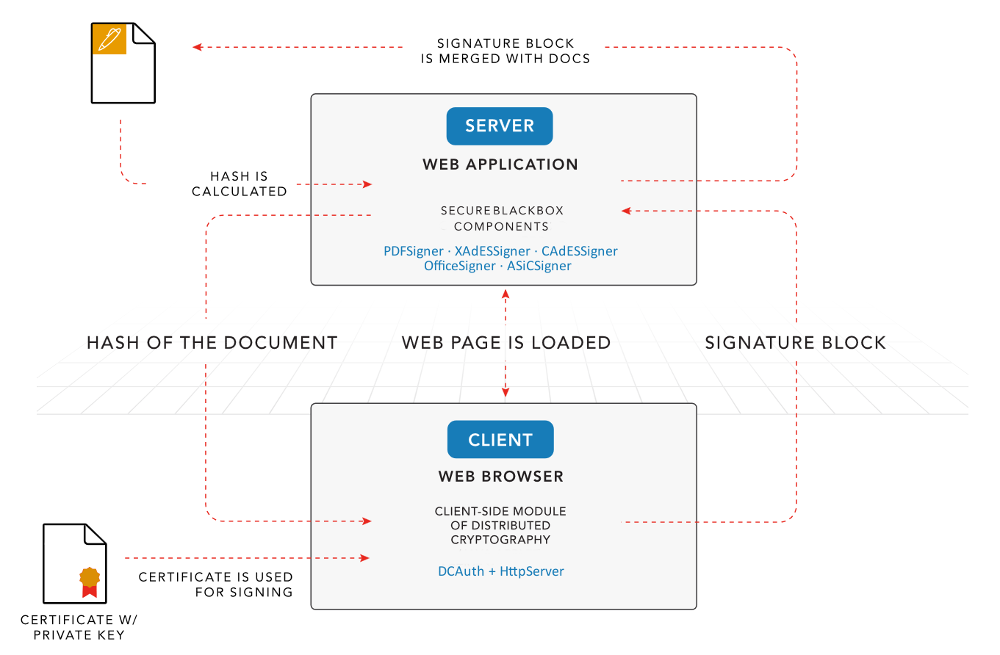
The distributed cryptography protocol involves two principal parties. The signing party, represented by structs such as PDFSigner, XAdESSigner, or OfficeSigner, pre-signs documents (such as PDF files), and encapsulates their hashes into what is called an async request. It then communicates the async request to the private key side, where the DCAuth struct extracts the hash and signs it with a local private key. DCAuth then encapsulates the signature into an async response, which is sent back to the signing party. The signing party completes the signing operation by extracting the signature from the async response and embedding it into the pre-signed document.
The protocol supports a variety of uses. The scheme above describes the most typical of them, where the signing party is represented by a web application, and the private key side is represented by a workstation. In that particular scenario DC provides a mechanism for the web app to sign documents residing on the web server with private keys residing on the users workstations, perhaps in non-exportable form (e.g. a USB dongle). Other uses include creation of a signing server for a team of driver developers, or an automated signing gateway for outgoing official documents.
In the webapp-to-browser setting the DCAuth control would normally be used within a web server running on the users workstation. That web server would accept async requests from the web page running in the browser, use DCAuth to generate the matching async response, and feed that response back to the web page. The web page will then submit it back to the web server.
Configuring and Using DCAuth
To process an async request, you need to set up a DCAuth object first, and then call its process_request method:
- Set the KeyId and KeySecret properties so they match the credentials used by the signing party - e.g. those of PDFSigner object:
      DCAuth.KeyId = "mykeyid";
      DCAuth.KeySecret = "mykeysecret123";
These two properties are used to verify the integrity of the incoming async requests. Keep them safe.
- Provide the signing certificate:
      DCAuth.SigningCertificate = "C:\Certs\SigningCert.pfx";
      DCAuth.CertPassword = "password789";
Alternatively, use storage_id to provide a certificate residing elsewhere, such as a PKCS#11 device.
- Assign the async request to the input property:
DCAuth.Input = Request;Make sure to provide the request in its original XML format. Some technologies and SecureBlackbox code samples may apply additional encoding when conveying async requests from their origin to the DCAuth endpoint. Please double check that you assign the request without any encodings applied. An async request is a properly formed XML document with the root element of SecureBlackboxAsyncState.
- Call the process_request method:
DCAuth.ProcessRequest;This method performs the actual signing of the hash. Make sure your code is prepared for potential signing errors.
- If the process_request call has succeeded, grab the async response from the output property:
Result = DCAuth.Output;
Object Lifetime
The new() method returns a mutable reference to a struct instance. The object itself is kept in the global list maintained by SecureBlackbox. Due to this, the DCAuth struct cannot be disposed of automatically. Please, call the dispose(&mut self) method of DCAuth when you have finished using the instance.
Property List
The following is the full list of the properties of the struct with short descriptions. Click on the links for further details.
| claimed_signing_time | The signing time from the signer's computer. |
| external_crypto_access_token | The bearer token used to access the external signing service. |
| external_crypto_async_document_id | Specifies an optional document ID for SignAsyncBegin() and SignAsyncEnd() calls. |
| external_crypto_credential | The identifier of the remote signing credential. |
| external_crypto_custom_params | Custom parameters to be passed to the signing service (uninterpreted). |
| external_crypto_data | Additional data to be included in the async state and mirrored back by the requestor. |
| external_crypto_external_hash_calculation | Specifies whether the message hash is to be calculated at the external endpoint. |
| external_crypto_hash_algorithm | Specifies the request's signature hash algorithm. |
| external_crypto_key_id | The ID of the pre-shared key used for DC request authentication. |
| external_crypto_key_secret | The pre-shared key used for DC request authentication. |
| external_crypto_method | Specifies the asynchronous signing method. |
| external_crypto_mode | Specifies the external cryptography mode. |
| external_crypto_public_key_algorithm | Provide the public key algorithm here if the certificate is not available on the pre-signing stage. |
| external_crypto_service_url | The URL of the external signing service. |
| external_crypto_signature_activation_data | An optional pre-obtained signature activation value. |
| fips_mode | Activates FIPS-only mode in the struct. |
| input | Contains the signing request to process. |
| input_encoding | Specifies request encoding. |
| key_id | Specifies the KeyID of the pre-shared authentication key. |
| key_secret | The pre-shared authentication key. |
| output | Contains the output of the request processing. |
| output_encoding | Specifies response encoding. |
| policies | Specifies the policies to use when processing requests. |
| profile | Specifies a pre-defined profile to apply when creating the signature. |
| proxy_address | The IP address of the proxy server. |
| proxy_authentication | The authentication type used by the proxy server. |
| proxy_password | The password to authenticate to the proxy server. |
| proxy_port | The port on the proxy server to connect to. |
| proxy_type | The type of the proxy server. |
| proxy_request_headers | Contains HTTP request headers for WebTunnel and HTTP proxy. |
| proxy_response_body | Contains the HTTP or HTTPS (WebTunnel) proxy response body. |
| proxy_response_headers | Contains response headers received from an HTTP or HTTPS (WebTunnel) proxy server. |
| proxy_use_ipv6 | Specifies whether IPv6 should be used when connecting through the proxy. |
| proxy_username | Specifies the username credential for proxy authentication. |
| signing_cert_bytes | Returns the raw certificate data in DER format. |
| signing_cert_handle | Allows to get or set a 'handle', a unique identifier of the underlying property object. |
| signing_chain_count | The number of records in the SigningChain arrays. |
| signing_chain_bytes | Returns the raw certificate data in DER format. |
| signing_chain_handle | Allows to get or set a 'handle', a unique identifier of the underlying property object. |
| socket_dns_mode | Selects the DNS resolver to use: the struct's (secure) built-in one, or the one provided by the system. |
| socket_dns_port | Specifies the port number to be used for sending queries to the DNS server. |
| socket_dns_query_timeout | The timeout (in milliseconds) for each DNS query. |
| socket_dns_servers | The addresses of DNS servers to use for address resolution, separated by commas or semicolons. |
| socket_dns_total_timeout | The timeout (in milliseconds) for the whole resolution process. |
| socket_incoming_speed_limit | The maximum number of bytes to read from the socket, per second. |
| socket_local_address | The local network interface to bind the socket to. |
| socket_local_port | The local port number to bind the socket to. |
| socket_outgoing_speed_limit | The maximum number of bytes to write to the socket, per second. |
| socket_timeout | The maximum period of waiting, in milliseconds, after which the socket operation is considered unsuccessful. |
| socket_use_ipv6 | Enables or disables IP protocol version 6. |
| storage_id | Specifies the signing certificate residing in an alternative location. |
| timestamp_server | The address of the timestamping server. |
| tls_client_cert_count | The number of records in the TLSClientCert arrays. |
| tls_client_cert_bytes | Returns the raw certificate data in DER format. |
| tls_client_cert_handle | Allows to get or set a 'handle', a unique identifier of the underlying property object. |
| tls_server_cert_count | The number of records in the TLSServerCert arrays. |
| tls_server_cert_bytes | Returns the raw certificate data in DER format. |
| tls_server_cert_fingerprint | Contains the fingerprint (a hash imprint) of this certificate. |
| tls_server_cert_handle | Allows to get or set a 'handle', a unique identifier of the underlying property object. |
| tls_server_cert_issuer | The common name of the certificate issuer (CA), typically a company name. |
| tls_server_cert_issuer_rdn | A list of Property=Value pairs that uniquely identify the certificate issuer. |
| tls_server_cert_key_algorithm | Specifies the public key algorithm of this certificate. |
| tls_server_cert_key_bits | Returns the length of the public key in bits. |
| tls_server_cert_key_usage | Indicates the purposes of the key contained in the certificate, in the form of an OR'ed flag set. |
| tls_server_cert_self_signed | Indicates whether the certificate is self-signed (root) or signed by an external CA. |
| tls_server_cert_serial_number | Returns the certificate's serial number. |
| tls_server_cert_sig_algorithm | Indicates the algorithm that was used by the CA to sign this certificate. |
| tls_server_cert_subject | The common name of the certificate holder, typically an individual's name, a URL, an e-mail address, or a company name. |
| tls_server_cert_subject_rdn | A list of Property=Value pairs that uniquely identify the certificate holder (subject). |
| tls_server_cert_valid_from | The time point at which the certificate becomes valid, in UTC. |
| tls_server_cert_valid_to | The time point at which the certificate expires, in UTC. |
| tls_auto_validate_certificates | Specifies whether server-side TLS certificates should be validated automatically using internal validation rules. |
| tls_base_configuration | Selects the base configuration for the TLS settings. |
| tls_ciphersuites | A list of ciphersuites separated with commas or semicolons. |
| tls_client_auth | Enables or disables certificate-based client authentication. |
| tls_extensions | Provides access to TLS extensions. |
| tls_force_resume_if_destination_changes | Whether to force TLS session resumption when the destination address changes. |
| tls_groups | Specifies a list of key exchange groups to attempt during the TLS key exchange. |
| tls_pre_shared_identity | Defines the identity used when the PSK (Pre-Shared Key) key-exchange mechanism is negotiated. |
| tls_pre_shared_key | Contains the pre-shared key for the PSK (Pre-Shared Key) key-exchange mechanism, encoded with base16. |
| tls_pre_shared_key_ciphersuite | Defines the ciphersuite used for PSK (Pre-Shared Key) negotiation. |
| tls_renegotiation_attack_prevention_mode | Selects the renegotiation attack prevention mechanism. |
| tls_revocation_check | Specifies the kind(s) of revocation check to perform. |
| tls_ssl_options | Various SSL (TLS) protocol options, set of cssloExpectShutdownMessage 0x001 Wait for the close-notify message when shutting down the connection cssloOpenSSLDTLSWorkaround 0x002 (DEPRECATED) Use a DTLS version workaround when talking to very old OpenSSL versions cssloDisableKexLengthAlignment 0x004 Do not align the client-side PMS by the RSA modulus size. |
| tls_mode | Specifies the TLS mode to use. |
| tls_use_extended_master_secret | Enables the Extended Master Secret Extension, as defined in RFC 7627. |
| tls_use_session_resumption | Enables or disables the TLS session resumption capability. |
| tls_versions | The SSL/TLS versions to enable by default. |
Method List
The following is the full list of the methods of the struct with short descriptions. Click on the links for further details.
| config | Sets or retrieves a configuration setting. |
| do_action | Performs an additional action. |
| process_request | Processes the request. |
| reset | Resets the struct settings. |
Event List
The following is the full list of the events fired by the struct with short descriptions. Click on the links for further details.
| on_authorization_needed | Requests authorization data required by an external service. |
| on_custom_parameters_received | Passes custom request parameters to the application. |
| on_error | Reports information about errors during request processing or signing. |
| on_external_sign | Handles remote or external signing initiated by the SignExternal method or other source. |
| on_key_secret_needed | Requests the key secret from the application. |
| on_notification | This event notifies the application about an underlying control flow event. |
| on_parameter_received | Passes a standard request parameter to the user code. |
| on_sign_request | This event signifies the processing of an atomic signing request. |
| on_sign_request_completed | This event signifies completion of the processing of an atomic signing request. |
| on_timestamp_request | Fires when the struct is ready to request a timestamp from an external TSA. |
| on_tls_cert_needed | Fires when a remote TLS party requests a client certificate. |
| on_tls_cert_validate | This event is fired upon receipt of the TLS server's certificate, allowing the user to control its acceptance. |
| on_tls_established | Fires when a TLS handshake with Host successfully completes. |
| on_tls_handshake | Fires when a new TLS handshake is initiated, before the handshake commences. |
| on_tls_shutdown | Reports the graceful closure of a TLS connection. |
Config Settings
The following is a list of config settings for the struct with short descriptions. Click on the links for further details.
| DataURL | (obsolete) The DataURL parameter to pass to the signer. |
| FingerprintAlgorithm | The fingerprint algorithm to use. |
| GoURL | (obsolete) The GoURL parameter to pass to the signer. |
| PolicyHash | The EPES policy hash. |
| PolicyHashAlgorithm | The EPES policy hash algorithm. |
| PolicyID | The EPES policy identifier. |
| PolicyURI | The EPES policy URL. |
| RequireDefinedSignCert | (obsolete) The RequireDefinedSignCert parameter to pass to the signer. |
| SchemeParams | The algorithm scheme parameters to employ. |
| SessionID | (obsolete) The SessionID parameter to pass to the signer. |
| TLSChainValidationDetails | Contains the advanced details of the TLS server certificate validation. |
| TLSChainValidationResult | Contains the result of the TLS server certificate validation. |
| TLSClientAuthRequested | Indicates whether the TLS server requests client authentication. |
| TLSValidationLog | Contains the log of the TLS server certificate validation. |
| TokenName | The TokenName parameter to pass to the signer. |
| TokensLibraries | (obsolete) The TokensLibraries parameter to pass to the signer. |
| TspAttemptCount | Specifies the number of timestamping request attempts. |
| TspHashAlgorithm | Sets a specific hash algorithm for use with the timestamping service. |
| TspReqPolicy | Sets a request policy ID to include in the timestamping request. |
| ASN1UseGlobalTagCache | Controls whether ASN.1 module should use a global object cache. |
| AssignSystemSmartCardPins | Specifies whether CSP-level PINs should be assigned to CNG keys. |
| CheckKeyIntegrityBeforeUse | Enables or disable private key integrity check before use. |
| CookieCaching | Specifies whether a cookie cache should be used for HTTP(S) transports. |
| Cookies | Gets or sets local cookies for the struct. |
| DefDeriveKeyIterations | Specifies the default key derivation algorithm iteration count. |
| DNSLocalSuffix | The suffix to assign for TLD names. |
| EnableClientSideSSLFFDHE | Enables or disables finite field DHE key exchange support in TLS clients. |
| EnableSSHMLKEM | Enables support for ML-KEM/hybrid key exchange algorithms in SSH client and server structs. |
| EnableTLSMLKEM | Enables support for ML-KEM and hybrid groups in TLS client and server structs. |
| GlobalCookies | Gets or sets global cookies for all the HTTP transports. |
| HardwareCryptoUsePolicy | The hardware crypto usage policy. |
| HttpUserAgent | Specifies the user agent name to be used by all HTTP clients. |
| HttpVersion | The HTTP version to use in any inner HTTP client structs created. |
| IgnoreExpiredMSCTLSigningCert | Whether to tolerate the expired Windows Update signing certificate. |
| ListDelimiter | The delimiter character for multi-element lists. |
| LogDestination | Specifies the debug log destination. |
| LogDetails | Specifies the debug log details to dump. |
| LogFile | Specifies the debug log filename. |
| LogFilters | Specifies the debug log filters. |
| LogFlushMode | Specifies the log flush mode. |
| LogLevel | Specifies the debug log level. |
| LogMaxEventCount | Specifies the maximum number of events to cache before further action is taken. |
| LogRotationMode | Specifies the log rotation mode. |
| MaxASN1BufferLength | Specifies the maximal allowed length for ASN.1 primitive tag data. |
| MaxASN1TreeDepth | Specifies the maximal depth for processed ASN.1 trees. |
| OCSPHashAlgorithm | Specifies the hash algorithm to be used to identify certificates in OCSP requests. |
| OldClientSideRSAFallback | Specifies whether the SSH client should use a SHA1 fallback. |
| PKICache | Specifies which PKI elements (certificates, CRLs, OCSP responses) should be cached. |
| PKICachePath | Specifies the file system path where cached PKI data is stored. |
| ProductVersion | Returns the version of the SecureBlackbox library. |
| ServerSSLDHKeyLength | Sets the size of the TLS DHE key exchange group. |
| StaticDNS | Specifies whether static DNS rules should be used. |
| StaticIPAddress[domain] | Gets or sets an IP address for the specified domain name. |
| StaticIPAddresses | Gets or sets all the static DNS rules. |
| Tag | Allows to store any custom data. |
| TLSSessionGroup | Specifies the group name of TLS sessions to be used for session resumption. |
| TLSSessionLifetime | Specifies lifetime in seconds of the cached TLS session. |
| TLSSessionPurgeInterval | Specifies how often the session cache should remove the expired TLS sessions. |
| UseCRLObjectCaching | Specifies whether reuse of loaded CRL objects is enabled. |
| UseInternalRandom | Switches between SecureBlackbox-own and platform PRNGs. |
| UseLegacyAdESValidation | Enables legacy AdES validation mode. |
| UseOCSPResponseObjectCaching | Specifies whether reuse of loaded OCSP response objects is enabled. |
| UseOwnDNSResolver | Specifies whether the client structs should use own DNS resolver. |
| UseSharedSystemStorages | Specifies whether the validation engine should use a global per-process copy of the system certificate stores. |
| UseSystemNativeSizeCalculation | An internal CryptoAPI access tweak. |
| UseSystemOAEPAndPSS | Enforces or disables the use of system-driven RSA OAEP and PSS computations. |
| UseSystemRandom | Enables or disables the use of the OS PRNG. |
| XMLRDNDescriptorName[OID] | Defines an OID mapping to descriptor names for the certificate's IssuerRDN or SubjectRDN. |
| XMLRDNDescriptorPriority[OID] | Specifies the priority of descriptor names associated with a specific OID. |
| XMLRDNDescriptorReverseOrder | Specifies whether to reverse the order of descriptors in RDN. |
| XMLRDNDescriptorSeparator | Specifies the separator used between descriptors in RDN. |
claimed_signing_time property (DCAuth Struct)
The signing time from the signer's computer.
Syntax
fn claimed_signing_time(&self ) -> Result<String, SecureBlackboxError>
fn set_claimed_signing_time(&self, value : &str) ->  Option<SecureBlackboxError>
fn set_claimed_signing_time_ref(&self, value : &String) ->  Option<SecureBlackboxError>
Default Value
""
Remarks
Use this property to provide the signature production time. The claimed time is not supported by a trusted source; it may be inaccurate, forfeited, or wrong, and as such is usually taken for informational purposes only by verifiers. Use timestamp servers to embed verifiable trusted timestamps. The time is in UTC.
Data Type
String
external_crypto_access_token property (DCAuth Struct)
The bearer token used to access the external signing service.
Syntax
fn external_crypto_access_token(&self ) -> Result<String, SecureBlackboxError>
fn set_external_crypto_access_token(&self, value : &str) ->  Option<SecureBlackboxError>
fn set_external_crypto_access_token_ref(&self, value : &String) ->  Option<SecureBlackboxError>
Default Value
""
Remarks
The bearer token used to access the external signing service.
TBD
Data Type
String
external_crypto_async_document_id property (DCAuth Struct)
Specifies an optional document ID for SignAsyncBegin() and SignAsyncEnd() calls.
Syntax
fn external_crypto_async_document_id(&self ) -> Result<String, SecureBlackboxError>
fn set_external_crypto_async_document_id(&self, value : &str) ->  Option<SecureBlackboxError>
fn set_external_crypto_async_document_id_ref(&self, value : &String) ->  Option<SecureBlackboxError>
Default Value
""
Remarks
Specifies an optional document ID for SignAsyncBegin() and SignAsyncEnd() calls.
Use this property when working with multi-signature DCAuth requests and responses to uniquely identify documents signed within a larger batch. On the completion stage, this value helps the signing component identify the correct signature in the returned batch of responses.
If using batched requests, make sure to set this property to the same value on both the pre-signing (SignAsyncBegin) and completion (SignAsyncEnd) stages.
Data Type
String
external_crypto_credential property (DCAuth Struct)
The identifier of the remote signing credential.
Syntax
fn external_crypto_credential(&self ) -> Result<String, SecureBlackboxError>
fn set_external_crypto_credential(&self, value : &str) ->  Option<SecureBlackboxError>
fn set_external_crypto_credential_ref(&self, value : &String) ->  Option<SecureBlackboxError>
Default Value
""
Remarks
The identifier of the remote signing credential.
TBD
Data Type
String
external_crypto_custom_params property (DCAuth Struct)
Custom parameters to be passed to the signing service (uninterpreted).
Syntax
fn external_crypto_custom_params(&self ) -> Result<String, SecureBlackboxError>
fn set_external_crypto_custom_params(&self, value : &str) ->  Option<SecureBlackboxError>
fn set_external_crypto_custom_params_ref(&self, value : &String) ->  Option<SecureBlackboxError>
Default Value
""
Remarks
Custom parameters to be passed to the signing service (uninterpreted).
Data Type
String
external_crypto_data property (DCAuth Struct)
Additional data to be included in the async state and mirrored back by the requestor.
Syntax
fn external_crypto_data(&self ) -> Result<String, SecureBlackboxError>
fn set_external_crypto_data(&self, value : &str) ->  Option<SecureBlackboxError>
fn set_external_crypto_data_ref(&self, value : &String) ->  Option<SecureBlackboxError>
Default Value
""
Remarks
Additional data to be included in the async state and mirrored back by the requestor.
In the CSC mode this value is sent as the optional CSC clientData field in credential information, authorization, and signing requests. TBD
Data Type
String
external_crypto_external_hash_calculation property (DCAuth Struct)
Specifies whether the message hash is to be calculated at the external endpoint.
Syntax
fn external_crypto_external_hash_calculation(&self ) -> Result<bool, SecureBlackboxError>
fn set_external_crypto_external_hash_calculation(&self, value : bool) ->  Option<SecureBlackboxError>
Default Value
false
Remarks
Specifies whether the message hash is to be calculated at the external endpoint. Please note that this mode is not supported by the DCAuth struct.
If set to true, the struct will pass a few kilobytes of to-be-signed data from the document to the OnExternalSign event. This only applies when SignExternal() is called.
Data Type
bool
external_crypto_hash_algorithm property (DCAuth Struct)
Specifies the request's signature hash algorithm.
Syntax
fn external_crypto_hash_algorithm(&self ) -> Result<String, SecureBlackboxError>
fn set_external_crypto_hash_algorithm(&self, value : &str) ->  Option<SecureBlackboxError>
fn set_external_crypto_hash_algorithm_ref(&self, value : &String) ->  Option<SecureBlackboxError>
Default Value
"SHA256"
Remarks
Specifies the request's signature hash algorithm.
| SB_HASH_ALGORITHM_SHA1 | SHA1 | |
| SB_HASH_ALGORITHM_SHA224 | SHA224 | |
| SB_HASH_ALGORITHM_SHA256 | SHA256 | |
| SB_HASH_ALGORITHM_SHA384 | SHA384 | |
| SB_HASH_ALGORITHM_SHA512 | SHA512 | |
| SB_HASH_ALGORITHM_MD2 | MD2 | |
| SB_HASH_ALGORITHM_MD4 | MD4 | |
| SB_HASH_ALGORITHM_MD5 | MD5 | |
| SB_HASH_ALGORITHM_RIPEMD160 | RIPEMD160 | |
| SB_HASH_ALGORITHM_CRC32 | CRC32 | |
| SB_HASH_ALGORITHM_SSL3 | SSL3 | |
| SB_HASH_ALGORITHM_GOST_R3411_1994 | GOST1994 | |
| SB_HASH_ALGORITHM_WHIRLPOOL | WHIRLPOOL | |
| SB_HASH_ALGORITHM_POLY1305 | POLY1305 | |
| SB_HASH_ALGORITHM_SHA3_224 | SHA3_224 | |
| SB_HASH_ALGORITHM_SHA3_256 | SHA3_256 | |
| SB_HASH_ALGORITHM_SHA3_384 | SHA3_384 | |
| SB_HASH_ALGORITHM_SHA3_512 | SHA3_512 | |
| SB_HASH_ALGORITHM_BLAKE2S_128 | BLAKE2S_128 | |
| SB_HASH_ALGORITHM_BLAKE2S_160 | BLAKE2S_160 | |
| SB_HASH_ALGORITHM_BLAKE2S_224 | BLAKE2S_224 | |
| SB_HASH_ALGORITHM_BLAKE2S_256 | BLAKE2S_256 | |
| SB_HASH_ALGORITHM_BLAKE2B_160 | BLAKE2B_160 | |
| SB_HASH_ALGORITHM_BLAKE2B_256 | BLAKE2B_256 | |
| SB_HASH_ALGORITHM_BLAKE2B_384 | BLAKE2B_384 | |
| SB_HASH_ALGORITHM_BLAKE2B_512 | BLAKE2B_512 | |
| SB_HASH_ALGORITHM_SHAKE_128 | SHAKE_128 | |
| SB_HASH_ALGORITHM_SHAKE_256 | SHAKE_256 | |
| SB_HASH_ALGORITHM_SHAKE_128_LEN | SHAKE_128_LEN | |
| SB_HASH_ALGORITHM_SHAKE_256_LEN | SHAKE_256_LEN |
Data Type
String
external_crypto_key_id property (DCAuth Struct)
The ID of the pre-shared key used for DC request authentication.
Syntax
fn external_crypto_key_id(&self ) -> Result<String, SecureBlackboxError>
fn set_external_crypto_key_id(&self, value : &str) ->  Option<SecureBlackboxError>
fn set_external_crypto_key_id_ref(&self, value : &String) ->  Option<SecureBlackboxError>
Default Value
""
Remarks
The ID of the pre-shared key used for DC request authentication.
Asynchronous DCAuth-driven communication requires that parties authenticate each other with a secret pre-shared cryptographic key. This provides an extra protection layer for the protocol and diminishes the risk of the private key becoming abused by foreign parties. Use this property to provide the pre-shared key identifier, and use external_crypto_key_secret to pass the key itself.
The same KeyID/KeySecret pair should be used on the DCAuth side for the signing requests to be accepted.
Note: The KeyID/KeySecret scheme is very similar to the AuthKey scheme used in various Cloud service providers to authenticate users.
Example:
  signer.ExternalCrypto.KeyID = "MainSigningKey";
  signer.ExternalCrypto.KeySecret = "abcdef0123456789";
Data Type
String
external_crypto_key_secret property (DCAuth Struct)
The pre-shared key used for DC request authentication.
Syntax
fn external_crypto_key_secret(&self ) -> Result<String, SecureBlackboxError>
fn set_external_crypto_key_secret(&self, value : &str) ->  Option<SecureBlackboxError>
fn set_external_crypto_key_secret_ref(&self, value : &String) ->  Option<SecureBlackboxError>
Default Value
""
Remarks
The pre-shared key used for DC request authentication. This key must be set and match the key used by the DCAuth counterpart for the scheme to work.
Read more about configuring authentication in the external_crypto_key_id topic.
Data Type
String
external_crypto_method property (DCAuth Struct)
Specifies the asynchronous signing method.
Syntax
fn external_crypto_method(&self ) -> Result<i32, SecureBlackboxError>
fn set_external_crypto_method(&self, value : i32) ->  Option<SecureBlackboxError>
Possible Values
0   // PKCS1
1   // PKCS7
Default Value
0
Remarks
Specifies the asynchronous signing method. This is typically defined by the DC server capabilities and setup.
Available options:
| asmdPKCS1 | 0 |
| asmdPKCS7 | 1 |
Data Type
i32
external_crypto_mode property (DCAuth Struct)
Specifies the external cryptography mode.
Syntax
fn external_crypto_mode(&self ) -> Result<i32, SecureBlackboxError>
fn set_external_crypto_mode(&self, value : i32) ->  Option<SecureBlackboxError>
Possible Values
0   // Default
1   // Disabled
2   // Generic
3   // DCAuth
4   // DCAuthJSON
5   // CSC
Default Value
0
Remarks
Specifies the external cryptography mode.
Available options:
| ecmDefault | The default value (0) |
| ecmDisabled | Do not use DC or external signing (1) |
| ecmGeneric | Generic external signing with the OnExternalSign event (2) |
| ecmDCAuth | DCAuth signing (3) |
| ecmDCAuthJSON | DCAuth signing in JSON format (4) |
| ecmCSC | CSC 2.2 cloud signing (5) |
Data Type
i32
external_crypto_public_key_algorithm property (DCAuth Struct)
Provide the public key algorithm here if the certificate is not available on the pre-signing stage.
Syntax
fn external_crypto_public_key_algorithm(&self ) -> Result<String, SecureBlackboxError>
fn set_external_crypto_public_key_algorithm(&self, value : &str) ->  Option<SecureBlackboxError>
fn set_external_crypto_public_key_algorithm_ref(&self, value : &String) ->  Option<SecureBlackboxError>
Default Value
""
Remarks
Provide the public key algorithm here if the certificate is not available on the pre-signing stage.
| SB_CERT_ALGORITHM_ID_RSA_ENCRYPTION | rsaEncryption | |
| SB_CERT_ALGORITHM_MD2_RSA_ENCRYPTION | md2withRSAEncryption | |
| SB_CERT_ALGORITHM_MD5_RSA_ENCRYPTION | md5withRSAEncryption | |
| SB_CERT_ALGORITHM_SHA1_RSA_ENCRYPTION | sha1withRSAEncryption | |
| SB_CERT_ALGORITHM_ID_DSA | id-dsa | |
| SB_CERT_ALGORITHM_ID_DSA_SHA1 | id-dsa-with-sha1 | |
| SB_CERT_ALGORITHM_DH_PUBLIC | dhpublicnumber | |
| SB_CERT_ALGORITHM_SHA224_RSA_ENCRYPTION | sha224WithRSAEncryption | |
| SB_CERT_ALGORITHM_SHA256_RSA_ENCRYPTION | sha256WithRSAEncryption | |
| SB_CERT_ALGORITHM_SHA384_RSA_ENCRYPTION | sha384WithRSAEncryption | |
| SB_CERT_ALGORITHM_SHA512_RSA_ENCRYPTION | sha512WithRSAEncryption | |
| SB_CERT_ALGORITHM_ID_RSAPSS | id-RSASSA-PSS | |
| SB_CERT_ALGORITHM_ID_RSAOAEP | id-RSAES-OAEP | |
| SB_CERT_ALGORITHM_RSASIGNATURE_RIPEMD160 | ripemd160withRSA | |
| SB_CERT_ALGORITHM_ID_ELGAMAL | elGamal | |
| SB_CERT_ALGORITHM_SHA1_ECDSA | ecdsa-with-SHA1 | |
| SB_CERT_ALGORITHM_RECOMMENDED_ECDSA | ecdsa-recommended | |
| SB_CERT_ALGORITHM_SHA224_ECDSA | ecdsa-with-SHA224 | |
| SB_CERT_ALGORITHM_SHA256_ECDSA | ecdsa-with-SHA256 | |
| SB_CERT_ALGORITHM_SHA384_ECDSA | ecdsa-with-SHA384 | |
| SB_CERT_ALGORITHM_SHA512_ECDSA | ecdsa-with-SHA512 | |
| SB_CERT_ALGORITHM_EC | id-ecPublicKey | |
| SB_CERT_ALGORITHM_SPECIFIED_ECDSA | ecdsa-specified | |
| SB_CERT_ALGORITHM_GOST_R3410_1994 | id-GostR3410-94 | |
| SB_CERT_ALGORITHM_GOST_R3410_2001 | id-GostR3410-2001 | |
| SB_CERT_ALGORITHM_GOST_R3411_WITH_R3410_1994 | id-GostR3411-94-with-GostR3410-94 | |
| SB_CERT_ALGORITHM_GOST_R3411_WITH_R3410_2001 | id-GostR3411-94-with-GostR3410-2001 | |
| SB_CERT_ALGORITHM_SHA1_ECDSA_PLAIN | ecdsa-plain-SHA1 | |
| SB_CERT_ALGORITHM_SHA224_ECDSA_PLAIN | ecdsa-plain-SHA224 | |
| SB_CERT_ALGORITHM_SHA256_ECDSA_PLAIN | ecdsa-plain-SHA256 | |
| SB_CERT_ALGORITHM_SHA384_ECDSA_PLAIN | ecdsa-plain-SHA384 | |
| SB_CERT_ALGORITHM_SHA512_ECDSA_PLAIN | ecdsa-plain-SHA512 | |
| SB_CERT_ALGORITHM_RIPEMD160_ECDSA_PLAIN | ecdsa-plain-RIPEMD160 | |
| SB_CERT_ALGORITHM_WHIRLPOOL_RSA_ENCRYPTION | whirlpoolWithRSAEncryption | |
| SB_CERT_ALGORITHM_ID_DSA_SHA224 | id-dsa-with-sha224 | |
| SB_CERT_ALGORITHM_ID_DSA_SHA256 | id-dsa-with-sha256 | |
| SB_CERT_ALGORITHM_SHA3_224_RSA_ENCRYPTION | id-rsassa-pkcs1-v1_5-with-sha3-224 | |
| SB_CERT_ALGORITHM_SHA3_256_RSA_ENCRYPTION | id-rsassa-pkcs1-v1_5-with-sha3-256 | |
| SB_CERT_ALGORITHM_SHA3_384_RSA_ENCRYPTION | id-rsassa-pkcs1-v1_5-with-sha3-384 | |
| SB_CERT_ALGORITHM_SHA3_512_RSA_ENCRYPTION | id-rsassa-pkcs1-v1_5-with-sha3-512 | |
| SB_CERT_ALGORITHM_SHA3_224_ECDSA | id-ecdsa-with-sha3-224 | |
| SB_CERT_ALGORITHM_SHA3_256_ECDSA | id-ecdsa-with-sha3-256 | |
| SB_CERT_ALGORITHM_SHA3_384_ECDSA | id-ecdsa-with-sha3-384 | |
| SB_CERT_ALGORITHM_SHA3_512_ECDSA | id-ecdsa-with-sha3-512 | |
| SB_CERT_ALGORITHM_SHA3_224_ECDSA_PLAIN | id-ecdsa-plain-with-sha3-224 | |
| SB_CERT_ALGORITHM_SHA3_256_ECDSA_PLAIN | id-ecdsa-plain-with-sha3-256 | |
| SB_CERT_ALGORITHM_SHA3_384_ECDSA_PLAIN | id-ecdsa-plain-with-sha3-384 | |
| SB_CERT_ALGORITHM_SHA3_512_ECDSA_PLAIN | id-ecdsa-plain-with-sha3-512 | |
| SB_CERT_ALGORITHM_ID_DSA_SHA3_224 | id-dsa-with-sha3-224 | |
| SB_CERT_ALGORITHM_ID_DSA_SHA3_256 | id-dsa-with-sha3-256 | |
| SB_CERT_ALGORITHM_BLAKE2S_128_RSA_ENCRYPTION | id-rsassa-pkcs1-v1_5-with-blake2s128 | |
| SB_CERT_ALGORITHM_BLAKE2S_160_RSA_ENCRYPTION | id-rsassa-pkcs1-v1_5-with-blake2s160 | |
| SB_CERT_ALGORITHM_BLAKE2S_224_RSA_ENCRYPTION | id-rsassa-pkcs1-v1_5-with-blake2s224 | |
| SB_CERT_ALGORITHM_BLAKE2S_256_RSA_ENCRYPTION | id-rsassa-pkcs1-v1_5-with-blake2s256 | |
| SB_CERT_ALGORITHM_BLAKE2B_160_RSA_ENCRYPTION | id-rsassa-pkcs1-v1_5-with-blake2b160 | |
| SB_CERT_ALGORITHM_BLAKE2B_256_RSA_ENCRYPTION | id-rsassa-pkcs1-v1_5-with-blake2b256 | |
| SB_CERT_ALGORITHM_BLAKE2B_384_RSA_ENCRYPTION | id-rsassa-pkcs1-v1_5-with-blake2b384 | |
| SB_CERT_ALGORITHM_BLAKE2B_512_RSA_ENCRYPTION | id-rsassa-pkcs1-v1_5-with-blake2b512 | |
| SB_CERT_ALGORITHM_BLAKE2S_128_ECDSA | id-ecdsa-with-blake2s128 | |
| SB_CERT_ALGORITHM_BLAKE2S_160_ECDSA | id-ecdsa-with-blake2s160 | |
| SB_CERT_ALGORITHM_BLAKE2S_224_ECDSA | id-ecdsa-with-blake2s224 | |
| SB_CERT_ALGORITHM_BLAKE2S_256_ECDSA | id-ecdsa-with-blake2s256 | |
| SB_CERT_ALGORITHM_BLAKE2B_160_ECDSA | id-ecdsa-with-blake2b160 | |
| SB_CERT_ALGORITHM_BLAKE2B_256_ECDSA | id-ecdsa-with-blake2b256 | |
| SB_CERT_ALGORITHM_BLAKE2B_384_ECDSA | id-ecdsa-with-blake2b384 | |
| SB_CERT_ALGORITHM_BLAKE2B_512_ECDSA | id-ecdsa-with-blake2b512 | |
| SB_CERT_ALGORITHM_BLAKE2S_128_ECDSA_PLAIN | id-ecdsa-plain-with-blake2s128 | |
| SB_CERT_ALGORITHM_BLAKE2S_160_ECDSA_PLAIN | id-ecdsa-plain-with-blake2s160 | |
| SB_CERT_ALGORITHM_BLAKE2S_224_ECDSA_PLAIN | id-ecdsa-plain-with-blake2s224 | |
| SB_CERT_ALGORITHM_BLAKE2S_256_ECDSA_PLAIN | id-ecdsa-plain-with-blake2s256 | |
| SB_CERT_ALGORITHM_BLAKE2B_160_ECDSA_PLAIN | id-ecdsa-plain-with-blake2b160 | |
| SB_CERT_ALGORITHM_BLAKE2B_256_ECDSA_PLAIN | id-ecdsa-plain-with-blake2b256 | |
| SB_CERT_ALGORITHM_BLAKE2B_384_ECDSA_PLAIN | id-ecdsa-plain-with-blake2b384 | |
| SB_CERT_ALGORITHM_BLAKE2B_512_ECDSA_PLAIN | id-ecdsa-plain-with-blake2b512 | |
| SB_CERT_ALGORITHM_ID_DSA_BLAKE2S_224 | id-dsa-with-blake2s224 | |
| SB_CERT_ALGORITHM_ID_DSA_BLAKE2S_256 | id-dsa-with-blake2s256 | |
| SB_CERT_ALGORITHM_EDDSA_ED25519 | id-Ed25519 | |
| SB_CERT_ALGORITHM_EDDSA_ED448 | id-Ed448 | |
| SB_CERT_ALGORITHM_EDDSA_ED25519_PH | id-Ed25519ph | |
| SB_CERT_ALGORITHM_EDDSA_ED448_PH | id-Ed448ph | |
| SB_CERT_ALGORITHM_EDDSA | id-EdDSA | |
| SB_CERT_ALGORITHM_EDDSA_SIGNATURE | id-EdDSA-sig | |
| SB_CERT_ALGORITHM_MLDSA_44 | id-ml-dsa-44 | |
| SB_CERT_ALGORITHM_MLDSA_65 | id-ml-dsa-65 | |
| SB_CERT_ALGORITHM_MLDSA_87 | id-ml-dsa-87 | |
| SB_CERT_ALGORITHM_HASH_MLDSA_44_SHA512 | id-hash-ml-dsa-44-with-sha512 | |
| SB_CERT_ALGORITHM_HASH_MLDSA_65_SHA512 | id-hash-ml-dsa-65-with-sha512 | |
| SB_CERT_ALGORITHM_HASH_MLDSA_87_SHA512 | id-hash-ml-dsa-87-with-sha512 | |
| SB_CERT_ALGORITHM_MLKEM_512 | id-ml-kem-512 | |
| SB_CERT_ALGORITHM_MLKEM_768 | id-ml-kem-768 | |
| SB_CERT_ALGORITHM_MLKEM_1024 | id-ml-kem-1024 |
Data Type
String
external_crypto_service_url property (DCAuth Struct)
The URL of the external signing service.
Syntax
fn external_crypto_service_url(&self ) -> Result<String, SecureBlackboxError>
fn set_external_crypto_service_url(&self, value : &str) ->  Option<SecureBlackboxError>
fn set_external_crypto_service_url_ref(&self, value : &String) ->  Option<SecureBlackboxError>
Default Value
""
Remarks
The URL of the external signing service.
TBD
Data Type
String
external_crypto_signature_activation_data property (DCAuth Struct)
An optional pre-obtained signature activation value.
Syntax
fn external_crypto_signature_activation_data(&self ) -> Result<String, SecureBlackboxError>
fn set_external_crypto_signature_activation_data(&self, value : &str) ->  Option<SecureBlackboxError>
fn set_external_crypto_signature_activation_data_ref(&self, value : &String) ->  Option<SecureBlackboxError>
Default Value
""
Remarks
An optional pre-obtained signature activation value.
TBD
Data Type
String
fips_mode property (DCAuth Struct)
Activates FIPS-only mode in the struct.
Syntax
fn fips_mode(&self ) -> Result<bool, SecureBlackboxError>
fn set_fips_mode(&self, value : bool) ->  Option<SecureBlackboxError>
Default Value
false
Remarks
This property activates the FIPS-compliant mode in the component by disabling the product's security implementation and redirecting all security calls (encryption, hashing, digital signing, key agreement) to a certified security subsystem available in the platform. This mode is only supported on Windows systems through their FIPS-certified CNG layer.
Data Type
bool
input property (DCAuth Struct)
Contains the signing request to process.
Syntax
fn input(&self ) -> Result<String, SecureBlackboxError>
fn set_input(&self, value : &str) ->  Option<SecureBlackboxError>
fn set_input_ref(&self, value : &String) ->  Option<SecureBlackboxError>
Default Value
""
Remarks
Assign the request you received from the counterparty to this property before calling the process_request method. Use output to read the resulting signature response after process_request completes.
Data Type
String
input_encoding property (DCAuth Struct)
Specifies request encoding.
Syntax
fn input_encoding(&self ) -> Result<i32, SecureBlackboxError>
fn set_input_encoding(&self, value : i32) ->  Option<SecureBlackboxError>
Possible Values
0   // None
1   // Auto
2   // Base64
Default Value
0
Remarks
Use this property to specify the encoding to expect the requests to be in.
Data Type
i32
key_id property (DCAuth Struct)
Specifies the KeyID of the pre-shared authentication key.
Syntax
fn key_id(&self ) -> Result<String, SecureBlackboxError>
fn set_key_id(&self, value : &str) ->  Option<SecureBlackboxError>
fn set_key_id_ref(&self, value : &String) ->  Option<SecureBlackboxError>
Default Value
""
Remarks
If processing requests from a single known party, assign the Id of the key you pre-shared with them to this property, and the key itself to the key_secret property. If you expect to receive requests from many parties with different authentication keys, use on_key_secret_needed event instead.
Data Type
String
key_secret property (DCAuth Struct)
The pre-shared authentication key.
Syntax
fn key_secret(&self ) -> Result<String, SecureBlackboxError>
fn set_key_secret(&self, value : &str) ->  Option<SecureBlackboxError>
fn set_key_secret_ref(&self, value : &String) ->  Option<SecureBlackboxError>
Default Value
""
Remarks
If processing requests from a single known party, assign the key you pre-shared with them to this property. Use key_id property to assign the ID of that key. If you expect to receive requests from many parties with different authentication keys, use on_key_secret_needed event instead.
Data Type
String
output property (DCAuth Struct)
Contains the output of the request processing.
Syntax
fn output(&self ) -> Result<String, SecureBlackboxError>
Default Value
""
Remarks
When process_request method completes it saves the processing output to this property. The output typically contains the response to be sent back to the requestor.
This property is read-only.
Data Type
String
output_encoding property (DCAuth Struct)
Specifies response encoding.
Syntax
fn output_encoding(&self ) -> Result<i32, SecureBlackboxError>
fn set_output_encoding(&self, value : i32) ->  Option<SecureBlackboxError>
Possible Values
0   // None
1   // Auto
2   // Base64
Default Value
0
Remarks
Use this property to specify the encoding you want the response to be produced in.
Data Type
i32
policies property (DCAuth Struct)
Specifies the policies to use when processing requests.
Syntax
fn policies(&self ) -> Result<i32, SecureBlackboxError>
fn set_policies(&self, value : i32) ->  Option<SecureBlackboxError>
Default Value
0
Remarks
This property lets you specify policies to apply blanketly to the requests. If this property does not give you enough flexibility - for example, if you need to cherry-pick requests basing on their content - please consider using the on_sign_request (allows you to track individual requests) and/or on_external_sign (lets you perform the signing manually) events. This setting is a bit mask of the following flags:
| aspAcceptUnsignedRequests | 1 | Allows the component to accept unauthenticated messages (those not signed with KeyID/KeySecret). Use with extreme care. |
| aspIgnorePKCS1Requests | 2 | Ignore requests of PKCS1 type. |
| aspIgnorePKCS7Requests | 4 | Ignore requests of PKCS7 type. |
| aspIgnoreRequestTSA | 8 | Ignore the TSA URL provided in the request, and either stick with the service provided via TimestampServer property, or not timestamp the message altogether. |
| aspIgnoreRequestSigningTime | 16 | Ignore the signing time included in the request. |
| aspIgnoreRequestPKCS7Settings | 32 | Ignore auxiliary PKCS7 settings (content type, attributes) included in the request. |
| aspAlwaysTimestampSigs | 64 | Timestamp created signatures (PKCS7 only), even if the client did not request it. |
Data Type
i32
profile property (DCAuth Struct)
Specifies a pre-defined profile to apply when creating the signature.
Syntax
fn profile(&self ) -> Result<String, SecureBlackboxError>
fn set_profile(&self, value : &str) ->  Option<SecureBlackboxError>
fn set_profile_ref(&self, value : &String) ->  Option<SecureBlackboxError>
Default Value
""
Remarks
Advanced signatures come in many variants, which are often defined by parties that needs to process them or by local standards. SecureBlackbox profiles are sets of pre-defined configurations which correspond to particular signature variants. By specifying a profile, you are pre-configuring the component to make it produce the signature that matches the configuration corresponding to that profile.
Data Type
String
proxy_address property (DCAuth Struct)
The IP address of the proxy server.
Syntax
fn proxy_address(&self ) -> Result<String, SecureBlackboxError>
fn set_proxy_address(&self, value : &str) ->  Option<SecureBlackboxError>
fn set_proxy_address_ref(&self, value : &String) ->  Option<SecureBlackboxError>
Default Value
""
Remarks
The IP address of the proxy server.
Data Type
String
proxy_authentication property (DCAuth Struct)
The authentication type used by the proxy server.
Syntax
fn proxy_authentication(&self ) -> Result<i32, SecureBlackboxError>
fn set_proxy_authentication(&self, value : i32) ->  Option<SecureBlackboxError>
Possible Values
0   // NoAuthentication
1   // Basic
2   // Digest
3   // NTLM
Default Value
0
Remarks
The authentication type used by the proxy server.
| patNoAuthentication | 0 |
| patBasic | 1 |
| patDigest | 2 |
| patNTLM | 3 |
Data Type
i32
proxy_password property (DCAuth Struct)
The password to authenticate to the proxy server.
Syntax
fn proxy_password(&self ) -> Result<String, SecureBlackboxError>
fn set_proxy_password(&self, value : &str) ->  Option<SecureBlackboxError>
fn set_proxy_password_ref(&self, value : &String) ->  Option<SecureBlackboxError>
Default Value
""
Remarks
The password to authenticate to the proxy server.
Data Type
String
proxy_port property (DCAuth Struct)
The port on the proxy server to connect to.
Syntax
fn proxy_port(&self ) -> Result<i32, SecureBlackboxError>
fn set_proxy_port(&self, value : i32) ->  Option<SecureBlackboxError>
Default Value
0
Remarks
The port on the proxy server to connect to.
Data Type
i32
proxy_type property (DCAuth Struct)
The type of the proxy server.
Syntax
fn proxy_type(&self ) -> Result<i32, SecureBlackboxError>
fn set_proxy_type(&self, value : i32) ->  Option<SecureBlackboxError>
Possible Values
0   // None
1   // Socks4
2   // Socks5
3   // WebTunnel
4   // HTTP
Default Value
0
Remarks
The type of the proxy server.
| cptNone | 0 |
| cptSocks4 | 1 |
| cptSocks5 | 2 |
| cptWebTunnel | 3 |
| cptHTTP | 4 |
Data Type
i32
proxy_request_headers property (DCAuth Struct)
Contains HTTP request headers for WebTunnel and HTTP proxy.
Syntax
fn proxy_request_headers(&self ) -> Result<String, SecureBlackboxError>
fn set_proxy_request_headers(&self, value : &str) ->  Option<SecureBlackboxError>
fn set_proxy_request_headers_ref(&self, value : &String) ->  Option<SecureBlackboxError>
Default Value
""
Remarks
Contains HTTP request headers for WebTunnel and HTTP proxy.
Data Type
String
proxy_response_body property (DCAuth Struct)
Contains the HTTP or HTTPS (WebTunnel) proxy response body.
Syntax
fn proxy_response_body(&self ) -> Result<String, SecureBlackboxError>
fn set_proxy_response_body(&self, value : &str) ->  Option<SecureBlackboxError>
fn set_proxy_response_body_ref(&self, value : &String) ->  Option<SecureBlackboxError>
Default Value
""
Remarks
Contains the HTTP or HTTPS (WebTunnel) proxy response body.
Data Type
String
proxy_response_headers property (DCAuth Struct)
Contains response headers received from an HTTP or HTTPS (WebTunnel) proxy server.
Syntax
fn proxy_response_headers(&self ) -> Result<String, SecureBlackboxError>
fn set_proxy_response_headers(&self, value : &str) ->  Option<SecureBlackboxError>
fn set_proxy_response_headers_ref(&self, value : &String) ->  Option<SecureBlackboxError>
Default Value
""
Remarks
Contains response headers received from an HTTP or HTTPS (WebTunnel) proxy server.
Data Type
String
proxy_use_ipv6 property (DCAuth Struct)
Specifies whether IPv6 should be used when connecting through the proxy.
Syntax
fn proxy_use_ipv6(&self ) -> Result<bool, SecureBlackboxError>
fn set_proxy_use_ipv6(&self, value : bool) ->  Option<SecureBlackboxError>
Default Value
false
Remarks
Specifies whether IPv6 should be used when connecting through the proxy.
Data Type
bool
proxy_username property (DCAuth Struct)
Specifies the username credential for proxy authentication.
Syntax
fn proxy_username(&self ) -> Result<String, SecureBlackboxError>
fn set_proxy_username(&self, value : &str) ->  Option<SecureBlackboxError>
fn set_proxy_username_ref(&self, value : &String) ->  Option<SecureBlackboxError>
Default Value
""
Remarks
Specifies the username credential for proxy authentication.
Data Type
String
signing_cert_bytes property (DCAuth Struct)
Returns the raw certificate data in DER format.
Syntax
fn signing_cert_bytes(&self ) -> Result<Vec<u8>, SecureBlackboxError>
Remarks
Returns the raw certificate data in DER format.
This property is read-only.
Data Type
Vec
signing_cert_handle property (DCAuth Struct)
Allows to get or set a 'handle', a unique identifier of the underlying property object.
Syntax
fn signing_cert_handle(&self ) -> Result<i64, SecureBlackboxError>
fn set_signing_cert_handle(&self, value : i64) ->  Option<SecureBlackboxError>
Default Value
0
Remarks
Allows to get or set a 'handle', a unique identifier of the underlying property object. Use this property to assign objects of the same type in a quicker manner, without copying them fieldwise.
When you pass a handle of one object to another, the source object is copied to the destination rather than assigned. It is safe to get rid of the original object
after such operation.
pdfSigner.setSigningCertHandle(certMgr.getCertHandle());
Data Type
i64
signing_chain_count property (DCAuth Struct)
The number of records in the SigningChain arrays.
Syntax
fn signing_chain_count(&self ) -> Result<i32, SecureBlackboxError>
fn set_signing_chain_count(&self, value : i32) ->  Option<SecureBlackboxError>
Default Value
0
Remarks
This property controls the size of the following arrays:
The array indices start at 0 and end at signing_chain_count - 1.Data Type
i32
signing_chain_bytes property (DCAuth Struct)
Returns the raw certificate data in DER format.
Syntax
fn signing_chain_bytes(&self , SigningChainIndex : i32) -> Result<Vec<u8>, SecureBlackboxError>
Remarks
Returns the raw certificate data in DER format.
The SigningChainIndex parameter specifies the index of the item in the array. The size of the array is controlled by the SigningChainCount property.
This property is read-only.
Data Type
Vec
signing_chain_handle property (DCAuth Struct)
Allows to get or set a 'handle', a unique identifier of the underlying property object.
Syntax
fn signing_chain_handle(&self , SigningChainIndex : i32) -> Result<i64, SecureBlackboxError>
fn set_signing_chain_handle(&self, SigningChainIndex : i32, value : i64) ->  Option<SecureBlackboxError>
Default Value
0
Remarks
Allows to get or set a 'handle', a unique identifier of the underlying property object. Use this property to assign objects of the same type in a quicker manner, without copying them fieldwise.
When you pass a handle of one object to another, the source object is copied to the destination rather than assigned. It is safe to get rid of the original object
after such operation.
pdfSigner.setSigningCertHandle(certMgr.getCertHandle());
The SigningChainIndex parameter specifies the index of the item in the array. The size of the array is controlled by the SigningChainCount property.
Data Type
i64
socket_dns_mode property (DCAuth Struct)
Selects the DNS resolver to use: the struct's (secure) built-in one, or the one provided by the system.
Syntax
fn socket_dns_mode(&self ) -> Result<i32, SecureBlackboxError>
fn set_socket_dns_mode(&self, value : i32) ->  Option<SecureBlackboxError>
Possible Values
0   // Auto
1   // Platform
2   // Own
3   // OwnSecure
Default Value
0
Remarks
Selects the DNS resolver to use: the component's (secure) built-in one, or the one provided by the system.
| dmAuto | 0 |
| dmPlatform | 1 |
| dmOwn | 2 |
| dmOwnSecure | 3 |
Data Type
i32
socket_dns_port property (DCAuth Struct)
Specifies the port number to be used for sending queries to the DNS server.
Syntax
fn socket_dns_port(&self ) -> Result<i32, SecureBlackboxError>
fn set_socket_dns_port(&self, value : i32) ->  Option<SecureBlackboxError>
Default Value
0
Remarks
Specifies the port number to be used for sending queries to the DNS server.
Data Type
i32
socket_dns_query_timeout property (DCAuth Struct)
The timeout (in milliseconds) for each DNS query.
Syntax
fn socket_dns_query_timeout(&self ) -> Result<i32, SecureBlackboxError>
fn set_socket_dns_query_timeout(&self, value : i32) ->  Option<SecureBlackboxError>
Default Value
0
Remarks
The timeout (in milliseconds) for each DNS query. The value of 0 indicates an infinite timeout.
Data Type
i32
socket_dns_servers property (DCAuth Struct)
The addresses of DNS servers to use for address resolution, separated by commas or semicolons.
Syntax
fn socket_dns_servers(&self ) -> Result<String, SecureBlackboxError>
fn set_socket_dns_servers(&self, value : &str) ->  Option<SecureBlackboxError>
fn set_socket_dns_servers_ref(&self, value : &String) ->  Option<SecureBlackboxError>
Default Value
""
Remarks
The addresses of DNS servers to use for address resolution, separated by commas or semicolons.
Data Type
String
socket_dns_total_timeout property (DCAuth Struct)
The timeout (in milliseconds) for the whole resolution process.
Syntax
fn socket_dns_total_timeout(&self ) -> Result<i32, SecureBlackboxError>
fn set_socket_dns_total_timeout(&self, value : i32) ->  Option<SecureBlackboxError>
Default Value
0
Remarks
The timeout (in milliseconds) for the whole resolution process. The value of 0 indicates an infinite timeout.
Data Type
i32
socket_incoming_speed_limit property (DCAuth Struct)
The maximum number of bytes to read from the socket, per second.
Syntax
fn socket_incoming_speed_limit(&self ) -> Result<i32, SecureBlackboxError>
fn set_socket_incoming_speed_limit(&self, value : i32) ->  Option<SecureBlackboxError>
Default Value
0
Remarks
The maximum number of bytes to read from the socket, per second.
Data Type
i32
socket_local_address property (DCAuth Struct)
The local network interface to bind the socket to.
Syntax
fn socket_local_address(&self ) -> Result<String, SecureBlackboxError>
fn set_socket_local_address(&self, value : &str) ->  Option<SecureBlackboxError>
fn set_socket_local_address_ref(&self, value : &String) ->  Option<SecureBlackboxError>
Default Value
""
Remarks
The local network interface to bind the socket to.
Data Type
String
socket_local_port property (DCAuth Struct)
The local port number to bind the socket to.
Syntax
fn socket_local_port(&self ) -> Result<i32, SecureBlackboxError>
fn set_socket_local_port(&self, value : i32) ->  Option<SecureBlackboxError>
Default Value
0
Remarks
The local port number to bind the socket to.
Data Type
i32
socket_outgoing_speed_limit property (DCAuth Struct)
The maximum number of bytes to write to the socket, per second.
Syntax
fn socket_outgoing_speed_limit(&self ) -> Result<i32, SecureBlackboxError>
fn set_socket_outgoing_speed_limit(&self, value : i32) ->  Option<SecureBlackboxError>
Default Value
0
Remarks
The maximum number of bytes to write to the socket, per second.
Data Type
i32
socket_timeout property (DCAuth Struct)
The maximum period of waiting, in milliseconds, after which the socket operation is considered unsuccessful.
Syntax
fn socket_timeout(&self ) -> Result<i32, SecureBlackboxError>
fn set_socket_timeout(&self, value : i32) ->  Option<SecureBlackboxError>
Default Value
60000
Remarks
The maximum period of waiting, in milliseconds, after which the socket operation is considered unsuccessful.
If Timeout is set to 0, a socket operation will expire after the system-default timeout (2 hrs 8 min for TCP stack).
Data Type
i32
socket_use_ipv6 property (DCAuth Struct)
Enables or disables IP protocol version 6.
Syntax
fn socket_use_ipv6(&self ) -> Result<bool, SecureBlackboxError>
fn set_socket_use_ipv6(&self, value : bool) ->  Option<SecureBlackboxError>
Default Value
false
Remarks
Enables or disables IP protocol version 6.
Data Type
bool
storage_id property (DCAuth Struct)
Specifies the signing certificate residing in an alternative location.
Syntax
fn storage_id(&self ) -> Result<String, SecureBlackboxError>
fn set_storage_id(&self, value : &str) ->  Option<SecureBlackboxError>
fn set_storage_id_ref(&self, value : &String) ->  Option<SecureBlackboxError>
Default Value
""
Remarks
Use this property to specify the signing certificate contained on alternative media, such as a hardware device or in a system certificate store.
Example 1: The certificate resides on a PKCS#11 device
pkcs11://user:pin@/c:/windows/system32/pkcsdriver.dll?slot=0&readonly=1
Example 2: The certificate resides in a system store
system://localmachine@/?store=MY
You can use the following URI modifiers to provide more accurate specifiers for the needed certificate:
- cn: the common name of the certificate subject.
- keyid: the unique identifier included in subject key identifier extension of the certificate.
- keyusage: a comma-separated list of enabled (+) or disabled (-) key usages. The following usages are supported: signature, nonrepudiation, keyencipherment, dataencipherment, keyagreement, keycertsign, crlsign, encipheronly, decipheronly, serverauth, clientauth, codesigning, emailprotection, timestamping, ocspsigning, smartcardlogon, keypurposeclientauth, keypurposekdc.
- fingerprint: the fingerprint of the certificate.
Example 3: selecting the certificate with a given fingerprint:
pkcs11://user:pin@/c:/windows/system32/pkcsdriver.dll?slot=0&readonly=1&fingerprint=001122334455667788aabbccddeeff0011223344
Data Type
String
timestamp_server property (DCAuth Struct)
The address of the timestamping server.
Syntax
fn timestamp_server(&self ) -> Result<String, SecureBlackboxError>
fn set_timestamp_server(&self, value : &str) ->  Option<SecureBlackboxError>
fn set_timestamp_server_ref(&self, value : &String) ->  Option<SecureBlackboxError>
Default Value
""
Remarks
Use this property to provide the address of the Time Stamping Authority (TSA) server to be used for timestamping the signature.
SecureBlackbox supports RFC3161-compliant timestamping servers, available via HTTP or HTTPS.
If your timestamping service enforces credential-based user authentication (basic or digest), you can provide the credentials in the same URL:
http://user:password@timestamp.server.com/TsaService
For TSAs using certificate-based TLS authentication, provide the client certificate via the tls_client_chain property.
If this property is left empty, no timestamp will be added to the signature.
Starting from summer 2021 update (Vol. 2), the virtual timestamping service is supported, which allows you to intervene in the timestamping routine and provide your own handling for the TSA exchange. This may be handy if the service that you are requesting timestamps from uses a non-standard TSP protocol or requires special authentication option.
To employ the virtual service, assign an URI of the following format to this property:
virtual://localhost?hashonly=true&includecerts=true&reqpolicy=1.2.3.4.5&halg=SHA256&ignorenonce=true
Subscribe to on_notification event to get notified about the virtualized timestamping event. The EventID of the timestamping event is TimestampRequest. Inside the event handler, read the base16-encoded request from the EventParam parameter and forward it to the timestamping authority. Upon receiving the response, pass it back to the component, encoded in base16, via the TimestampResponse config property:
component.Config("TimestampResponse=308208ab...");
Note that all the exchange with your custom TSA should take place within the same invocation of the Notification event.
The hashonly parameter of the virtual URI tells the component to only return the timestamp message imprint via the EventParam parameter. If set to false, EventParam will contain the complete RFC3161 timestamping request.
The includecerts parameter specifies that the requestCertificates parameter of the timestamping request should be set to true.
The reqpolicy parameter lets you specify the request policy, and the halg parameter specifies the hash algorithm to use for timestamping.
The ignorenonce parameter allows you to switch off client nonce verification to enable compatibility with TSA services that do not support nonce mirroring.
All the parameters are optional.
Data Type
String
tls_client_cert_count property (DCAuth Struct)
The number of records in the TLSClientCert arrays.
Syntax
fn tls_client_cert_count(&self ) -> Result<i32, SecureBlackboxError>
fn set_tls_client_cert_count(&self, value : i32) ->  Option<SecureBlackboxError>
Default Value
0
Remarks
This property controls the size of the following arrays:
The array indices start at 0 and end at tls_client_cert_count - 1.Data Type
i32
tls_client_cert_bytes property (DCAuth Struct)
Returns the raw certificate data in DER format.
Syntax
fn tls_client_cert_bytes(&self , TLSClientCertIndex : i32) -> Result<Vec<u8>, SecureBlackboxError>
Remarks
Returns the raw certificate data in DER format.
The TLSClientCertIndex parameter specifies the index of the item in the array. The size of the array is controlled by the TLSClientCertCount property.
This property is read-only.
Data Type
Vec
tls_client_cert_handle property (DCAuth Struct)
Allows to get or set a 'handle', a unique identifier of the underlying property object.
Syntax
fn tls_client_cert_handle(&self , TLSClientCertIndex : i32) -> Result<i64, SecureBlackboxError>
fn set_tls_client_cert_handle(&self, TLSClientCertIndex : i32, value : i64) ->  Option<SecureBlackboxError>
Default Value
0
Remarks
Allows to get or set a 'handle', a unique identifier of the underlying property object. Use this property to assign objects of the same type in a quicker manner, without copying them fieldwise.
When you pass a handle of one object to another, the source object is copied to the destination rather than assigned. It is safe to get rid of the original object
after such operation.
pdfSigner.setSigningCertHandle(certMgr.getCertHandle());
The TLSClientCertIndex parameter specifies the index of the item in the array. The size of the array is controlled by the TLSClientCertCount property.
Data Type
i64
tls_server_cert_count property (DCAuth Struct)
The number of records in the TLSServerCert arrays.
Syntax
fn tls_server_cert_count(&self ) -> Result<i32, SecureBlackboxError>
Default Value
0
Remarks
This property controls the size of the following arrays:
- tls_server_cert_bytes
- tls_server_cert_fingerprint
- tls_server_cert_handle
- tls_server_cert_issuer
- tls_server_cert_issuer_rdn
- tls_server_cert_key_algorithm
- tls_server_cert_key_bits
- tls_server_cert_key_usage
- tls_server_cert_self_signed
- tls_server_cert_serial_number
- tls_server_cert_sig_algorithm
- tls_server_cert_subject
- tls_server_cert_subject_rdn
- tls_server_cert_valid_from
- tls_server_cert_valid_to
This property is read-only.
Data Type
i32
tls_server_cert_bytes property (DCAuth Struct)
Returns the raw certificate data in DER format.
Syntax
fn tls_server_cert_bytes(&self , TLSServerCertIndex : i32) -> Result<Vec<u8>, SecureBlackboxError>
Remarks
Returns the raw certificate data in DER format.
The TLSServerCertIndex parameter specifies the index of the item in the array. The size of the array is controlled by the TLSServerCertCount property.
This property is read-only.
Data Type
Vec
tls_server_cert_fingerprint property (DCAuth Struct)
Contains the fingerprint (a hash imprint) of this certificate.
Syntax
fn tls_server_cert_fingerprint(&self , TLSServerCertIndex : i32) -> Result<String, SecureBlackboxError>
Default Value
""
Remarks
Contains the fingerprint (a hash imprint) of this certificate.
While there is no formal standard defining what a fingerprint is, a SHA1 hash of the certificate's DER-encoded body is typically used.
The TLSServerCertIndex parameter specifies the index of the item in the array. The size of the array is controlled by the TLSServerCertCount property.
This property is read-only.
Data Type
String
tls_server_cert_handle property (DCAuth Struct)
Allows to get or set a 'handle', a unique identifier of the underlying property object.
Syntax
fn tls_server_cert_handle(&self , TLSServerCertIndex : i32) -> Result<i64, SecureBlackboxError>
Default Value
0
Remarks
Allows to get or set a 'handle', a unique identifier of the underlying property object. Use this property to assign objects of the same type in a quicker manner, without copying them fieldwise.
When you pass a handle of one object to another, the source object is copied to the destination rather than assigned. It is safe to get rid of the original object
after such operation.
pdfSigner.setSigningCertHandle(certMgr.getCertHandle());
The TLSServerCertIndex parameter specifies the index of the item in the array. The size of the array is controlled by the TLSServerCertCount property.
This property is read-only.
Data Type
i64
tls_server_cert_issuer property (DCAuth Struct)
The common name of the certificate issuer (CA), typically a company name.
Syntax
fn tls_server_cert_issuer(&self , TLSServerCertIndex : i32) -> Result<String, SecureBlackboxError>
Default Value
""
Remarks
The common name of the certificate issuer (CA), typically a company name. This is part of a larger set of credentials available via tls_issuer_rdn.
The TLSServerCertIndex parameter specifies the index of the item in the array. The size of the array is controlled by the TLSServerCertCount property.
This property is read-only.
Data Type
String
tls_server_cert_issuer_rdn property (DCAuth Struct)
A list of Property=Value pairs that uniquely identify the certificate issuer.
Syntax
fn tls_server_cert_issuer_rdn(&self , TLSServerCertIndex : i32) -> Result<String, SecureBlackboxError>
Default Value
""
Remarks
A list of Property=Value pairs that uniquely identify the certificate issuer.
Example: /C=US/O=Nationwide CA/CN=Web Certification Authority
The TLSServerCertIndex parameter specifies the index of the item in the array. The size of the array is controlled by the TLSServerCertCount property.
This property is read-only.
Data Type
String
tls_server_cert_key_algorithm property (DCAuth Struct)
Specifies the public key algorithm of this certificate.
Syntax
fn tls_server_cert_key_algorithm(&self , TLSServerCertIndex : i32) -> Result<String, SecureBlackboxError>
Default Value
"0"
Remarks
Specifies the public key algorithm of this certificate.
| SB_CERT_ALGORITHM_ID_RSA_ENCRYPTION | rsaEncryption | |
| SB_CERT_ALGORITHM_MD2_RSA_ENCRYPTION | md2withRSAEncryption | |
| SB_CERT_ALGORITHM_MD5_RSA_ENCRYPTION | md5withRSAEncryption | |
| SB_CERT_ALGORITHM_SHA1_RSA_ENCRYPTION | sha1withRSAEncryption | |
| SB_CERT_ALGORITHM_ID_DSA | id-dsa | |
| SB_CERT_ALGORITHM_ID_DSA_SHA1 | id-dsa-with-sha1 | |
| SB_CERT_ALGORITHM_DH_PUBLIC | dhpublicnumber | |
| SB_CERT_ALGORITHM_SHA224_RSA_ENCRYPTION | sha224WithRSAEncryption | |
| SB_CERT_ALGORITHM_SHA256_RSA_ENCRYPTION | sha256WithRSAEncryption | |
| SB_CERT_ALGORITHM_SHA384_RSA_ENCRYPTION | sha384WithRSAEncryption | |
| SB_CERT_ALGORITHM_SHA512_RSA_ENCRYPTION | sha512WithRSAEncryption | |
| SB_CERT_ALGORITHM_ID_RSAPSS | id-RSASSA-PSS | |
| SB_CERT_ALGORITHM_ID_RSAOAEP | id-RSAES-OAEP | |
| SB_CERT_ALGORITHM_RSASIGNATURE_RIPEMD160 | ripemd160withRSA | |
| SB_CERT_ALGORITHM_ID_ELGAMAL | elGamal | |
| SB_CERT_ALGORITHM_SHA1_ECDSA | ecdsa-with-SHA1 | |
| SB_CERT_ALGORITHM_RECOMMENDED_ECDSA | ecdsa-recommended | |
| SB_CERT_ALGORITHM_SHA224_ECDSA | ecdsa-with-SHA224 | |
| SB_CERT_ALGORITHM_SHA256_ECDSA | ecdsa-with-SHA256 | |
| SB_CERT_ALGORITHM_SHA384_ECDSA | ecdsa-with-SHA384 | |
| SB_CERT_ALGORITHM_SHA512_ECDSA | ecdsa-with-SHA512 | |
| SB_CERT_ALGORITHM_EC | id-ecPublicKey | |
| SB_CERT_ALGORITHM_SPECIFIED_ECDSA | ecdsa-specified | |
| SB_CERT_ALGORITHM_GOST_R3410_1994 | id-GostR3410-94 | |
| SB_CERT_ALGORITHM_GOST_R3410_2001 | id-GostR3410-2001 | |
| SB_CERT_ALGORITHM_GOST_R3411_WITH_R3410_1994 | id-GostR3411-94-with-GostR3410-94 | |
| SB_CERT_ALGORITHM_GOST_R3411_WITH_R3410_2001 | id-GostR3411-94-with-GostR3410-2001 | |
| SB_CERT_ALGORITHM_SHA1_ECDSA_PLAIN | ecdsa-plain-SHA1 | |
| SB_CERT_ALGORITHM_SHA224_ECDSA_PLAIN | ecdsa-plain-SHA224 | |
| SB_CERT_ALGORITHM_SHA256_ECDSA_PLAIN | ecdsa-plain-SHA256 | |
| SB_CERT_ALGORITHM_SHA384_ECDSA_PLAIN | ecdsa-plain-SHA384 | |
| SB_CERT_ALGORITHM_SHA512_ECDSA_PLAIN | ecdsa-plain-SHA512 | |
| SB_CERT_ALGORITHM_RIPEMD160_ECDSA_PLAIN | ecdsa-plain-RIPEMD160 | |
| SB_CERT_ALGORITHM_WHIRLPOOL_RSA_ENCRYPTION | whirlpoolWithRSAEncryption | |
| SB_CERT_ALGORITHM_ID_DSA_SHA224 | id-dsa-with-sha224 | |
| SB_CERT_ALGORITHM_ID_DSA_SHA256 | id-dsa-with-sha256 | |
| SB_CERT_ALGORITHM_SHA3_224_RSA_ENCRYPTION | id-rsassa-pkcs1-v1_5-with-sha3-224 | |
| SB_CERT_ALGORITHM_SHA3_256_RSA_ENCRYPTION | id-rsassa-pkcs1-v1_5-with-sha3-256 | |
| SB_CERT_ALGORITHM_SHA3_384_RSA_ENCRYPTION | id-rsassa-pkcs1-v1_5-with-sha3-384 | |
| SB_CERT_ALGORITHM_SHA3_512_RSA_ENCRYPTION | id-rsassa-pkcs1-v1_5-with-sha3-512 | |
| SB_CERT_ALGORITHM_SHA3_224_ECDSA | id-ecdsa-with-sha3-224 | |
| SB_CERT_ALGORITHM_SHA3_256_ECDSA | id-ecdsa-with-sha3-256 | |
| SB_CERT_ALGORITHM_SHA3_384_ECDSA | id-ecdsa-with-sha3-384 | |
| SB_CERT_ALGORITHM_SHA3_512_ECDSA | id-ecdsa-with-sha3-512 | |
| SB_CERT_ALGORITHM_SHA3_224_ECDSA_PLAIN | id-ecdsa-plain-with-sha3-224 | |
| SB_CERT_ALGORITHM_SHA3_256_ECDSA_PLAIN | id-ecdsa-plain-with-sha3-256 | |
| SB_CERT_ALGORITHM_SHA3_384_ECDSA_PLAIN | id-ecdsa-plain-with-sha3-384 | |
| SB_CERT_ALGORITHM_SHA3_512_ECDSA_PLAIN | id-ecdsa-plain-with-sha3-512 | |
| SB_CERT_ALGORITHM_ID_DSA_SHA3_224 | id-dsa-with-sha3-224 | |
| SB_CERT_ALGORITHM_ID_DSA_SHA3_256 | id-dsa-with-sha3-256 | |
| SB_CERT_ALGORITHM_BLAKE2S_128_RSA_ENCRYPTION | id-rsassa-pkcs1-v1_5-with-blake2s128 | |
| SB_CERT_ALGORITHM_BLAKE2S_160_RSA_ENCRYPTION | id-rsassa-pkcs1-v1_5-with-blake2s160 | |
| SB_CERT_ALGORITHM_BLAKE2S_224_RSA_ENCRYPTION | id-rsassa-pkcs1-v1_5-with-blake2s224 | |
| SB_CERT_ALGORITHM_BLAKE2S_256_RSA_ENCRYPTION | id-rsassa-pkcs1-v1_5-with-blake2s256 | |
| SB_CERT_ALGORITHM_BLAKE2B_160_RSA_ENCRYPTION | id-rsassa-pkcs1-v1_5-with-blake2b160 | |
| SB_CERT_ALGORITHM_BLAKE2B_256_RSA_ENCRYPTION | id-rsassa-pkcs1-v1_5-with-blake2b256 | |
| SB_CERT_ALGORITHM_BLAKE2B_384_RSA_ENCRYPTION | id-rsassa-pkcs1-v1_5-with-blake2b384 | |
| SB_CERT_ALGORITHM_BLAKE2B_512_RSA_ENCRYPTION | id-rsassa-pkcs1-v1_5-with-blake2b512 | |
| SB_CERT_ALGORITHM_BLAKE2S_128_ECDSA | id-ecdsa-with-blake2s128 | |
| SB_CERT_ALGORITHM_BLAKE2S_160_ECDSA | id-ecdsa-with-blake2s160 | |
| SB_CERT_ALGORITHM_BLAKE2S_224_ECDSA | id-ecdsa-with-blake2s224 | |
| SB_CERT_ALGORITHM_BLAKE2S_256_ECDSA | id-ecdsa-with-blake2s256 | |
| SB_CERT_ALGORITHM_BLAKE2B_160_ECDSA | id-ecdsa-with-blake2b160 | |
| SB_CERT_ALGORITHM_BLAKE2B_256_ECDSA | id-ecdsa-with-blake2b256 | |
| SB_CERT_ALGORITHM_BLAKE2B_384_ECDSA | id-ecdsa-with-blake2b384 | |
| SB_CERT_ALGORITHM_BLAKE2B_512_ECDSA | id-ecdsa-with-blake2b512 | |
| SB_CERT_ALGORITHM_BLAKE2S_128_ECDSA_PLAIN | id-ecdsa-plain-with-blake2s128 | |
| SB_CERT_ALGORITHM_BLAKE2S_160_ECDSA_PLAIN | id-ecdsa-plain-with-blake2s160 | |
| SB_CERT_ALGORITHM_BLAKE2S_224_ECDSA_PLAIN | id-ecdsa-plain-with-blake2s224 | |
| SB_CERT_ALGORITHM_BLAKE2S_256_ECDSA_PLAIN | id-ecdsa-plain-with-blake2s256 | |
| SB_CERT_ALGORITHM_BLAKE2B_160_ECDSA_PLAIN | id-ecdsa-plain-with-blake2b160 | |
| SB_CERT_ALGORITHM_BLAKE2B_256_ECDSA_PLAIN | id-ecdsa-plain-with-blake2b256 | |
| SB_CERT_ALGORITHM_BLAKE2B_384_ECDSA_PLAIN | id-ecdsa-plain-with-blake2b384 | |
| SB_CERT_ALGORITHM_BLAKE2B_512_ECDSA_PLAIN | id-ecdsa-plain-with-blake2b512 | |
| SB_CERT_ALGORITHM_ID_DSA_BLAKE2S_224 | id-dsa-with-blake2s224 | |
| SB_CERT_ALGORITHM_ID_DSA_BLAKE2S_256 | id-dsa-with-blake2s256 | |
| SB_CERT_ALGORITHM_EDDSA_ED25519 | id-Ed25519 | |
| SB_CERT_ALGORITHM_EDDSA_ED448 | id-Ed448 | |
| SB_CERT_ALGORITHM_EDDSA_ED25519_PH | id-Ed25519ph | |
| SB_CERT_ALGORITHM_EDDSA_ED448_PH | id-Ed448ph | |
| SB_CERT_ALGORITHM_EDDSA | id-EdDSA | |
| SB_CERT_ALGORITHM_EDDSA_SIGNATURE | id-EdDSA-sig | |
| SB_CERT_ALGORITHM_MLDSA_44 | id-ml-dsa-44 | |
| SB_CERT_ALGORITHM_MLDSA_65 | id-ml-dsa-65 | |
| SB_CERT_ALGORITHM_MLDSA_87 | id-ml-dsa-87 | |
| SB_CERT_ALGORITHM_HASH_MLDSA_44_SHA512 | id-hash-ml-dsa-44-with-sha512 | |
| SB_CERT_ALGORITHM_HASH_MLDSA_65_SHA512 | id-hash-ml-dsa-65-with-sha512 | |
| SB_CERT_ALGORITHM_HASH_MLDSA_87_SHA512 | id-hash-ml-dsa-87-with-sha512 | |
| SB_CERT_ALGORITHM_MLKEM_512 | id-ml-kem-512 | |
| SB_CERT_ALGORITHM_MLKEM_768 | id-ml-kem-768 | |
| SB_CERT_ALGORITHM_MLKEM_1024 | id-ml-kem-1024 |
Use the tls_key_bits, tls_curve, and tls_public_key_bytes properties to get more details about the key the certificate contains.
The TLSServerCertIndex parameter specifies the index of the item in the array. The size of the array is controlled by the TLSServerCertCount property.
This property is read-only.
Data Type
String
tls_server_cert_key_bits property (DCAuth Struct)
Returns the length of the public key in bits.
Syntax
fn tls_server_cert_key_bits(&self , TLSServerCertIndex : i32) -> Result<i32, SecureBlackboxError>
Default Value
0
Remarks
Returns the length of the public key in bits.
This value indicates the length of the principal cryptographic parameter of the key, such as the length of the RSA modulus or ECDSA field. The key data returned by the tls_public_key_bytes or tls_private_key_bytes property would typically contain auxiliary values, and therefore be longer.
The TLSServerCertIndex parameter specifies the index of the item in the array. The size of the array is controlled by the TLSServerCertCount property.
This property is read-only.
Data Type
i32
tls_server_cert_key_usage property (DCAuth Struct)
Indicates the purposes of the key contained in the certificate, in the form of an OR'ed flag set.
Syntax
fn tls_server_cert_key_usage(&self , TLSServerCertIndex : i32) -> Result<i32, SecureBlackboxError>
Default Value
0
Remarks
Indicates the purposes of the key contained in the certificate, in the form of an OR'ed flag set.
This value is a bit mask of the following values:
| ckuUnknown | 0x00000 | Unknown key usage |
| ckuDigitalSignature | 0x00001 | Digital signature |
| ckuNonRepudiation | 0x00002 | Non-repudiation |
| ckuKeyEncipherment | 0x00004 | Key encipherment |
| ckuDataEncipherment | 0x00008 | Data encipherment |
| ckuKeyAgreement | 0x00010 | Key agreement |
| ckuKeyCertSign | 0x00020 | Certificate signing |
| ckuCRLSign | 0x00040 | Revocation signing |
| ckuEncipherOnly | 0x00080 | Encipher only |
| ckuDecipherOnly | 0x00100 | Decipher only |
| ckuServerAuthentication | 0x00200 | Server authentication |
| ckuClientAuthentication | 0x00400 | Client authentication |
| ckuCodeSigning | 0x00800 | Code signing |
| ckuEmailProtection | 0x01000 | Email protection |
| ckuTimeStamping | 0x02000 | Timestamping |
| ckuOCSPSigning | 0x04000 | OCSP signing |
| ckuSmartCardLogon | 0x08000 | Smartcard logon |
| ckuKeyPurposeClientAuth | 0x10000 | Kerberos - client authentication |
| ckuKeyPurposeKDC | 0x20000 | Kerberos - KDC |
Set this property before generating the certificate to propagate the key usage flags to the new certificate.
The TLSServerCertIndex parameter specifies the index of the item in the array. The size of the array is controlled by the TLSServerCertCount property.
This property is read-only.
Data Type
i32
tls_server_cert_self_signed property (DCAuth Struct)
Indicates whether the certificate is self-signed (root) or signed by an external CA.
Syntax
fn tls_server_cert_self_signed(&self , TLSServerCertIndex : i32) -> Result<bool, SecureBlackboxError>
Default Value
false
Remarks
Indicates whether the certificate is self-signed (root) or signed by an external CA.
The TLSServerCertIndex parameter specifies the index of the item in the array. The size of the array is controlled by the TLSServerCertCount property.
This property is read-only.
Data Type
bool
tls_server_cert_serial_number property (DCAuth Struct)
Returns the certificate's serial number.
Syntax
fn tls_server_cert_serial_number(&self , TLSServerCertIndex : i32) -> Result<Vec<u8>, SecureBlackboxError>
Remarks
Returns the certificate's serial number.
The serial number is a binary string that uniquely identifies a certificate among others issued by the same CA. According to the X.509 standard, the (issuer, serial number) pair should be globally unique to facilitate chain building.
The TLSServerCertIndex parameter specifies the index of the item in the array. The size of the array is controlled by the TLSServerCertCount property.
This property is read-only.
Data Type
Vec
tls_server_cert_sig_algorithm property (DCAuth Struct)
Indicates the algorithm that was used by the CA to sign this certificate.
Syntax
fn tls_server_cert_sig_algorithm(&self , TLSServerCertIndex : i32) -> Result<String, SecureBlackboxError>
Default Value
""
Remarks
Indicates the algorithm that was used by the CA to sign this certificate.
A signature algorithm typically combines hash and public key algorithms together, such as sha256WithRSAEncryption or ecdsa-with-SHA256.
The TLSServerCertIndex parameter specifies the index of the item in the array. The size of the array is controlled by the TLSServerCertCount property.
This property is read-only.
Data Type
String
tls_server_cert_subject property (DCAuth Struct)
The common name of the certificate holder, typically an individual's name, a URL, an e-mail address, or a company name.
Syntax
fn tls_server_cert_subject(&self , TLSServerCertIndex : i32) -> Result<String, SecureBlackboxError>
Default Value
""
Remarks
The common name of the certificate holder, typically an individual's name, a URL, an e-mail address, or a company name. This is part of a larger set of credentials available via tls_subject_rdn.
The TLSServerCertIndex parameter specifies the index of the item in the array. The size of the array is controlled by the TLSServerCertCount property.
This property is read-only.
Data Type
String
tls_server_cert_subject_rdn property (DCAuth Struct)
A list of Property=Value pairs that uniquely identify the certificate holder (subject).
Syntax
fn tls_server_cert_subject_rdn(&self , TLSServerCertIndex : i32) -> Result<String, SecureBlackboxError>
Default Value
""
Remarks
A list of Property=Value pairs that uniquely identify the certificate holder (subject).
Depending on the purpose of the certificate and the policies of the CA that issued it, the values included in the subject record may differ drastically and contain business or personal names, web URLs, email addresses, and other data.
Example: /C=US/O=Oranges and Apples, Inc./OU=Accounts Receivable/1.2.3.4.5=Value with unknown OID/CN=Margaret Watkins.
The TLSServerCertIndex parameter specifies the index of the item in the array. The size of the array is controlled by the TLSServerCertCount property.
This property is read-only.
Data Type
String
tls_server_cert_valid_from property (DCAuth Struct)
The time point at which the certificate becomes valid, in UTC.
Syntax
fn tls_server_cert_valid_from(&self , TLSServerCertIndex : i32) -> Result<String, SecureBlackboxError>
Default Value
""
Remarks
The time point at which the certificate becomes valid, in UTC.
The TLSServerCertIndex parameter specifies the index of the item in the array. The size of the array is controlled by the TLSServerCertCount property.
This property is read-only.
Data Type
String
tls_server_cert_valid_to property (DCAuth Struct)
The time point at which the certificate expires, in UTC.
Syntax
fn tls_server_cert_valid_to(&self , TLSServerCertIndex : i32) -> Result<String, SecureBlackboxError>
Default Value
""
Remarks
The time point at which the certificate expires, in UTC.
The TLSServerCertIndex parameter specifies the index of the item in the array. The size of the array is controlled by the TLSServerCertCount property.
This property is read-only.
Data Type
String
tls_auto_validate_certificates property (DCAuth Struct)
Specifies whether server-side TLS certificates should be validated automatically using internal validation rules.
Syntax
fn tls_auto_validate_certificates(&self ) -> Result<bool, SecureBlackboxError>
fn set_tls_auto_validate_certificates(&self, value : bool) ->  Option<SecureBlackboxError>
Default Value
true
Remarks
Specifies whether server-side TLS certificates should be validated automatically using internal validation rules.
Data Type
bool
tls_base_configuration property (DCAuth Struct)
Selects the base configuration for the TLS settings.
Syntax
fn tls_base_configuration(&self ) -> Result<i32, SecureBlackboxError>
fn set_tls_base_configuration(&self, value : i32) ->  Option<SecureBlackboxError>
Possible Values
0   // Default
1   // Compatible
2   // ComprehensiveInsecure
3   // HighlySecure
Default Value
0
Remarks
Selects the base configuration for the TLS settings. Several profiles are offered and tuned up for different purposes, such as high security or higher compatibility.
| stpcDefault | 0 | |
| stpcCompatible | 1 | |
| stpcComprehensiveInsecure | 2 | |
| stpcHighlySecure | 3 |
Data Type
i32
tls_ciphersuites property (DCAuth Struct)
A list of ciphersuites separated with commas or semicolons.
Syntax
fn tls_ciphersuites(&self ) -> Result<String, SecureBlackboxError>
fn set_tls_ciphersuites(&self, value : &str) ->  Option<SecureBlackboxError>
fn set_tls_ciphersuites_ref(&self, value : &String) ->  Option<SecureBlackboxError>
Default Value
""
Remarks
A list of ciphersuites separated with commas or semicolons. Each ciphersuite in the list may be prefixed with a minus sign (-) to indicate that the ciphersuite should be disabled rather than enabled. Besides the specific ciphersuite modifiers, this property supports the all (and -all) aliases, allowing all ciphersuites to be blanketly enabled or disabled at once.
Note: the list of ciphersuites provided to this property alters the baseline list of ciphersuites as defined by tls_base_configuration. Remember to start your ciphersuite string with -all; if you need to only enable a specific fixed set of ciphersuites. The list of supported ciphersuites is provided below:
- NULL_NULL_NULL
- RSA_NULL_MD5
- RSA_NULL_SHA
- RSA_RC4_MD5
- RSA_RC4_SHA
- RSA_RC2_MD5
- RSA_IDEA_MD5
- RSA_IDEA_SHA
- RSA_DES_MD5
- RSA_DES_SHA
- RSA_3DES_MD5
- RSA_3DES_SHA
- RSA_AES128_SHA
- RSA_AES256_SHA
- DH_DSS_DES_SHA
- DH_DSS_3DES_SHA
- DH_DSS_AES128_SHA
- DH_DSS_AES256_SHA
- DH_RSA_DES_SHA
- DH_RSA_3DES_SHA
- DH_RSA_AES128_SHA
- DH_RSA_AES256_SHA
- DHE_DSS_DES_SHA
- DHE_DSS_3DES_SHA
- DHE_DSS_AES128_SHA
- DHE_DSS_AES256_SHA
- DHE_RSA_DES_SHA
- DHE_RSA_3DES_SHA
- DHE_RSA_AES128_SHA
- DHE_RSA_AES256_SHA
- DH_ANON_RC4_MD5
- DH_ANON_DES_SHA
- DH_ANON_3DES_SHA
- DH_ANON_AES128_SHA
- DH_ANON_AES256_SHA
- RSA_RC2_MD5_EXPORT
- RSA_RC4_MD5_EXPORT
- RSA_DES_SHA_EXPORT
- DH_DSS_DES_SHA_EXPORT
- DH_RSA_DES_SHA_EXPORT
- DHE_DSS_DES_SHA_EXPORT
- DHE_RSA_DES_SHA_EXPORT
- DH_ANON_RC4_MD5_EXPORT
- DH_ANON_DES_SHA_EXPORT
- RSA_CAMELLIA128_SHA
- DH_DSS_CAMELLIA128_SHA
- DH_RSA_CAMELLIA128_SHA
- DHE_DSS_CAMELLIA128_SHA
- DHE_RSA_CAMELLIA128_SHA
- DH_ANON_CAMELLIA128_SHA
- RSA_CAMELLIA256_SHA
- DH_DSS_CAMELLIA256_SHA
- DH_RSA_CAMELLIA256_SHA
- DHE_DSS_CAMELLIA256_SHA
- DHE_RSA_CAMELLIA256_SHA
- DH_ANON_CAMELLIA256_SHA
- PSK_RC4_SHA
- PSK_3DES_SHA
- PSK_AES128_SHA
- PSK_AES256_SHA
- DHE_PSK_RC4_SHA
- DHE_PSK_3DES_SHA
- DHE_PSK_AES128_SHA
- DHE_PSK_AES256_SHA
- RSA_PSK_RC4_SHA
- RSA_PSK_3DES_SHA
- RSA_PSK_AES128_SHA
- RSA_PSK_AES256_SHA
- RSA_SEED_SHA
- DH_DSS_SEED_SHA
- DH_RSA_SEED_SHA
- DHE_DSS_SEED_SHA
- DHE_RSA_SEED_SHA
- DH_ANON_SEED_SHA
- SRP_SHA_3DES_SHA
- SRP_SHA_RSA_3DES_SHA
- SRP_SHA_DSS_3DES_SHA
- SRP_SHA_AES128_SHA
- SRP_SHA_RSA_AES128_SHA
- SRP_SHA_DSS_AES128_SHA
- SRP_SHA_AES256_SHA
- SRP_SHA_RSA_AES256_SHA
- SRP_SHA_DSS_AES256_SHA
- ECDH_ECDSA_NULL_SHA
- ECDH_ECDSA_RC4_SHA
- ECDH_ECDSA_3DES_SHA
- ECDH_ECDSA_AES128_SHA
- ECDH_ECDSA_AES256_SHA
- ECDHE_ECDSA_NULL_SHA
- ECDHE_ECDSA_RC4_SHA
- ECDHE_ECDSA_3DES_SHA
- ECDHE_ECDSA_AES128_SHA
- ECDHE_ECDSA_AES256_SHA
- ECDH_RSA_NULL_SHA
- ECDH_RSA_RC4_SHA
- ECDH_RSA_3DES_SHA
- ECDH_RSA_AES128_SHA
- ECDH_RSA_AES256_SHA
- ECDHE_RSA_NULL_SHA
- ECDHE_RSA_RC4_SHA
- ECDHE_RSA_3DES_SHA
- ECDHE_RSA_AES128_SHA
- ECDHE_RSA_AES256_SHA
- ECDH_ANON_NULL_SHA
- ECDH_ANON_RC4_SHA
- ECDH_ANON_3DES_SHA
- ECDH_ANON_AES128_SHA
- ECDH_ANON_AES256_SHA
- RSA_NULL_SHA256
- RSA_AES128_SHA256
- RSA_AES256_SHA256
- DH_DSS_AES128_SHA256
- DH_RSA_AES128_SHA256
- DHE_DSS_AES128_SHA256
- DHE_RSA_AES128_SHA256
- DH_DSS_AES256_SHA256
- DH_RSA_AES256_SHA256
- DHE_DSS_AES256_SHA256
- DHE_RSA_AES256_SHA256
- DH_ANON_AES128_SHA256
- DH_ANON_AES256_SHA256
- RSA_AES128_GCM_SHA256
- RSA_AES256_GCM_SHA384
- DHE_RSA_AES128_GCM_SHA256
- DHE_RSA_AES256_GCM_SHA384
- DH_RSA_AES128_GCM_SHA256
- DH_RSA_AES256_GCM_SHA384
- DHE_DSS_AES128_GCM_SHA256
- DHE_DSS_AES256_GCM_SHA384
- DH_DSS_AES128_GCM_SHA256
- DH_DSS_AES256_GCM_SHA384
- DH_ANON_AES128_GCM_SHA256
- DH_ANON_AES256_GCM_SHA384
- ECDHE_ECDSA_AES128_SHA256
- ECDHE_ECDSA_AES256_SHA384
- ECDH_ECDSA_AES128_SHA256
- ECDH_ECDSA_AES256_SHA384
- ECDHE_RSA_AES128_SHA256
- ECDHE_RSA_AES256_SHA384
- ECDH_RSA_AES128_SHA256
- ECDH_RSA_AES256_SHA384
- ECDHE_ECDSA_AES128_GCM_SHA256
- ECDHE_ECDSA_AES256_GCM_SHA384
- ECDH_ECDSA_AES128_GCM_SHA256
- ECDH_ECDSA_AES256_GCM_SHA384
- ECDHE_RSA_AES128_GCM_SHA256
- ECDHE_RSA_AES256_GCM_SHA384
- ECDH_RSA_AES128_GCM_SHA256
- ECDH_RSA_AES256_GCM_SHA384
- PSK_AES128_GCM_SHA256
- PSK_AES256_GCM_SHA384
- DHE_PSK_AES128_GCM_SHA256
- DHE_PSK_AES256_GCM_SHA384
- RSA_PSK_AES128_GCM_SHA256
- RSA_PSK_AES256_GCM_SHA384
- PSK_AES128_SHA256
- PSK_AES256_SHA384
- PSK_NULL_SHA256
- PSK_NULL_SHA384
- DHE_PSK_AES128_SHA256
- DHE_PSK_AES256_SHA384
- DHE_PSK_NULL_SHA256
- DHE_PSK_NULL_SHA384
- RSA_PSK_AES128_SHA256
- RSA_PSK_AES256_SHA384
- RSA_PSK_NULL_SHA256
- RSA_PSK_NULL_SHA384
- RSA_CAMELLIA128_SHA256
- DH_DSS_CAMELLIA128_SHA256
- DH_RSA_CAMELLIA128_SHA256
- DHE_DSS_CAMELLIA128_SHA256
- DHE_RSA_CAMELLIA128_SHA256
- DH_ANON_CAMELLIA128_SHA256
- RSA_CAMELLIA256_SHA256
- DH_DSS_CAMELLIA256_SHA256
- DH_RSA_CAMELLIA256_SHA256
- DHE_DSS_CAMELLIA256_SHA256
- DHE_RSA_CAMELLIA256_SHA256
- DH_ANON_CAMELLIA256_SHA256
- ECDHE_ECDSA_CAMELLIA128_SHA256
- ECDHE_ECDSA_CAMELLIA256_SHA384
- ECDH_ECDSA_CAMELLIA128_SHA256
- ECDH_ECDSA_CAMELLIA256_SHA384
- ECDHE_RSA_CAMELLIA128_SHA256
- ECDHE_RSA_CAMELLIA256_SHA384
- ECDH_RSA_CAMELLIA128_SHA256
- ECDH_RSA_CAMELLIA256_SHA384
- RSA_CAMELLIA128_GCM_SHA256
- RSA_CAMELLIA256_GCM_SHA384
- DHE_RSA_CAMELLIA128_GCM_SHA256
- DHE_RSA_CAMELLIA256_GCM_SHA384
- DH_RSA_CAMELLIA128_GCM_SHA256
- DH_RSA_CAMELLIA256_GCM_SHA384
- DHE_DSS_CAMELLIA128_GCM_SHA256
- DHE_DSS_CAMELLIA256_GCM_SHA384
- DH_DSS_CAMELLIA128_GCM_SHA256
- DH_DSS_CAMELLIA256_GCM_SHA384
- DH_anon_CAMELLIA128_GCM_SHA256
- DH_anon_CAMELLIA256_GCM_SHA384
- ECDHE_ECDSA_CAMELLIA128_GCM_SHA256
- ECDHE_ECDSA_CAMELLIA256_GCM_SHA384
- ECDH_ECDSA_CAMELLIA128_GCM_SHA256
- ECDH_ECDSA_CAMELLIA256_GCM_SHA384
- ECDHE_RSA_CAMELLIA128_GCM_SHA256
- ECDHE_RSA_CAMELLIA256_GCM_SHA384
- ECDH_RSA_CAMELLIA128_GCM_SHA256
- ECDH_RSA_CAMELLIA256_GCM_SHA384
- PSK_CAMELLIA128_GCM_SHA256
- PSK_CAMELLIA256_GCM_SHA384
- DHE_PSK_CAMELLIA128_GCM_SHA256
- DHE_PSK_CAMELLIA256_GCM_SHA384
- RSA_PSK_CAMELLIA128_GCM_SHA256
- RSA_PSK_CAMELLIA256_GCM_SHA384
- PSK_CAMELLIA128_SHA256
- PSK_CAMELLIA256_SHA384
- DHE_PSK_CAMELLIA128_SHA256
- DHE_PSK_CAMELLIA256_SHA384
- RSA_PSK_CAMELLIA128_SHA256
- RSA_PSK_CAMELLIA256_SHA384
- ECDHE_PSK_CAMELLIA128_SHA256
- ECDHE_PSK_CAMELLIA256_SHA384
- ECDHE_PSK_RC4_SHA
- ECDHE_PSK_3DES_SHA
- ECDHE_PSK_AES128_SHA
- ECDHE_PSK_AES256_SHA
- ECDHE_PSK_AES128_SHA256
- ECDHE_PSK_AES256_SHA384
- ECDHE_PSK_NULL_SHA
- ECDHE_PSK_NULL_SHA256
- ECDHE_PSK_NULL_SHA384
- ECDHE_RSA_CHACHA20_POLY1305_SHA256
- ECDHE_ECDSA_CHACHA20_POLY1305_SHA256
- DHE_RSA_CHACHA20_POLY1305_SHA256
- PSK_CHACHA20_POLY1305_SHA256
- ECDHE_PSK_CHACHA20_POLY1305_SHA256
- DHE_PSK_CHACHA20_POLY1305_SHA256
- RSA_PSK_CHACHA20_POLY1305_SHA256
- AES128_GCM_SHA256
- AES256_GCM_SHA384
- CHACHA20_POLY1305_SHA256
- AES128_CCM_SHA256
- AES128_CCM8_SHA256
Data Type
String
tls_client_auth property (DCAuth Struct)
Enables or disables certificate-based client authentication.
Syntax
fn tls_client_auth(&self ) -> Result<i32, SecureBlackboxError>
fn set_tls_client_auth(&self, value : i32) ->  Option<SecureBlackboxError>
Possible Values
0   // NoAuth
1   // RequestCert
2   // RequireCert
Default Value
0
Remarks
Enables or disables certificate-based client authentication.
Set this property to true to tune up the client authentication type:
| ccatNoAuth | 0 | |
| ccatRequestCert | 1 | |
| ccatRequireCert | 2 |
Data Type
i32
tls_extensions property (DCAuth Struct)
Provides access to TLS extensions.
Syntax
fn tls_extensions(&self ) -> Result<String, SecureBlackboxError>
fn set_tls_extensions(&self, value : &str) ->  Option<SecureBlackboxError>
fn set_tls_extensions_ref(&self, value : &String) ->  Option<SecureBlackboxError>
Default Value
""
Remarks
Provides access to TLS extensions.
Data Type
String
tls_force_resume_if_destination_changes property (DCAuth Struct)
Whether to force TLS session resumption when the destination address changes.
Syntax
fn tls_force_resume_if_destination_changes(&self ) -> Result<bool, SecureBlackboxError>
fn set_tls_force_resume_if_destination_changes(&self, value : bool) ->  Option<SecureBlackboxError>
Default Value
false
Remarks
Whether to force TLS session resumption when the destination address changes.
Data Type
bool
tls_groups property (DCAuth Struct)
Specifies a list of key exchange groups to attempt during the TLS key exchange.
Syntax
fn tls_groups(&self ) -> Result<String, SecureBlackboxError>
fn set_tls_groups(&self, value : &str) ->  Option<SecureBlackboxError>
fn set_tls_groups_ref(&self, value : &String) ->  Option<SecureBlackboxError>
Default Value
""
Remarks
Specifies a list of key exchange groups to attempt during the TLS key exchange.
Keep this setting at its default value (empty string) to stick with the default list of key exchange groups. You can tweak the list by using '+' and '-' modifiers that are immediately followed by a group name or the all placeholder:
  // Ensure the two x25519-based groups are enabled and the finite field DHE2048 is disabled
  client.TLSSettings.Groups = "+x25519mlkem768;+x25519;-ffdhe2048";

  // Only enable the hybrid X25519/ML-KEM768 group
  client.TLSSettings.Groups = "-all;+x25519mlkem768";
The list of groups supported by the component is provided below. All the names are case-insensitive:
Elliptic curve-based groups:
- SECT163K1
- SECT163R1
- SECT163R2
- SECT193R1
- SECT193R2
- SECT233K1
- SECT233R1
- SECT239K1
- SECT283K1
- SECT283R1
- SECT409K1
- SECT409R1
- SECT571K1
- SECT571R1
- SECP160K1
- SECP160R1
- SECP160R2
- SECP192K1
- SECP192R1
- SECP224K1
- SECP224R1
- SECP256K1
- SECP256R1
- SECP384R1
- SECP521R1
- BRAINPOOLP256R1
- BRAINPOOLP384R1
- BRAINPOOLP512R1
- X25519
- X448
Finite field-based groups:
- FFDHE2048
- FFDHE3072
- FFDHE4096
- FFDHE6144
- FFDHE8192
Post-Quantum and Hybrid groups:
- MLKEM512
- MLKEM768
- MLKEM1024
- SECP256R1MLKEM768
- X25519MLKEM768
- SECP384R1MLKEM1024
Note: this property was called ECCurves in SecureBlackbox 2024 and older.
Data Type
String
tls_pre_shared_identity property (DCAuth Struct)
Defines the identity used when the PSK (Pre-Shared Key) key-exchange mechanism is negotiated.
Syntax
fn tls_pre_shared_identity(&self ) -> Result<String, SecureBlackboxError>
fn set_tls_pre_shared_identity(&self, value : &str) ->  Option<SecureBlackboxError>
fn set_tls_pre_shared_identity_ref(&self, value : &String) ->  Option<SecureBlackboxError>
Default Value
""
Remarks
Defines the identity used when the PSK (Pre-Shared Key) key-exchange mechanism is negotiated.
Data Type
String
tls_pre_shared_key property (DCAuth Struct)
Contains the pre-shared key for the PSK (Pre-Shared Key) key-exchange mechanism, encoded with base16.
Syntax
fn tls_pre_shared_key(&self ) -> Result<String, SecureBlackboxError>
fn set_tls_pre_shared_key(&self, value : &str) ->  Option<SecureBlackboxError>
fn set_tls_pre_shared_key_ref(&self, value : &String) ->  Option<SecureBlackboxError>
Default Value
""
Remarks
Contains the pre-shared key for the PSK (Pre-Shared Key) key-exchange mechanism, encoded with base16.
Data Type
String
tls_pre_shared_key_ciphersuite property (DCAuth Struct)
Defines the ciphersuite used for PSK (Pre-Shared Key) negotiation.
Syntax
fn tls_pre_shared_key_ciphersuite(&self ) -> Result<String, SecureBlackboxError>
fn set_tls_pre_shared_key_ciphersuite(&self, value : &str) ->  Option<SecureBlackboxError>
fn set_tls_pre_shared_key_ciphersuite_ref(&self, value : &String) ->  Option<SecureBlackboxError>
Default Value
""
Remarks
Defines the ciphersuite used for PSK (Pre-Shared Key) negotiation.
Data Type
String
tls_renegotiation_attack_prevention_mode property (DCAuth Struct)
Selects the renegotiation attack prevention mechanism.
Syntax
fn tls_renegotiation_attack_prevention_mode(&self ) -> Result<i32, SecureBlackboxError>
fn set_tls_renegotiation_attack_prevention_mode(&self, value : i32) ->  Option<SecureBlackboxError>
Possible Values
0   // Compatible
1   // Strict
2   // Auto
Default Value
2
Remarks
Selects the renegotiation attack prevention mechanism.
The following options are available:
| crapmCompatible | 0 | TLS 1.0 and 1.1 compatibility mode (renegotiation indication extension is disabled). |
| crapmStrict | 1 | Renegotiation attack prevention is enabled and enforced. |
| crapmAuto | 2 | Automatically choose whether to enable or disable renegotiation attack prevention. |
Data Type
i32
tls_revocation_check property (DCAuth Struct)
Specifies the kind(s) of revocation check to perform.
Syntax
fn tls_revocation_check(&self ) -> Result<i32, SecureBlackboxError>
fn set_tls_revocation_check(&self, value : i32) ->  Option<SecureBlackboxError>
Possible Values
0   // None
1   // Auto
2   // AllCRL
3   // AllOCSP
4   // AllCRLAndOCSP
5   // AnyCRL
6   // AnyOCSP
7   // AnyCRLOrOCSP
8   // AnyOCSPOrCRL
Default Value
1
Remarks
Specifies the kind(s) of revocation check to perform.
Revocation checking is necessary to ensure the integrity of the chain and obtain up-to-date certificate validity and trustworthiness information.
| crcNone | 0 | No revocation checking. |
| crcAuto | 1 | Automatic mode selection. Currently this maps to crcAnyOCSPOrCRL, but it may change in the future. |
| crcAllCRL | 2 | All provided CRL endpoints will be checked, and all checks must succeed. |
| crcAllOCSP | 3 | All provided OCSP endpoints will be checked, and all checks must succeed. |
| crcAllCRLAndOCSP | 4 | All provided CRL and OCSP endpoints will be checked, and all checks must succeed. |
| crcAnyCRL | 5 | All provided CRL endpoints will be checked, and at least one check must succeed. |
| crcAnyOCSP | 6 | All provided OCSP endpoints will be checked, and at least one check must succeed. |
| crcAnyCRLOrOCSP | 7 | All provided CRL and OCSP endpoints will be checked, and at least one check must succeed. CRL endpoints are checked first. |
| crcAnyOCSPOrCRL | 8 | All provided CRL and OCSP endpoints will be checked, and at least one check must succeed. OCSP endpoints are checked first. |
This setting controls the way the revocation checks are performed for every certificate in the chain. Typically certificates come with two types of revocation information sources: CRL (certificate revocation lists) and OCSP responders. CRLs are static objects periodically published by the CA at some online location. OCSP responders are active online services maintained by the CA that can provide up-to-date information on certificate statuses in near real time.
There are some conceptual differences between the two. CRLs are normally larger in size. Their use involves some latency because there is normally some delay between the time when a certificate was revoked and the time the subsequent CRL mentioning that is published. The benefits of CRL is that the same object can provide statuses for all certificates issued by a particular CA, and that the whole technology is much simpler than OCSP (and thus is supported by more CAs).
This setting lets you adjust the validation course by including or excluding certain types of revocation sources from the validation process. The crcAnyOCSPOrCRL setting (give preference to the faster OCSP route and only demand one source to succeed) is a good choice for most typical validation environments. The "crcAll*" modes are much stricter, and may be used in scenarios where bulletproof validity information is essential.
NOTE: If no CRL or OCSP endpoints are provided by the CA, the revocation check will be considered successful. This is because the CA chose not to supply revocation information for its certificates, meaning they are considered irrevocable.
NOTE: Within each of the above settings, if any retrieved CRL or OCSP response indicates that the certificate has been revoked, the revocation check fails.
Data Type
i32
tls_ssl_options property (DCAuth Struct)
Various SSL (TLS) protocol options, set of cssloExpectShutdownMessage 0x001 Wait for the close-notify message when shutting down the connection cssloOpenSSLDTLSWorkaround 0x002 (DEPRECATED) Use a DTLS version workaround when talking to very old OpenSSL versions cssloDisableKexLengthAlignment 0x004 Do not align the client-side PMS by the RSA modulus size.
Syntax
fn tls_ssl_options(&self ) -> Result<i32, SecureBlackboxError>
fn set_tls_ssl_options(&self, value : i32) ->  Option<SecureBlackboxError>
Default Value
16
Remarks
Various SSL (TLS) protocol options, set of
| cssloExpectShutdownMessage | 0x001 | Wait for the close-notify message when shutting down the connection |
| cssloOpenSSLDTLSWorkaround | 0x002 | (DEPRECATED) Use a DTLS version workaround when talking to very old OpenSSL versions |
| cssloDisableKexLengthAlignment | 0x004 | Do not align the client-side PMS by the RSA modulus size. It is unlikely that you will ever need to adjust it. |
| cssloForceUseOfClientCertHashAlg | 0x008 | Enforce the use of the client certificate hash algorithm. It is unlikely that you will ever need to adjust it. |
| cssloAutoAddServerNameExtension | 0x010 | Automatically add the server name extension when known |
| cssloAcceptTrustedSRPPrimesOnly | 0x020 | Accept trusted SRP primes only |
| cssloDisableSignatureAlgorithmsExtension | 0x040 | Disable (do not send) the signature algorithms extension. It is unlikely that you will ever need to adjust it. |
| cssloIntolerateHigherProtocolVersions | 0x080 | (server option) Do not allow fallback from TLS versions higher than currently enabled |
| cssloStickToPrefCertHashAlg | 0x100 | Stick to preferred certificate hash algorithms |
| cssloNoImplicitTLS12Fallback | 0x200 | Disable implicit TLS 1.3 to 1.2 fallbacks |
| cssloUseHandshakeBatches | 0x400 | Send the handshake message as large batches rather than individually |
Data Type
i32
tls_mode property (DCAuth Struct)
Specifies the TLS mode to use.
Syntax
fn tls_mode(&self ) -> Result<i32, SecureBlackboxError>
fn set_tls_mode(&self, value : i32) ->  Option<SecureBlackboxError>
Possible Values
0   // Default
1   // NoTLS
2   // ExplicitTLS
3   // ImplicitTLS
4   // MixedTLS
Default Value
0
Remarks
Specifies the TLS mode to use.
| smDefault | 0 | |
| smNoTLS | 1 | Do not use TLS |
| smExplicitTLS | 2 | Connect to the server without any encryption and then request an SSL session. |
| smImplicitTLS | 3 | Connect to the specified port, and establish the SSL session at once. |
| smMixedTLS | 4 | Connect to the specified port, and establish the SSL session at once, but allow plain data. |
Data Type
i32
tls_use_extended_master_secret property (DCAuth Struct)
Enables the Extended Master Secret Extension, as defined in RFC 7627.
Syntax
fn tls_use_extended_master_secret(&self ) -> Result<bool, SecureBlackboxError>
fn set_tls_use_extended_master_secret(&self, value : bool) ->  Option<SecureBlackboxError>
Default Value
true
Remarks
Enables the Extended Master Secret Extension, as defined in RFC 7627.
Data Type
bool
tls_use_session_resumption property (DCAuth Struct)
Enables or disables the TLS session resumption capability.
Syntax
fn tls_use_session_resumption(&self ) -> Result<bool, SecureBlackboxError>
fn set_tls_use_session_resumption(&self, value : bool) ->  Option<SecureBlackboxError>
Default Value
false
Remarks
Enables or disables the TLS session resumption capability.
Data Type
bool
tls_versions property (DCAuth Struct)
The SSL/TLS versions to enable by default.
Syntax
fn tls_versions(&self ) -> Result<i32, SecureBlackboxError>
fn set_tls_versions(&self, value : i32) ->  Option<SecureBlackboxError>
Default Value
48
Remarks
The SSL/TLS versions to enable by default.
| csbSSL2 | 0x01 | SSL 2 |
| csbSSL3 | 0x02 | SSL 3 |
| csbTLS1 | 0x04 | TLS 1.0 |
| csbTLS11 | 0x08 | TLS 1.1 |
| csbTLS12 | 0x10 | TLS 1.2 |
| csbTLS13 | 0x20 | TLS 1.3 |
Data Type
i32
config method (DCAuth Struct)
Sets or retrieves a configuration setting.
Syntax
fn config(&self, configuration_string : &str) -> Result<String, SecureBlackboxError>
Remarks
config is a generic method available in every struct. It is used to set and retrieve configuration settings for the struct.
These settings are similar in functionality to properties, but they are rarely used. In order to avoid "polluting" the property namespace of the struct, access to these internal properties is provided through the config method.
To set a configuration setting named PROPERTY, you must call Config("PROPERTY=VALUE"), where VALUE is the value of the setting expressed as a string. For boolean values, use the strings "True", "False", "0", "1", "Yes", or "No" (case does not matter).
To read (query) the value of a configuration setting, you must call Config("PROPERTY"). The value will be returned as a string.
do_action method (DCAuth Struct)
Performs an additional action.
Syntax
fn do_action(&self, action_id : &str, action_params : &str) -> Result<String, SecureBlackboxError>
Remarks
do_action is a generic method available in every struct. It is used to perform an additional action introduced after the product major release. The list of actions is not fixed, and may be flexibly extended over time.
The unique identifier (case insensitive) of the action is provided in the ActionID parameter.
ActionParams contains the value of a single parameter, or a list of multiple parameters for the action in the form of PARAM1=VALUE1;PARAM2=VALUE2;....
Common ActionIDs:
| Action | Parameters | Returned value | Description |
| ResetTrustedListCache | none | none | Clears the cached list of trusted lists. |
| ResetCertificateCache | none | none | Clears the cached certificates. |
| ResetCRLCache | none | none | Clears the cached CRLs. |
| ResetOCSPResponseCache | none | none | Clears the cached OCSP responses. |
process_request method (DCAuth Struct)
Processes the request.
Syntax
fn process_request(&self) -> Result<(), SecureBlackboxError>
Remarks
Use this method to process the request, sign the hashes, and produce the response. This is the main method of the class. Note that a single request received from the counterparty may contain more than one signature request. This method processes them all, reporting each atomic signature request with on_sign_request and on_sign_request_completed events. Before calling this method, make sure you assign the request content to input. Upon completion, read the response (containing all the signatures) from output property.
reset method (DCAuth Struct)
Resets the struct settings.
Syntax
fn reset(&self) -> Result<(), SecureBlackboxError>
Remarks
reset is a generic method available in every struct.
on_authorization_needed event (DCAuth Struct)
Requests authorization data required by an external service.
Syntax
// DCAuthAuthorizationNeededEventArgs carries the DCAuth AuthorizationNeeded event's parameters.
pub struct DCAuthAuthorizationNeededEventArgs {
  fn service_type(&self) -> &String
  fn service(&self) -> &String
  fn auth_scope(&self) -> &String
  fn auth_type(&self) -> &String
  fn auth_info(&self) -> &String
  fn operation(&self) -> &String
  fn operation_params(&self) -> &String
  fn response(&self) -> &String
  fn set_response(&self, value : &str)
  fn set_response_ref(&self, value : &String)
  fn cancel(&self) -> bool
  fn set_cancel(&self, value : bool)
}

// DCAuthAuthorizationNeededEvent defines the signature of the DCAuth AuthorizationNeeded event's handler function.
pub trait DCAuthAuthorizationNeededEvent {
  fn on_authorization_needed(&self, sender : DCAuth, e : &mut DCAuthAuthorizationNeededEventArgs);
}

impl <'a> DCAuth<'a> {
  pub fn on_authorization_needed(&self) -> &'a dyn DCAuthAuthorizationNeededEvent;
  pub fn set_on_authorization_needed(&mut self, value : &'a dyn DCAuthAuthorizationNeededEvent);
  ...
}
Remarks
TBD
on_custom_parameters_received event (DCAuth Struct)
Passes custom request parameters to the application.
Syntax
// DCAuthCustomParametersReceivedEventArgs carries the DCAuth CustomParametersReceived event's parameters.
pub struct DCAuthCustomParametersReceivedEventArgs {
  fn value(&self) -> &String
}

// DCAuthCustomParametersReceivedEvent defines the signature of the DCAuth CustomParametersReceived event's handler function.
pub trait DCAuthCustomParametersReceivedEvent {
  fn on_custom_parameters_received(&self, sender : DCAuth, e : &mut DCAuthCustomParametersReceivedEventArgs);
}

impl <'a> DCAuth<'a> {
  pub fn on_custom_parameters_received(&self) -> &'a dyn DCAuthCustomParametersReceivedEvent;
  pub fn set_on_custom_parameters_received(&mut self, value : &'a dyn DCAuthCustomParametersReceivedEvent);
  ...
}
Remarks
This event is only provided for backward compatibility and is not currently used.
on_error event (DCAuth Struct)
Reports information about errors during request processing or signing.
Syntax
// DCAuthErrorEventArgs carries the DCAuth Error event's parameters.
pub struct DCAuthErrorEventArgs {
  fn error_code(&self) -> i32
  fn description(&self) -> &String
}

// DCAuthErrorEvent defines the signature of the DCAuth Error event's handler function.
pub trait DCAuthErrorEvent {
  fn on_error(&self, sender : DCAuth, e : &mut DCAuthErrorEventArgs);
}

impl <'a> DCAuth<'a> {
  pub fn on_error(&self) -> &'a dyn DCAuthErrorEvent;
  pub fn set_on_error(&mut self, value : &'a dyn DCAuthErrorEvent);
  ...
}
Remarks
The event is fired if an error occurs during the request processing. Use the ErrorCode and Description parameters to get the details.
on_external_sign event (DCAuth Struct)
Handles remote or external signing initiated by the SignExternal method or other source.
Syntax
// DCAuthExternalSignEventArgs carries the DCAuth ExternalSign event's parameters.
pub struct DCAuthExternalSignEventArgs {
  fn operation_id(&self) -> &String
  fn hash_algorithm(&self) -> &String
  fn pars(&self) -> &String
  fn method_pars(&self) -> &String
  fn data(&self) -> &String
  fn signed_data(&self) -> &String
  fn set_signed_data(&self, value : &str)
  fn set_signed_data_ref(&self, value : &String)
}

// DCAuthExternalSignEvent defines the signature of the DCAuth ExternalSign event's handler function.
pub trait DCAuthExternalSignEvent {
  fn on_external_sign(&self, sender : DCAuth, e : &mut DCAuthExternalSignEventArgs);
}

impl <'a> DCAuth<'a> {
  pub fn on_external_sign(&self) -> &'a dyn DCAuthExternalSignEvent;
  pub fn set_on_external_sign(&mut self, value : &'a dyn DCAuthExternalSignEvent);
  ...
}
Remarks
Assign a handler to this event if you need to delegate a low-level signing operation to an external, remote, or custom signing engine. Depending on the settings, the handler will receive a hashed or unhashed value to be signed.
The event handler must pass the value of Data to the signer, obtain the signature, and pass it back to the struct via the SignedData parameter.
OperationId provides a comment about the operation and its origin. It depends on the exact struct being used, and may be empty. HashAlgorithm specifies the hash algorithm being used for the operation, and Pars contains algorithm-dependent parameters.
The struct uses base16 (hex) encoding for the Data, SignedData, and Pars parameters. If your signing engine uses a different input and output encoding, you may need to decode and/or encode the data before and/or after the signing.
A sample MD5 hash encoded in base16: a0dee2a0382afbb09120ffa7ccd8a152 - lower case base16 A0DEE2A0382AFBB09120FFA7CCD8A152 - upper case base16
A sample event handler that uses the .NET RSACryptoServiceProvider class may look like the following:
signer.OnExternalSign += (s, e) =>
{
       var cert = new X509Certificate2("cert.pfx", "", X509KeyStorageFlags.Exportable);
       var key = (RSACryptoServiceProvider)cert.PrivateKey;

       var dataToSign = e.Data.FromBase16String();
       var signedData = key.SignHash(dataToSign, "2.16.840.1.101.3.4.2.1");
       e.SignedData = signedData.ToBase16String();
};
The MethodPars parameter contains the method-specific parameters. For example, for PKCS7 requests it contains the requested parameters of the PKCS7 blob.
on_key_secret_needed event (DCAuth Struct)
Requests the key secret from the application.
Syntax
// DCAuthKeySecretNeededEventArgs carries the DCAuth KeySecretNeeded event's parameters.
pub struct DCAuthKeySecretNeededEventArgs {
  fn key_id(&self) -> &String
  fn key_secret(&self) -> &String
  fn set_key_secret(&self, value : &str)
  fn set_key_secret_ref(&self, value : &String)
}

// DCAuthKeySecretNeededEvent defines the signature of the DCAuth KeySecretNeeded event's handler function.
pub trait DCAuthKeySecretNeededEvent {
  fn on_key_secret_needed(&self, sender : DCAuth, e : &mut DCAuthKeySecretNeededEventArgs);
}

impl <'a> DCAuth<'a> {
  pub fn on_key_secret_needed(&self) -> &'a dyn DCAuthKeySecretNeededEvent;
  pub fn set_on_key_secret_needed(&mut self, value : &'a dyn DCAuthKeySecretNeededEvent);
  ...
}
Remarks
Subscribe to this event to pass the key secret (a pre-shared request authentication code) to the signing component when it is needed. The authentication combination consists of the KeyId, a non-secret unique key identifier, and the KeySecret, shared by the parties, which should be kept private. This event is an alternative for key_secret property. Use it when you expect to process requests from requestors with different KeyIds and secrets. If you only expect to receive requests from a single requestor with a known KeyId, providing the key secret via key_id and key_secret properties would be an easier route.
on_notification event (DCAuth Struct)
This event notifies the application about an underlying control flow event.
Syntax
// DCAuthNotificationEventArgs carries the DCAuth Notification event's parameters.
pub struct DCAuthNotificationEventArgs {
  fn event_id(&self) -> &String
  fn event_param(&self) -> &String
}

// DCAuthNotificationEvent defines the signature of the DCAuth Notification event's handler function.
pub trait DCAuthNotificationEvent {
  fn on_notification(&self, sender : DCAuth, e : &mut DCAuthNotificationEventArgs);
}

impl <'a> DCAuth<'a> {
  pub fn on_notification(&self) -> &'a dyn DCAuthNotificationEvent;
  pub fn set_on_notification(&mut self, value : &'a dyn DCAuthNotificationEvent);
  ...
}
Remarks
The struct fires this event to let the application know about some event, occurrence, or milestone in the struct. For example, it may fire to report completion of the document processing. The list of events being reported is not fixed, and may be flexibly extended over time.
The unique identifier of the event is provided in the EventID parameter. EventParam contains any parameters accompanying the occurrence. Depending on the type of the struct, the exact action it is performing, or the document being processed, one or both may be omitted.
This struct can fire this event with the following EventID values:
| BeforeTimestamp | This event is fired before a timestamp is requested from the timestamping authority. Use the event handler to modify TSA and HTTP settings. |
| TimestampError | This event is only fired if the struct failed to obtain a timestamp from the timestamping authority. The EventParam parameter contains extended error info. |
on_parameter_received event (DCAuth Struct)
Passes a standard request parameter to the user code.
Syntax
// DCAuthParameterReceivedEventArgs carries the DCAuth ParameterReceived event's parameters.
pub struct DCAuthParameterReceivedEventArgs {
  fn name(&self) -> &String
  fn value(&self) -> &String
}

// DCAuthParameterReceivedEvent defines the signature of the DCAuth ParameterReceived event's handler function.
pub trait DCAuthParameterReceivedEvent {
  fn on_parameter_received(&self, sender : DCAuth, e : &mut DCAuthParameterReceivedEventArgs);
}

impl <'a> DCAuth<'a> {
  pub fn on_parameter_received(&self) -> &'a dyn DCAuthParameterReceivedEvent;
  pub fn set_on_parameter_received(&mut self, value : &'a dyn DCAuthParameterReceivedEvent);
  ...
}
Remarks
This event is only provided for backward compatibility and is not currently used.
on_sign_request event (DCAuth Struct)
This event signifies the processing of an atomic signing request.
Syntax
// DCAuthSignRequestEventArgs carries the DCAuth SignRequest event's parameters.
pub struct DCAuthSignRequestEventArgs {
  fn method(&self) -> i32
  fn hash_algorithm(&self) -> &String
  fn hash(&self) -> &[u8]
  fn key_id(&self) -> &String
  fn pars(&self) -> &String
  fn method_pars(&self) -> &String
  fn allow(&self) -> bool
  fn set_allow(&self, value : bool)
}

// DCAuthSignRequestEvent defines the signature of the DCAuth SignRequest event's handler function.
pub trait DCAuthSignRequestEvent {
  fn on_sign_request(&self, sender : DCAuth, e : &mut DCAuthSignRequestEventArgs);
}

impl <'a> DCAuth<'a> {
  pub fn on_sign_request(&self) -> &'a dyn DCAuthSignRequestEvent;
  pub fn set_on_sign_request(&mut self, value : &'a dyn DCAuthSignRequestEvent);
  ...
}
Remarks
Subscribe to this event to be notified of every signature request processed by the DC server. Note that any one request coming from the requestor may contain multiple individual signature requests (so-called 'batching'). This event is a good mechanism to track signature requests for accountability purposes, and provide basic access control over the signing operations. The Method parameter specifies the async signing method requested by the client:
| asmdPKCS1 | 0 |
| asmdPKCS7 | 1 |
The Hash parameter contains the hash, made using HashAlgorithm, that needs to be signed. KeyID contains the key identifier of the requestor.
The Pars string contains a semicolon-separated string of the principal signature parameters. This has the same format and content that is passed to on_external_sign, if it is used. The MethodPars contains a similar parameter string, but for the specific async signing method used. For the PKCS1 method there are no defined method parameters, while the PKCS7 method supports a selection of settings that tune up the CMS blob.
Set Allow to false to stop the request from being served. Use the on_sign_request_completed event to track completion of the initiated operation.
on_sign_request_completed event (DCAuth Struct)
This event signifies completion of the processing of an atomic signing request.
Syntax
// DCAuthSignRequestCompletedEventArgs carries the DCAuth SignRequestCompleted event's parameters.
pub struct DCAuthSignRequestCompletedEventArgs {
  fn method(&self) -> i32
  fn hash_algorithm(&self) -> &String
  fn hash(&self) -> &[u8]
  fn key_id(&self) -> &String
  fn pars(&self) -> &String
  fn method_pars(&self) -> &String
  fn signature(&self) -> &[u8]
}

// DCAuthSignRequestCompletedEvent defines the signature of the DCAuth SignRequestCompleted event's handler function.
pub trait DCAuthSignRequestCompletedEvent {
  fn on_sign_request_completed(&self, sender : DCAuth, e : &mut DCAuthSignRequestCompletedEventArgs);
}

impl <'a> DCAuth<'a> {
  pub fn on_sign_request_completed(&self) -> &'a dyn DCAuthSignRequestCompletedEvent;
  pub fn set_on_sign_request_completed(&mut self, value : &'a dyn DCAuthSignRequestCompletedEvent);
  ...
}
Remarks
Use this event to track completion of signing request processing. The Hash parameter contains the hash that is signed, as supplied by the requestor, and the Signature parameter contains the resulting cryptographic signature. The KeyID parameter matches the parameter in on_sign_request event.
on_timestamp_request event (DCAuth Struct)
Fires when the struct is ready to request a timestamp from an external TSA.
Syntax
// DCAuthTimestampRequestEventArgs carries the DCAuth TimestampRequest event's parameters.
pub struct DCAuthTimestampRequestEventArgs {
  fn tsa(&self) -> &String
  fn timestamp_request(&self) -> &String
  fn timestamp_response(&self) -> &String
  fn set_timestamp_response(&self, value : &str)
  fn set_timestamp_response_ref(&self, value : &String)
  fn suppress_default(&self) -> bool
  fn set_suppress_default(&self, value : bool)
}

// DCAuthTimestampRequestEvent defines the signature of the DCAuth TimestampRequest event's handler function.
pub trait DCAuthTimestampRequestEvent {
  fn on_timestamp_request(&self, sender : DCAuth, e : &mut DCAuthTimestampRequestEventArgs);
}

impl <'a> DCAuth<'a> {
  pub fn on_timestamp_request(&self) -> &'a dyn DCAuthTimestampRequestEvent;
  pub fn set_on_timestamp_request(&mut self, value : &'a dyn DCAuthTimestampRequestEvent);
  ...
}
Remarks
Subscribe to this event to intercept timestamp requests. You can use it to override timestamping requests and perform them in your code.
The TSA parameter indicates the timestamping service being used. It matches the value passed to the timestamp_server property. Set the SuppressDefault parameter to true if you would like to stop the built-in TSA request from going ahead. The built-in TSA request is also not performed if the returned TimestampResponse parameter is not empty.
on_tls_cert_needed event (DCAuth Struct)
Fires when a remote TLS party requests a client certificate.
Syntax
// DCAuthTLSCertNeededEventArgs carries the DCAuth TLSCertNeeded event's parameters.
pub struct DCAuthTLSCertNeededEventArgs {
  fn host(&self) -> &String
  fn ca_names(&self) -> &String
}

// DCAuthTLSCertNeededEvent defines the signature of the DCAuth TLSCertNeeded event's handler function.
pub trait DCAuthTLSCertNeededEvent {
  fn on_tls_cert_needed(&self, sender : DCAuth, e : &mut DCAuthTLSCertNeededEventArgs);
}

impl <'a> DCAuth<'a> {
  pub fn on_tls_cert_needed(&self) -> &'a dyn DCAuthTLSCertNeededEvent;
  pub fn set_on_tls_cert_needed(&mut self, value : &'a dyn DCAuthTLSCertNeededEvent);
  ...
}
Remarks
This event fires to notify the implementation that a remote TLS server has requested a client certificate. The Host parameter identifies the host that makes a request, and the CANames parameter (optional, according to the TLS spec) advises on the accepted issuing CAs.
Use the tls_client_chain property in response to this event to provide the requested certificate. Please make sure the client certificate includes the associated private key. Note that you may set the certificates before the connection without waiting for this event to fire.
This event is preceded by the on_tls_handshake event for the given host and, if the certificate was accepted, succeeded by the on_tls_established event.
on_tls_cert_validate event (DCAuth Struct)
This event is fired upon receipt of the TLS server's certificate, allowing the user to control its acceptance.
Syntax
// DCAuthTLSCertValidateEventArgs carries the DCAuth TLSCertValidate event's parameters.
pub struct DCAuthTLSCertValidateEventArgs {
  fn server_host(&self) -> &String
  fn server_ip(&self) -> &String
  fn accept(&self) -> bool
  fn set_accept(&self, value : bool)
}

// DCAuthTLSCertValidateEvent defines the signature of the DCAuth TLSCertValidate event's handler function.
pub trait DCAuthTLSCertValidateEvent {
  fn on_tls_cert_validate(&self, sender : DCAuth, e : &mut DCAuthTLSCertValidateEventArgs);
}

impl <'a> DCAuth<'a> {
  pub fn on_tls_cert_validate(&self) -> &'a dyn DCAuthTLSCertValidateEvent;
  pub fn set_on_tls_cert_validate(&mut self, value : &'a dyn DCAuthTLSCertValidateEvent);
  ...
}
Remarks
This event is fired during a TLS handshake. Use the tls_server_chain property to access the certificate chain. In general, structs may contact a number of TLS endpoints during their work, depending on their configuration.
Accept is assigned in accordance with the outcome of the internal validation check performed by the struct, and can be adjusted if needed.
on_tls_established event (DCAuth Struct)
Fires when a TLS handshake with Host successfully completes.
Syntax
// DCAuthTLSEstablishedEventArgs carries the DCAuth TLSEstablished event's parameters.
pub struct DCAuthTLSEstablishedEventArgs {
  fn host(&self) -> &String
  fn version(&self) -> &String
  fn ciphersuite(&self) -> &String
  fn connection_id(&self) -> &[u8]
  fn abort(&self) -> bool
  fn set_abort(&self, value : bool)
}

// DCAuthTLSEstablishedEvent defines the signature of the DCAuth TLSEstablished event's handler function.
pub trait DCAuthTLSEstablishedEvent {
  fn on_tls_established(&self, sender : DCAuth, e : &mut DCAuthTLSEstablishedEventArgs);
}

impl <'a> DCAuth<'a> {
  pub fn on_tls_established(&self) -> &'a dyn DCAuthTLSEstablishedEvent;
  pub fn set_on_tls_established(&mut self, value : &'a dyn DCAuthTLSEstablishedEvent);
  ...
}
Remarks
The struct uses this event to notify the application about a successful completion of a TLS handshake.
The Version, Ciphersuite, and ConnectionId parameters indicate the security parameters of the new connection. Use the Abort parameter if you need to terminate the connection at this stage.
on_tls_handshake event (DCAuth Struct)
Fires when a new TLS handshake is initiated, before the handshake commences.
Syntax
// DCAuthTLSHandshakeEventArgs carries the DCAuth TLSHandshake event's parameters.
pub struct DCAuthTLSHandshakeEventArgs {
  fn host(&self) -> &String
  fn abort(&self) -> bool
  fn set_abort(&self, value : bool)
}

// DCAuthTLSHandshakeEvent defines the signature of the DCAuth TLSHandshake event's handler function.
pub trait DCAuthTLSHandshakeEvent {
  fn on_tls_handshake(&self, sender : DCAuth, e : &mut DCAuthTLSHandshakeEventArgs);
}

impl <'a> DCAuth<'a> {
  pub fn on_tls_handshake(&self) -> &'a dyn DCAuthTLSHandshakeEvent;
  pub fn set_on_tls_handshake(&mut self, value : &'a dyn DCAuthTLSHandshakeEvent);
  ...
}
Remarks
The struct uses this event to notify the application about the start of a new TLS handshake to Host. If the handshake is successful, this event will be followed by the on_tls_established event. If the server chooses to request a client certificate, the on_tls_cert_needed event will also be fired.
on_tls_shutdown event (DCAuth Struct)
Reports the graceful closure of a TLS connection.
Syntax
// DCAuthTLSShutdownEventArgs carries the DCAuth TLSShutdown event's parameters.
pub struct DCAuthTLSShutdownEventArgs {
  fn host(&self) -> &String
}

// DCAuthTLSShutdownEvent defines the signature of the DCAuth TLSShutdown event's handler function.
pub trait DCAuthTLSShutdownEvent {
  fn on_tls_shutdown(&self, sender : DCAuth, e : &mut DCAuthTLSShutdownEventArgs);
}

impl <'a> DCAuth<'a> {
  pub fn on_tls_shutdown(&self) -> &'a dyn DCAuthTLSShutdownEvent;
  pub fn set_on_tls_shutdown(&mut self, value : &'a dyn DCAuthTLSShutdownEvent);
  ...
}
Remarks
This event notifies the application about the closure of an earlier established TLS connection. Note that only graceful connection closures are reported.
Config Settings (DCAuth Struct)
The struct accepts one or more of the following configuration settings. Configuration settings are similar in functionality to properties, but they are rarely used. In order to avoid "polluting" the property namespace of the struct, access to these internal properties is provided through the config method.DCAuth Config Settings
This setting is used to provide parameters for some cryptographic schemes. Use the Name1=Value1;Name2=Value2;... syntax to encode the parameters. For example: Scheme=PSS;SaltSize=32;TrailerField=1.
In case of a timestamping failure, provide new TSA and HTTP settings inside the on_notification event handler ('BeforeTimestamp' and 'TimestampError' event IDs).
Note: Unlike other structs, PDFSigner struct uses the same hash algorithm for the main signature and any associated timestamps during signing. Use this property to specify a different hash algorithm for the timestamp.
Base Config Settings
You can switch this property off to improve performance if your project only uses known, good private keys.
Supported values are:
| off | No caching (default) | |
| local | Local caching | |
| global | Global caching |
This setting only applies to sessions negotiated with TLS version 1.3.
Supported Values:
| auto | Use hardware cryptography if available; otherwise, fall back to software-based cryptography (default). |
| enable | Always attempt to use hardware cryptography. If unavailable, exception will be thrown. |
| disable | Do not use hardware cryptography. |
Supported values are:
| file | File | |
| console | Console | |
| systemlog | System Log (supported for Android only) | |
| debugger | Debugger (supported for VCL for Windows and .Net) |
Supported values are:
| time | Current time | |
| level | Level | |
| package | Package name | |
| module | Module name | |
| class | Class name | |
| method | Method name | |
| threadid | Thread Id | |
| contenttype | Content type | |
| content | Content | |
| all | All details |
Supported filter names are:
| exclude-package | Exclude a package specified in the value | |
| exclude-module | Exclude a module specified in the value | |
| exclude-class | Exclude a class specified in the value | |
| exclude-method | Exclude a method specified in the value | |
| include-package | Include a package specified in the value | |
| include-module | Include a module specified in the value | |
| include-class | Include a class specified in the value | |
| include-method | Include a method specified in the value |
| none | No flush (caching only) | |
| immediate | Immediate flush (real-time logging) | |
| maxcount | Flush cached entries upon reaching LogMaxEventCount entries in the cache. |
Supported values are:
| none | None (by default) | |
| fatal | Severe errors that cause premature termination. | |
| error | Other runtime errors or unexpected conditions. | |
| warning | Use of deprecated APIs, poor use of API, 'almost' errors, other runtime situations that are undesirable or unexpected, but not necessarily "wrong". | |
| info | Interesting runtime events (startup/shutdown). | |
| debug | Detailed information on flow of through the system. | |
| trace | More detailed information. |
The default value of this setting is 100.
| none | No rotation | |
| deleteolder | Delete older entries from the cache upon reaching LogMaxEventCount | |
| keepolder | Keep older entries in the cache upon reaching LogMaxEventCount (newer entries are discarded) |
Supported Values:
| certificate | Enables caching of certificates. |
| crl | Enables caching of Certificate Revocation Lists (CRLs). |
| ocsp | Enables caching of OCSP (Online Certificate Status Protocol) responses. |
Example (default value):
PKICache=certificate,crl,ocsp
In this example, the component caches certificates, CRLs, and OCSP responses.
The default value is an empty string - no cached PKI data is stored on disk.
Example:
PKICachePath=C:\Temp\cache
In this example, the cached PKI data is stored in the C:\Temp\cache directory.
Supported values are:
| none | No static DNS rules (default) | |
| local | Local static DNS rules | |
| global | Global static DNS rules |
This setting only applies to certificates originating from a Windows system store.
The property accepts comma-separated values where the first descriptor name is used when the OID is mapped, and subsequent values act as aliases for parsing.
Syntax:
Config("XMLRDNDescriptorName[OID]=PrimaryName,Alias1,Alias2");
Where:
OID: The Object Identifier from the certificate's IssuerRDN or SubjectRDN that you want to map.
PrimaryName: The main descriptor name used in the XML signature when the OID is encountered.
Alias1, Alias2, ...: Optional alternative names recognized during parsing.
Usage Examples:
Map OID 2.5.4.5 to SERIALNUMBER:
Config("XMLRDNDescriptorName[2.5.4.5]=SERIALNUMBER");
Map OID 1.2.840.113549.1.9.1 to E, with aliases EMAIL and EMAILADDRESS:
Config("XMLRDNDescriptorName[1.2.840.113549.1.9.1]=E,EMAIL,EMAILADDRESS");