Struct secureblackbox::SAMLSPServer
Properties Methods Events Config Settings Errors
The SAMLSPServer struct represents a SAML service provider.
Syntax
secureblackbox::SAMLSPServer
Remarks
The Service Provider in the SAML exchange flow represents the web server that receives and accepts authentication assertions issued by the Identity Provider for single sign-on (SSO). Most commonly, an SP server is part of the application responsible for communicating with an Identity Provider to establish the authenticity of application users.
SAMLSPServer provides easy means of integrating the SAML Service Provider functionality into your application. It presents a fully-features SP endpoint with its own HTTP(S) and assertion validation engines.
Please find below a step-by-step guide on setting up your own SAML SP endpoint.
- Register the IdP metadata using the import_settings method.
Most IDPs let you download their metadata in XML format. The metadata file contains general
parameters of the IdP endpoint, such as its web address and algorithm requirements.
server.ImportSettings(metadataBytes, false); // contains "<?xml version="1.0"?><md:EntityDescriptor ID="ab12" ... </md:EntityDescriptor>"; - Configure the main server capabilities:
// public server endpoint (use "https://" and/or port 443 if required) server.URL = "http://sp.myapp.com"; server.Port = 80; // IdP triggers this URL to pull metadata server.MetadataURL = '/sp/metadata'; // ACS is th "main" SP endpoint that receives assertions from the IdP server.AssertionConsumerService = '/sp/AssertionConsumerService'; server.SPToIDPBinding = csbtRedirect; // the SP will use HTTP redirect to forward the browser to the IdP when required server.AssertionConsumerServiceBindings = 'POST'; // and we want the IdP to use POST to submit its assertions server.PreferredIDPToSPBinding = csbtPOST; // Single logout service setup server.SingleLogoutService = '/sp/SingleLogoutService'; server.SingleLogoutServiceBindings = 'Redirect,POST,Artifact'; server.LogoutPage = '/sp/logout'; server.RedirectOnLogoutPage = 'https://www.nsoftware.com'; // The document root of the server on the local system server.BaseDir = "D:\\Inetpub\\SAMLSP"; // Security parameters: indicating that we want to sign both // the metadata and the requests server.SignAuthnRequests = true; server.SignMetadata = true; // We need to attach certificates to be able to sign. // Assume we have loaded our signing certificate into // a CertificateManager object. server.SigningCertificate = mgr.Certificate; server.MetaSigningCertificate = mgr.Certificate; - Personalize the server:
server.Config("OrganizationName=My Organization Ltd"); server.Config("OrganizationDisplayName=My Organization Pet Supplies"); server.Config("OrganizationURL=http://myorg.com"); server.Config("SigDigestMethod=http://www.w3.org/2001/04/xmlenc#sha256"); server.Config("SigMethod=http://www.w3.org/2001/04/xmldsig-more#rsa-sha256"); server.Config("WantAssertionsSigned=true"); - Optionally, save metadata to an XML file. This will let you send/upload it to the IdP,
so they could set your SP up. Some IdPs can download the metadata right from your SP
using the metadata_url that you've provided above, in which case saving it to a file
is not necessary.
server.SaveMetadata("my_metadata.xml");
server.Start();
The server should now be running on the local system, listening to incoming connections on the port that you
have specified above (80). Use your browser to check if the server is responding by navigating
to the metadata URL (http://127.0.0.1:80/sp/metadata). If the server has been set up right,
you should see something like this:
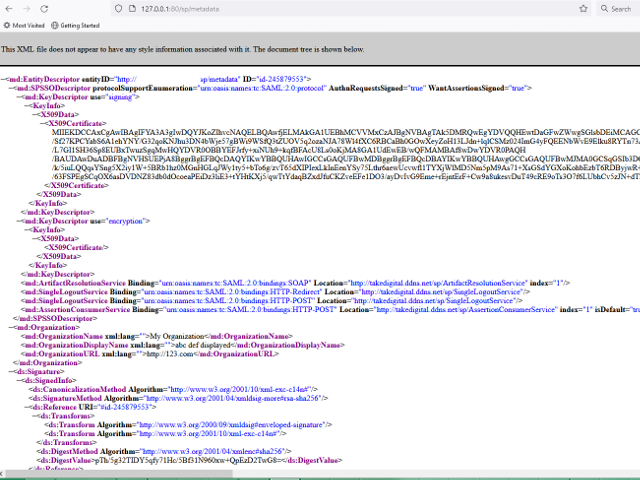
Now let us actually try to use the SAML functionality. Copy an arbitrary file - for example, a recent photo of your cat - to the directory you provided earlier via the base_dir property (D:\Inetpub\SAMLSP). Having copied the file (suppose it is called clifford.jpg), try to access it in your browser by navigating to http://127.0.0.1:80/clifford.jpg.
This is where SAML kicks in. Since you are not authenticated for the SP server yet (we have just launched it, so no one is), the server redirects your browser to the IdP endpoint for authentication. The address of the IdP is taken from the their_metadata.xml file that you have loaded at the very beginning.
Note: you can configure which resources to restrict access to using the protected_resources property. If protected_resources is empty, the server considers all the files in base_dir and its subfolders to be protected.
It is now the IdP services turn to authenticate you. Most IdPs on this stage will present you with a login form. Yet, if you have signed in recently, the IdP may still remember you, in which case it will skip the form and proceed directly to the next step. After establishing and proving your identity, the IdP will generate an assertion, a signed proof that effectively states that the IdP knows who you are and have verified your identity rigorously. Think of the assertion as your unique pass to the resources protected by the SP. The IdP will then submit that assertion back to the SP at its AssertionConsumerService endpoint, again using your browser.
Note that the SP service knows nothing about how IdP authenticates you. All the SP is interested in is an assertion.
If the assertion is well-formed and its signature is valid, the SAML exchange completes. At this point the SP accepts the assertion and creates a session for you. You can now access the resources protected by the SP for as long as the session lasts. If this step succeeds, you should see the photo of your cat in your browser.
Object Lifetime
The new() method returns a mutable reference to a struct instance. The object itself is kept in the global list maintained by SecureBlackbox. Due to this, the SAMLSPServer struct cannot be disposed of automatically. Please, call the dispose(&mut self) method of SAMLSPServer when you have finished using the instance.
Property List
The following is the full list of the properties of the struct with short descriptions. Click on the links for further details.
| active | Tells whether the server is active and ready to process requests. |
| base_dir | Base directory on the server. |
| binding_key_handle | Allows to get or set a 'handle', a unique identifier of the underlying property object. |
| decryption_cert_bytes | Returns the raw certificate data in DER format. |
| decryption_cert_handle | Allows to get or set a 'handle', a unique identifier of the underlying property object. |
| external_crypto_access_token | The bearer token used to access the external signing service. |
| external_crypto_async_document_id | Specifies an optional document ID for SignAsyncBegin() and SignAsyncEnd() calls. |
| external_crypto_credential | The identifier of the remote signing credential. |
| external_crypto_custom_params | Custom parameters to be passed to the signing service (uninterpreted). |
| external_crypto_data | Additional data to be included in the async state and mirrored back by the requestor. |
| external_crypto_external_hash_calculation | Specifies whether the message hash is to be calculated at the external endpoint. |
| external_crypto_hash_algorithm | Specifies the request's signature hash algorithm. |
| external_crypto_key_id | The ID of the pre-shared key used for DC request authentication. |
| external_crypto_key_secret | The pre-shared key used for DC request authentication. |
| external_crypto_method | Specifies the asynchronous signing method. |
| external_crypto_mode | Specifies the external cryptography mode. |
| external_crypto_public_key_algorithm | Provide the public key algorithm here if the certificate is not available on the pre-signing stage. |
| external_crypto_service_url | The URL of the external signing service. |
| external_crypto_signature_activation_data | An optional pre-obtained signature activation value. |
| fips_mode | Activates FIPS-only mode in the struct. |
| handshake_timeout | Specifies the handshake timeout in milliseconds. |
| host | Specifies the host address of the SP server. |
| id_p_service_count | The number of records in the IdPService arrays. |
| id_p_service_binding_type | Specifies the type of SAML binding that this endpoint accepts. |
| id_p_service_entity_id | Represents the SAML entity ID. |
| id_p_service_location | The location (URL) of the endpoint. |
| id_p_service_priority | The priority of the endpoint in relation to other endpoints with the same Location . |
| id_p_service_service | The kind of the service being provided at this endpoint. |
| id_p_service_service_index | The index of this endpoint. |
| id_p_contact_person | The contact person or persons for the entity. |
| id_p_encryption_key | Contains the entity's encryption key. |
| id_p_encryption_methods | Specifies the list of encryption methods supported by the entity. |
| id_p_entity_id | Represents the SAML entity ID. |
| id_p_flags | Adjusts secondary entity properties. |
| id_psso_link | Contains a local server page link that triggers SAML authentication to the SP. |
| id_p_name_id_formats | The list of NameID formats supported by this entity. |
| id_p_organization_display_name | The friendly name of the organization that maintains the entity. |
| id_p_organization_lang | The language preferred by the organization. |
| id_p_organization_name | The name of the organization that maintains the entity. |
| id_p_organization_url | The web URL of the organization that maintains the entity. |
| id_p_signature_validation_result | The outcome of the cryptographic signature validation. |
| id_p_signed | Specifies whether the SAML entity information is or should be signed. |
| id_p_signed_with | Contains the certificate or key that was used to sign the settings (metadata) document. |
| id_p_signing_key | Contains the entity's signing key. |
| id_p_valid_until | Specifies the expiration time of the SAML entity information. |
| issuer | Name identifier of the issuer of the SP's requests. |
| known_cert_count | The number of records in the KnownCert arrays. |
| known_cert_bytes | Returns the raw certificate data in DER format. |
| known_cert_handle | Allows to get or set a 'handle', a unique identifier of the underlying property object. |
| known_key_count | The number of records in the KnownKey arrays. |
| known_key_handle | Allows to get or set a 'handle', a unique identifier of the underlying property object. |
| logout_page | Specifies the location of the logout page. |
| metadata_url | The SP's metadata location. |
| meta_signing_cert_bytes | Returns the raw certificate data in DER format. |
| meta_signing_cert_handle | Allows to get or set a 'handle', a unique identifier of the underlying property object. |
| offline_mode | Enables the Offline mode. |
| pinned_client_aead_cipher | Indicates whether the encryption algorithm used is an AEAD cipher. |
| pinned_client_chain_validation_details | The details of a certificate chain validation outcome. |
| pinned_client_chain_validation_result | The outcome of a certificate chain validation routine. |
| pinned_client_ciphersuite | The cipher suite employed by this connection. |
| pinned_client_client_authenticated | Specifies whether client authentication was performed during this connection. |
| pinned_client_client_auth_requested | Specifies whether client authentication was requested during this connection. |
| pinned_client_connection_established | Indicates whether the connection has been established fully. |
| pinned_client_connection_id | The unique identifier assigned to this connection. |
| pinned_client_digest_algorithm | The digest algorithm used in a TLS-enabled connection. |
| pinned_client_encryption_algorithm | The symmetric encryption algorithm used in a TLS-enabled connection. |
| pinned_client_exportable | Indicates whether a TLS connection uses a reduced-strength exportable cipher. |
| pinned_client_group | The elliptic curve used in this connection. |
| pinned_client_id | The client connection's unique identifier. |
| pinned_client_key_exchange_algorithm | The key exchange algorithm used in a TLS-enabled connection. |
| pinned_client_key_exchange_key_bits | The length of the key exchange key of a TLS-enabled connection. |
| pinned_client_pfs_cipher | Indicates whether the chosen ciphersuite provides perfect forward secrecy (PFS). |
| pinned_client_pre_shared_identity | Specifies the identity used when the PSK (Pre-Shared Key) key-exchange mechanism is negotiated. |
| pinned_client_pre_shared_identity_hint | A hint professed by the server to help the client select the PSK identity to use. |
| pinned_client_public_key_bits | The length of the public key. |
| pinned_client_remote_address | The client's IP address. |
| pinned_client_remote_port | The remote port of the client connection. |
| pinned_client_resumed_session | Indicates whether a TLS-enabled connection was spawned from another TLS connection. |
| pinned_client_secure_connection | Indicates whether TLS or SSL is enabled for this connection. |
| pinned_client_server_authenticated | Indicates whether server authentication was performed during a TLS-enabled connection. |
| pinned_client_signature_algorithm | The signature algorithm used in a TLS handshake. |
| pinned_client_symmetric_block_size | The block size of the symmetric algorithm used. |
| pinned_client_symmetric_key_bits | The key length of the symmetric algorithm used. |
| pinned_client_total_bytes_received | The total number of bytes received over this connection. |
| pinned_client_total_bytes_sent | The total number of bytes sent over this connection. |
| pinned_client_validation_log | Contains the server certificate's chain validation log. |
| pinned_client_version | Indicates the version of SSL/TLS protocol negotiated during this connection. |
| pinned_client_cert_count | The number of records in the PinnedClientCert arrays. |
| pinned_client_cert_bytes | Returns the raw certificate data in DER format. |
| pinned_client_cert_ca_key_id | A unique identifier (fingerprint) of the CA certificate's cryptographic key. |
| pinned_client_cert_fingerprint | Contains the fingerprint (a hash imprint) of this certificate. |
| pinned_client_cert_handle | Allows to get or set a 'handle', a unique identifier of the underlying property object. |
| pinned_client_cert_issuer | The common name of the certificate issuer (CA), typically a company name. |
| pinned_client_cert_issuer_rdn | A list of Property=Value pairs that uniquely identify the certificate issuer. |
| pinned_client_cert_key_algorithm | Specifies the public key algorithm of this certificate. |
| pinned_client_cert_key_bits | Returns the length of the public key in bits. |
| pinned_client_cert_key_fingerprint | Returns a SHA1 fingerprint of the public key contained in the certificate. |
| pinned_client_cert_key_usage | Indicates the purposes of the key contained in the certificate, in the form of an OR'ed flag set. |
| pinned_client_cert_public_key_bytes | Contains the certificate's public key in DER format. |
| pinned_client_cert_self_signed | Indicates whether the certificate is self-signed (root) or signed by an external CA. |
| pinned_client_cert_serial_number | Returns the certificate's serial number. |
| pinned_client_cert_sig_algorithm | Indicates the algorithm that was used by the CA to sign this certificate. |
| pinned_client_cert_subject | The common name of the certificate holder, typically an individual's name, a URL, an e-mail address, or a company name. |
| pinned_client_cert_subject_key_id | Contains a unique identifier of the certificate's cryptographic key. |
| pinned_client_cert_subject_rdn | A list of Property=Value pairs that uniquely identify the certificate holder (subject). |
| pinned_client_cert_valid_from | The time point at which the certificate becomes valid, in UTC. |
| pinned_client_cert_valid_to | The time point at which the certificate expires, in UTC. |
| port | Specifies the listening port number. |
| protected_resources | Specifies the list of protected resources. |
| redirect_on_logout_page | Specifies the location to redirect the user on logout. |
| security_canonicalization_method | The canonicalization method to use in the signature. |
| security_digest_method | The digest method to use. |
| security_encryption_method | The encryption method used to encrypt the assertion. |
| security_flags | Provides access to secondary security parameters and tweaks. |
| security_sig_method | The signature method to use. |
| security_signature_policy | Specifies the signature validation policy. |
| sender_cert_count | The number of records in the SenderChain arrays. |
| sender_chain_bytes | Returns the raw certificate data in DER format. |
| sender_chain_handle | Allows to get or set a 'handle', a unique identifier of the underlying property object. |
| signing_cert_bytes | Returns the raw certificate data in DER format. |
| signing_cert_handle | Allows to get or set a 'handle', a unique identifier of the underlying property object. |
| signing_chain_count | The number of records in the SigningChain arrays. |
| signing_chain_bytes | Returns the raw certificate data in DER format. |
| signing_chain_handle | Allows to get or set a 'handle', a unique identifier of the underlying property object. |
| socket_incoming_speed_limit | The maximum number of bytes to read from the socket, per second. |
| socket_local_address | The local network interface to bind the socket to. |
| socket_local_port | The local port number to bind the socket to. |
| socket_outgoing_speed_limit | The maximum number of bytes to write to the socket, per second. |
| socket_timeout | The maximum period of waiting, in milliseconds, after which the socket operation is considered unsuccessful. |
| socket_use_ipv6 | Enables or disables IP protocol version 6. |
| sp_service_count | The number of records in the SPService arrays. |
| sp_service_binding_type | Specifies the type of SAML binding that this endpoint accepts. |
| sp_service_entity_id | Represents the SAML entity ID. |
| sp_service_location | The location (URL) of the endpoint. |
| sp_service_priority | The priority of the endpoint in relation to other endpoints with the same Location . |
| sp_service_service | The kind of the service being provided at this endpoint. |
| sp_service_service_index | The index of this endpoint. |
| sp_contact_person | The contact person or persons for the entity. |
| sp_encryption_key | Contains the entity's encryption key. |
| sp_encryption_methods | Specifies the list of encryption methods supported by the entity. |
| sp_entity_id | Represents the SAML entity ID. |
| sp_flags | Adjusts secondary entity properties. |
| sp_id_psso_link | Contains a local server page link that triggers SAML authentication to the SP. |
| sp_name_id_formats | The list of NameID formats supported by this entity. |
| sp_organization_display_name | The friendly name of the organization that maintains the entity. |
| sp_organization_lang | The language preferred by the organization. |
| sp_organization_name | The name of the organization that maintains the entity. |
| sp_organization_url | The web URL of the organization that maintains the entity. |
| sp_signature_validation_result | The outcome of the cryptographic signature validation. |
| sp_signed | Specifies whether the SAML entity information is or should be signed. |
| sp_signed_with | Contains the certificate or key that was used to sign the settings (metadata) document. |
| sp_signing_key | Contains the entity's signing key. |
| sp_valid_until | Specifies the expiration time of the SAML entity information. |
| tls_server_cert_count | The number of records in the TLSServerCert arrays. |
| tls_server_cert_bytes | Returns the raw certificate data in DER format. |
| tls_server_cert_handle | Allows to get or set a 'handle', a unique identifier of the underlying property object. |
| tls_auto_validate_certificates | Specifies whether server-side TLS certificates should be validated automatically using internal validation rules. |
| tls_base_configuration | Selects the base configuration for the TLS settings. |
| tls_ciphersuites | A list of ciphersuites separated with commas or semicolons. |
| tls_client_auth | Enables or disables certificate-based client authentication. |
| tls_extensions | Provides access to TLS extensions. |
| tls_force_resume_if_destination_changes | Whether to force TLS session resumption when the destination address changes. |
| tls_groups | Specifies a list of key exchange groups to attempt during the TLS key exchange. |
| tls_pre_shared_identity | Defines the identity used when the PSK (Pre-Shared Key) key-exchange mechanism is negotiated. |
| tls_pre_shared_key | Contains the pre-shared key for the PSK (Pre-Shared Key) key-exchange mechanism, encoded with base16. |
| tls_pre_shared_key_ciphersuite | Defines the ciphersuite used for PSK (Pre-Shared Key) negotiation. |
| tls_renegotiation_attack_prevention_mode | Selects the renegotiation attack prevention mechanism. |
| tls_revocation_check | Specifies the kind(s) of revocation check to perform. |
| tls_ssl_options | Various SSL (TLS) protocol options, set of cssloExpectShutdownMessage 0x001 Wait for the close-notify message when shutting down the connection cssloOpenSSLDTLSWorkaround 0x002 (DEPRECATED) Use a DTLS version workaround when talking to very old OpenSSL versions cssloDisableKexLengthAlignment 0x004 Do not align the client-side PMS by the RSA modulus size. |
| tls_mode | Specifies the TLS mode to use. |
| tls_use_extended_master_secret | Enables the Extended Master Secret Extension, as defined in RFC 7627. |
| tls_use_session_resumption | Enables or disables the TLS session resumption capability. |
| tls_versions | The SSL/TLS versions to enable by default. |
| url | Specifies the base URL of this SP server. |
Method List
The following is the full list of the methods of the struct with short descriptions. Click on the links for further details.
| add_id_p_service | Registers an IdP service in the IdPServices list. |
| add_sp_service | Registers an SP service in the SPServices list. |
| cleanup | Cleans up the server environment by purging expired sessions and cleaning caches. |
| config | Sets or retrieves a configuration setting. |
| do_action | Performs an additional action. |
| drop_client | Terminates a client connection. |
| export_settings | Saves the SP or IdP configuration to an XML metadata file. |
| get_client_buffer | Acquires a piece of operation data. |
| get_provider_property | Returns the value of a custom provider property. |
| get_request_bytes | Returns the contents of the connected client's HTTP request. |
| get_request_header | Returns a request header value. |
| get_response_header | Returns a response header value. |
| get_session_property | Returns the value of a custom session property. |
| import_settings | Loads the metadata required for information exchange with the identity provider. Both local (SP-side) and remote (IdP-side) metadata can be loaded with this call. |
| initiate_artifact_resolve | Initiates the artifact resolution protocol. |
| initiate_attribute_query | Initiates the attribute query. |
| initiate_auth | Starts SP-initiated SAML authentication flow. |
| initiate_logout | Starts SP-initiated SAML logout flow. |
| list_clients | Enumerates the connected clients. |
| pin_client | Takes a snapshot of the connection's properties. |
| process_artifact | Processes an artifact request received from the IdP service at one of artifact receiver endpoints. |
| process_artifact_resolve_request | Processes an artifact request received from the SP service at one of the ARS endpoints. |
| process_assertion | Processes assertion received from the IdP service at one of the ACS endpoints. |
| process_generic_request | Processes a generic HTTP SAML request. |
| process_logout_request | Processes logout request received from the IdP service at one of the SLS endpoints. |
| reset | Resets the struct settings. |
| set_client_buffer | Commits a data buffer to the connection. |
| set_provider_property | Sets the value of a custom provider property. |
| set_response_header | Sets a response header. |
| set_session_property | Sets the value of a custom provider session property. |
| start | Starts the SP server. |
| stop | Stops the IdP server. |
Event List
The following is the full list of the events fired by the struct with short descriptions. Click on the links for further details.
| on_accept | Reports an incoming connection. |
| on_artifact_received | The server fires this event upon receiving an Artifact message from the other side. |
| on_artifact_resolve_request_prepared | This event is fired when a new artifact resolution request message has been prepared by the struct. |
| on_artifact_resolve_request_received | Reports receipt of ArtifactResolveRequest message. |
| on_assertion_received | This event is fired when an assertion is received from the IdP. |
| on_attribute_query_prepared | Notifies the application of the preparation of an AttributeQuery. |
| on_authn_request_prepared | This event is fired when a new authentication request message has been prepared. |
| on_authorization_needed | Requests authorization data required by an external service. |
| on_connect | Reports an accepted connection. |
| on_disconnect | Fires to report a disconnected client. |
| on_encrypted | Notifies the application that the assertion is encrypted and provides recipient certificate details. |
| on_error | Information about errors during data delivery. |
| on_external_sign | Handles remote or external signing initiated by the server protocol. |
| on_logout_request_prepared | This event is fired when a new logout request has been prepared. |
| on_logout_request_received | The struct uses this event to notify the application about an incoming SAML Logout Request message. |
| on_logout_response_prepared | The struct uses this event to notify the application about the Logout Response message being ready to be sent. |
| on_logout_response_received | The struct uses this event to notify the application about an incoming SAML LogoutResponse message. |
| on_notification | This event notifies the application about an underlying control flow event. |
| on_processing_completed | This event notifies the application of the completion of request or response processing. |
| on_read_artifact | Requests content identified by an artifact from the application. |
| on_resource_close | Tells the application that it can close the opened resource. |
| on_resource_open | Requests the application to open the requested resource. |
| on_resource_read | Requests the application to read from an opened resource. |
| on_resource_request | Notifies the application that a server resource is requested. |
| on_resource_write | Requests the application to write to an opened resource. |
| on_saml_message_prepared | This event is fired when a SAML message has been prepared and is ready to be dispatched. |
| on_saml_message_received | The server fires this event for every SAML message it receives. |
| on_session_created | This event is fired when a new session has been established. |
| on_session_destroyed | This event is fired when the SP server has closed a session. |
| on_session_event | Notifies the application about SAML session events. |
| on_session_info_needed | This event is fired in OfflineMode to request the session ID for the current flow. |
| on_session_state_retrieve | This event fires to retrieve session state information from the application. |
| on_session_state_save | This event passes a session state object to the application for safekeeping. |
| on_signature_found | Signifies the start of signature validation. |
| on_signature_validated | Reports the signature validation result. |
| on_tls_cert_validate | Fires when a client certificate needs to be validated. |
| on_tls_established | Reports the setup of a TLS session. |
| on_tls_handshake | Fires when a newly established client connection initiates a TLS handshake. |
| on_tls_psk | Requests a pre-shared key for TLS-PSK. |
| on_tls_shutdown | Reports closure of a TLS session. |
| on_user_auth_completed | Notifies the application about the success of user authentication flow. |
| on_user_auth_failed | Notifies the application about failure of user authentication flow. |
| on_user_auth_start | Notifies the application about the start of user authentication flow. |
| on_user_logout_completed | Notifies the application about the completion of user logout flow. |
| on_user_logout_start | Notifies the application about the start of user logout flow. |
Config Settings
The following is a list of config settings for the struct with short descriptions. Click on the links for further details.
| AllowOptionsResponseWithoutAuth | Enables unauthenticated responses to OPTIONS requests. |
| AttributeConsumingService | TBD. |
| AuthDigestExpire | Specifies digest expiration time for digest authentication. |
| BoundPort | The port that was bound by the server. |
| ContactPerson | The ContactPerson entry of the provider metadata. |
| DualStack | Allows the use of ip4 and ip6 simultaneously. |
| HandshakeTimeout | The HTTPS handshake timeout. |
| HomePage | Specifies the home page resource name. |
| IDPAQS | TBD. |
| IDPARS | TBD. |
| IDPSLS | TBD. |
| IDPSSO | TBD. |
| MaxIssueInstantTimeDiff | The maximum issue-instant time delta. |
| OAuthAllowAccessByDefault | Specifies whether access to a resource is allowed by default. |
| OAuthAutoValidateTokens | Allows to validate OAuth 2.0 access tokens automatically. |
| OAuthIntrospectionClientID | Specifies a client ID on the authentication service. |
| OAuthIntrospectionClientSecret | Specifies a client secret on the authentication service. |
| OAuthIntrospectionURL | Specifies the URL to be used to introspect access tokens. |
| OAuthTokenValidationKeys | Specifies JW keys in JSON format for validating access token signatures. |
| OrganizationDisplayName | The OrganizationDisplayName entry of the provider metadata. |
| OrganizationLang | The OrganizationLang key of the provider metadata. |
| OrganizationName | The OrganizationName element of the provider metadata. |
| OrganizationURL | The OrganizationURL element of the provider metadata. |
| PortRangeFrom | The lower bound of allowed port scope to listen on. |
| PortRangeTo | The higher bound of allowed port scope to listen on. |
| RequestFilter | The request string modifier. |
| SAMLAction | TBD. |
| SAMLBuffer | TBD. |
| SAMLResourceProtected | TBD. |
| SAMLResourceSpecial | TBD. |
| SAMLString | TBD. |
| SendBufferSize | The network send buffer size. |
| ServerName | Specifies the server name for the created responses. |
| SessionTimeout | The HTTP session timeout. |
| SessionTTL | The SAML session time-to-live value. |
| SignatureAlgorithm | TBD. |
| TempPath | Path for storing temporary files. |
| UseZeroIndexForDefaultServices | TBD. |
| WantAssertionsSigned | TBD. |
| ASN1UseGlobalTagCache | Controls whether ASN.1 module should use a global object cache. |
| AssignSystemSmartCardPins | Specifies whether CSP-level PINs should be assigned to CNG keys. |
| CheckKeyIntegrityBeforeUse | Enables or disable private key integrity check before use. |
| CookieCaching | Specifies whether a cookie cache should be used for HTTP(S) transports. |
| Cookies | Gets or sets local cookies for the struct. |
| DefDeriveKeyIterations | Specifies the default key derivation algorithm iteration count. |
| DNSLocalSuffix | The suffix to assign for TLD names. |
| EnableClientSideSSLFFDHE | Enables or disables finite field DHE key exchange support in TLS clients. |
| EnableSSHMLKEM | Enables support for ML-KEM/hybrid key exchange algorithms in SSH client and server structs. |
| EnableTLSMLKEM | Enables support for ML-KEM and hybrid groups in TLS client and server structs. |
| GlobalCookies | Gets or sets global cookies for all the HTTP transports. |
| HardwareCryptoUsePolicy | The hardware crypto usage policy. |
| HttpUserAgent | Specifies the user agent name to be used by all HTTP clients. |
| HttpVersion | The HTTP version to use in any inner HTTP client structs created. |
| IgnoreExpiredMSCTLSigningCert | Whether to tolerate the expired Windows Update signing certificate. |
| ListDelimiter | The delimiter character for multi-element lists. |
| LogDestination | Specifies the debug log destination. |
| LogDetails | Specifies the debug log details to dump. |
| LogFile | Specifies the debug log filename. |
| LogFilters | Specifies the debug log filters. |
| LogFlushMode | Specifies the log flush mode. |
| LogLevel | Specifies the debug log level. |
| LogMaxEventCount | Specifies the maximum number of events to cache before further action is taken. |
| LogRotationMode | Specifies the log rotation mode. |
| MaxASN1BufferLength | Specifies the maximal allowed length for ASN.1 primitive tag data. |
| MaxASN1TreeDepth | Specifies the maximal depth for processed ASN.1 trees. |
| OCSPHashAlgorithm | Specifies the hash algorithm to be used to identify certificates in OCSP requests. |
| OldClientSideRSAFallback | Specifies whether the SSH client should use a SHA1 fallback. |
| PKICache | Specifies which PKI elements (certificates, CRLs, OCSP responses) should be cached. |
| PKICachePath | Specifies the file system path where cached PKI data is stored. |
| ProductVersion | Returns the version of the SecureBlackbox library. |
| ServerSSLDHKeyLength | Sets the size of the TLS DHE key exchange group. |
| StaticDNS | Specifies whether static DNS rules should be used. |
| StaticIPAddress[domain] | Gets or sets an IP address for the specified domain name. |
| StaticIPAddresses | Gets or sets all the static DNS rules. |
| Tag | Allows to store any custom data. |
| TLSSessionGroup | Specifies the group name of TLS sessions to be used for session resumption. |
| TLSSessionLifetime | Specifies lifetime in seconds of the cached TLS session. |
| TLSSessionPurgeInterval | Specifies how often the session cache should remove the expired TLS sessions. |
| UseCRLObjectCaching | Specifies whether reuse of loaded CRL objects is enabled. |
| UseInternalRandom | Switches between SecureBlackbox-own and platform PRNGs. |
| UseLegacyAdESValidation | Enables legacy AdES validation mode. |
| UseOCSPResponseObjectCaching | Specifies whether reuse of loaded OCSP response objects is enabled. |
| UseOwnDNSResolver | Specifies whether the client structs should use own DNS resolver. |
| UseSharedSystemStorages | Specifies whether the validation engine should use a global per-process copy of the system certificate stores. |
| UseSystemNativeSizeCalculation | An internal CryptoAPI access tweak. |
| UseSystemOAEPAndPSS | Enforces or disables the use of system-driven RSA OAEP and PSS computations. |
| UseSystemRandom | Enables or disables the use of the OS PRNG. |
| XMLRDNDescriptorName[OID] | Defines an OID mapping to descriptor names for the certificate's IssuerRDN or SubjectRDN. |
| XMLRDNDescriptorPriority[OID] | Specifies the priority of descriptor names associated with a specific OID. |
| XMLRDNDescriptorReverseOrder | Specifies whether to reverse the order of descriptors in RDN. |
| XMLRDNDescriptorSeparator | Specifies the separator used between descriptors in RDN. |
active property (SAMLSPServer Struct)
Tells whether the server is active and ready to process requests.
Syntax
fn active(&self ) -> Result<bool, SecureBlackboxError>
Default Value
false
Remarks
This property indicates whether the IdP server is in an active state.
This property is read-only.
Data Type
bool
base_dir property (SAMLSPServer Struct)
Base directory on the server.
Syntax
fn base_dir(&self ) -> Result<String, SecureBlackboxError>
fn set_base_dir(&self, value : &str) ->  Option<SecureBlackboxError>
fn set_base_dir_ref(&self, value : &String) ->  Option<SecureBlackboxError>
Default Value
""
Remarks
Use this property to specify the base directory for the SP server.
Data Type
String
binding_key_handle property (SAMLSPServer Struct)
Allows to get or set a 'handle', a unique identifier of the underlying property object.
Syntax
fn binding_key_handle(&self ) -> Result<i64, SecureBlackboxError>
fn set_binding_key_handle(&self, value : i64) ->  Option<SecureBlackboxError>
Default Value
0
Remarks
Allows to get or set a 'handle', a unique identifier of the underlying property object. Use this property to assign objects of the same type in a quicker manner, without copying them fieldwise.
When you pass a handle of one object to another, the source object is copied to the destination rather than assigned. It is safe to get rid of the original object
after such operation.
pdfSigner.setSigningCertHandle(certMgr.getCertHandle());
Data Type
i64
decryption_cert_bytes property (SAMLSPServer Struct)
Returns the raw certificate data in DER format.
Syntax
fn decryption_cert_bytes(&self ) -> Result<Vec<u8>, SecureBlackboxError>
Remarks
Returns the raw certificate data in DER format.
This property is read-only.
Data Type
Vec
decryption_cert_handle property (SAMLSPServer Struct)
Allows to get or set a 'handle', a unique identifier of the underlying property object.
Syntax
fn decryption_cert_handle(&self ) -> Result<i64, SecureBlackboxError>
fn set_decryption_cert_handle(&self, value : i64) ->  Option<SecureBlackboxError>
Default Value
0
Remarks
Allows to get or set a 'handle', a unique identifier of the underlying property object. Use this property to assign objects of the same type in a quicker manner, without copying them fieldwise.
When you pass a handle of one object to another, the source object is copied to the destination rather than assigned. It is safe to get rid of the original object
after such operation.
pdfSigner.setSigningCertHandle(certMgr.getCertHandle());
Data Type
i64
external_crypto_access_token property (SAMLSPServer Struct)
The bearer token used to access the external signing service.
Syntax
fn external_crypto_access_token(&self ) -> Result<String, SecureBlackboxError>
fn set_external_crypto_access_token(&self, value : &str) ->  Option<SecureBlackboxError>
fn set_external_crypto_access_token_ref(&self, value : &String) ->  Option<SecureBlackboxError>
Default Value
""
Remarks
The bearer token used to access the external signing service.
TBD
Data Type
String
external_crypto_async_document_id property (SAMLSPServer Struct)
Specifies an optional document ID for SignAsyncBegin() and SignAsyncEnd() calls.
Syntax
fn external_crypto_async_document_id(&self ) -> Result<String, SecureBlackboxError>
fn set_external_crypto_async_document_id(&self, value : &str) ->  Option<SecureBlackboxError>
fn set_external_crypto_async_document_id_ref(&self, value : &String) ->  Option<SecureBlackboxError>
Default Value
""
Remarks
Specifies an optional document ID for SignAsyncBegin() and SignAsyncEnd() calls.
Use this property when working with multi-signature DCAuth requests and responses to uniquely identify documents signed within a larger batch. On the completion stage, this value helps the signing component identify the correct signature in the returned batch of responses.
If using batched requests, make sure to set this property to the same value on both the pre-signing (SignAsyncBegin) and completion (SignAsyncEnd) stages.
Data Type
String
external_crypto_credential property (SAMLSPServer Struct)
The identifier of the remote signing credential.
Syntax
fn external_crypto_credential(&self ) -> Result<String, SecureBlackboxError>
fn set_external_crypto_credential(&self, value : &str) ->  Option<SecureBlackboxError>
fn set_external_crypto_credential_ref(&self, value : &String) ->  Option<SecureBlackboxError>
Default Value
""
Remarks
The identifier of the remote signing credential.
TBD
Data Type
String
external_crypto_custom_params property (SAMLSPServer Struct)
Custom parameters to be passed to the signing service (uninterpreted).
Syntax
fn external_crypto_custom_params(&self ) -> Result<String, SecureBlackboxError>
fn set_external_crypto_custom_params(&self, value : &str) ->  Option<SecureBlackboxError>
fn set_external_crypto_custom_params_ref(&self, value : &String) ->  Option<SecureBlackboxError>
Default Value
""
Remarks
Custom parameters to be passed to the signing service (uninterpreted).
Data Type
String
external_crypto_data property (SAMLSPServer Struct)
Additional data to be included in the async state and mirrored back by the requestor.
Syntax
fn external_crypto_data(&self ) -> Result<String, SecureBlackboxError>
fn set_external_crypto_data(&self, value : &str) ->  Option<SecureBlackboxError>
fn set_external_crypto_data_ref(&self, value : &String) ->  Option<SecureBlackboxError>
Default Value
""
Remarks
Additional data to be included in the async state and mirrored back by the requestor.
In the CSC mode this value is sent as the optional CSC clientData field in credential information, authorization, and signing requests. TBD
Data Type
String
external_crypto_external_hash_calculation property (SAMLSPServer Struct)
Specifies whether the message hash is to be calculated at the external endpoint.
Syntax
fn external_crypto_external_hash_calculation(&self ) -> Result<bool, SecureBlackboxError>
fn set_external_crypto_external_hash_calculation(&self, value : bool) ->  Option<SecureBlackboxError>
Default Value
false
Remarks
Specifies whether the message hash is to be calculated at the external endpoint. Please note that this mode is not supported by the DCAuth struct.
If set to true, the struct will pass a few kilobytes of to-be-signed data from the document to the OnExternalSign event. This only applies when SignExternal() is called.
Data Type
bool
external_crypto_hash_algorithm property (SAMLSPServer Struct)
Specifies the request's signature hash algorithm.
Syntax
fn external_crypto_hash_algorithm(&self ) -> Result<String, SecureBlackboxError>
fn set_external_crypto_hash_algorithm(&self, value : &str) ->  Option<SecureBlackboxError>
fn set_external_crypto_hash_algorithm_ref(&self, value : &String) ->  Option<SecureBlackboxError>
Default Value
"SHA256"
Remarks
Specifies the request's signature hash algorithm.
| SB_HASH_ALGORITHM_SHA1 | SHA1 | |
| SB_HASH_ALGORITHM_SHA224 | SHA224 | |
| SB_HASH_ALGORITHM_SHA256 | SHA256 | |
| SB_HASH_ALGORITHM_SHA384 | SHA384 | |
| SB_HASH_ALGORITHM_SHA512 | SHA512 | |
| SB_HASH_ALGORITHM_MD2 | MD2 | |
| SB_HASH_ALGORITHM_MD4 | MD4 | |
| SB_HASH_ALGORITHM_MD5 | MD5 | |
| SB_HASH_ALGORITHM_RIPEMD160 | RIPEMD160 | |
| SB_HASH_ALGORITHM_CRC32 | CRC32 | |
| SB_HASH_ALGORITHM_SSL3 | SSL3 | |
| SB_HASH_ALGORITHM_GOST_R3411_1994 | GOST1994 | |
| SB_HASH_ALGORITHM_WHIRLPOOL | WHIRLPOOL | |
| SB_HASH_ALGORITHM_POLY1305 | POLY1305 | |
| SB_HASH_ALGORITHM_SHA3_224 | SHA3_224 | |
| SB_HASH_ALGORITHM_SHA3_256 | SHA3_256 | |
| SB_HASH_ALGORITHM_SHA3_384 | SHA3_384 | |
| SB_HASH_ALGORITHM_SHA3_512 | SHA3_512 | |
| SB_HASH_ALGORITHM_BLAKE2S_128 | BLAKE2S_128 | |
| SB_HASH_ALGORITHM_BLAKE2S_160 | BLAKE2S_160 | |
| SB_HASH_ALGORITHM_BLAKE2S_224 | BLAKE2S_224 | |
| SB_HASH_ALGORITHM_BLAKE2S_256 | BLAKE2S_256 | |
| SB_HASH_ALGORITHM_BLAKE2B_160 | BLAKE2B_160 | |
| SB_HASH_ALGORITHM_BLAKE2B_256 | BLAKE2B_256 | |
| SB_HASH_ALGORITHM_BLAKE2B_384 | BLAKE2B_384 | |
| SB_HASH_ALGORITHM_BLAKE2B_512 | BLAKE2B_512 | |
| SB_HASH_ALGORITHM_SHAKE_128 | SHAKE_128 | |
| SB_HASH_ALGORITHM_SHAKE_256 | SHAKE_256 | |
| SB_HASH_ALGORITHM_SHAKE_128_LEN | SHAKE_128_LEN | |
| SB_HASH_ALGORITHM_SHAKE_256_LEN | SHAKE_256_LEN |
Data Type
String
external_crypto_key_id property (SAMLSPServer Struct)
The ID of the pre-shared key used for DC request authentication.
Syntax
fn external_crypto_key_id(&self ) -> Result<String, SecureBlackboxError>
fn set_external_crypto_key_id(&self, value : &str) ->  Option<SecureBlackboxError>
fn set_external_crypto_key_id_ref(&self, value : &String) ->  Option<SecureBlackboxError>
Default Value
""
Remarks
The ID of the pre-shared key used for DC request authentication.
Asynchronous DCAuth-driven communication requires that parties authenticate each other with a secret pre-shared cryptographic key. This provides an extra protection layer for the protocol and diminishes the risk of the private key becoming abused by foreign parties. Use this property to provide the pre-shared key identifier, and use external_crypto_key_secret to pass the key itself.
The same KeyID/KeySecret pair should be used on the DCAuth side for the signing requests to be accepted.
Note: The KeyID/KeySecret scheme is very similar to the AuthKey scheme used in various Cloud service providers to authenticate users.
Example:
  signer.ExternalCrypto.KeyID = "MainSigningKey";
  signer.ExternalCrypto.KeySecret = "abcdef0123456789";
Data Type
String
external_crypto_key_secret property (SAMLSPServer Struct)
The pre-shared key used for DC request authentication.
Syntax
fn external_crypto_key_secret(&self ) -> Result<String, SecureBlackboxError>
fn set_external_crypto_key_secret(&self, value : &str) ->  Option<SecureBlackboxError>
fn set_external_crypto_key_secret_ref(&self, value : &String) ->  Option<SecureBlackboxError>
Default Value
""
Remarks
The pre-shared key used for DC request authentication. This key must be set and match the key used by the DCAuth counterpart for the scheme to work.
Read more about configuring authentication in the external_crypto_key_id topic.
Data Type
String
external_crypto_method property (SAMLSPServer Struct)
Specifies the asynchronous signing method.
Syntax
fn external_crypto_method(&self ) -> Result<i32, SecureBlackboxError>
fn set_external_crypto_method(&self, value : i32) ->  Option<SecureBlackboxError>
Possible Values
0   // PKCS1
1   // PKCS7
Default Value
0
Remarks
Specifies the asynchronous signing method. This is typically defined by the DC server capabilities and setup.
Available options:
| asmdPKCS1 | 0 |
| asmdPKCS7 | 1 |
Data Type
i32
external_crypto_mode property (SAMLSPServer Struct)
Specifies the external cryptography mode.
Syntax
fn external_crypto_mode(&self ) -> Result<i32, SecureBlackboxError>
fn set_external_crypto_mode(&self, value : i32) ->  Option<SecureBlackboxError>
Possible Values
0   // Default
1   // Disabled
2   // Generic
3   // DCAuth
4   // DCAuthJSON
5   // CSC
Default Value
0
Remarks
Specifies the external cryptography mode.
Available options:
| ecmDefault | The default value (0) |
| ecmDisabled | Do not use DC or external signing (1) |
| ecmGeneric | Generic external signing with the OnExternalSign event (2) |
| ecmDCAuth | DCAuth signing (3) |
| ecmDCAuthJSON | DCAuth signing in JSON format (4) |
| ecmCSC | CSC 2.2 cloud signing (5) |
Data Type
i32
external_crypto_public_key_algorithm property (SAMLSPServer Struct)
Provide the public key algorithm here if the certificate is not available on the pre-signing stage.
Syntax
fn external_crypto_public_key_algorithm(&self ) -> Result<String, SecureBlackboxError>
fn set_external_crypto_public_key_algorithm(&self, value : &str) ->  Option<SecureBlackboxError>
fn set_external_crypto_public_key_algorithm_ref(&self, value : &String) ->  Option<SecureBlackboxError>
Default Value
""
Remarks
Provide the public key algorithm here if the certificate is not available on the pre-signing stage.
| SB_CERT_ALGORITHM_ID_RSA_ENCRYPTION | rsaEncryption | |
| SB_CERT_ALGORITHM_MD2_RSA_ENCRYPTION | md2withRSAEncryption | |
| SB_CERT_ALGORITHM_MD5_RSA_ENCRYPTION | md5withRSAEncryption | |
| SB_CERT_ALGORITHM_SHA1_RSA_ENCRYPTION | sha1withRSAEncryption | |
| SB_CERT_ALGORITHM_ID_DSA | id-dsa | |
| SB_CERT_ALGORITHM_ID_DSA_SHA1 | id-dsa-with-sha1 | |
| SB_CERT_ALGORITHM_DH_PUBLIC | dhpublicnumber | |
| SB_CERT_ALGORITHM_SHA224_RSA_ENCRYPTION | sha224WithRSAEncryption | |
| SB_CERT_ALGORITHM_SHA256_RSA_ENCRYPTION | sha256WithRSAEncryption | |
| SB_CERT_ALGORITHM_SHA384_RSA_ENCRYPTION | sha384WithRSAEncryption | |
| SB_CERT_ALGORITHM_SHA512_RSA_ENCRYPTION | sha512WithRSAEncryption | |
| SB_CERT_ALGORITHM_ID_RSAPSS | id-RSASSA-PSS | |
| SB_CERT_ALGORITHM_ID_RSAOAEP | id-RSAES-OAEP | |
| SB_CERT_ALGORITHM_RSASIGNATURE_RIPEMD160 | ripemd160withRSA | |
| SB_CERT_ALGORITHM_ID_ELGAMAL | elGamal | |
| SB_CERT_ALGORITHM_SHA1_ECDSA | ecdsa-with-SHA1 | |
| SB_CERT_ALGORITHM_RECOMMENDED_ECDSA | ecdsa-recommended | |
| SB_CERT_ALGORITHM_SHA224_ECDSA | ecdsa-with-SHA224 | |
| SB_CERT_ALGORITHM_SHA256_ECDSA | ecdsa-with-SHA256 | |
| SB_CERT_ALGORITHM_SHA384_ECDSA | ecdsa-with-SHA384 | |
| SB_CERT_ALGORITHM_SHA512_ECDSA | ecdsa-with-SHA512 | |
| SB_CERT_ALGORITHM_EC | id-ecPublicKey | |
| SB_CERT_ALGORITHM_SPECIFIED_ECDSA | ecdsa-specified | |
| SB_CERT_ALGORITHM_GOST_R3410_1994 | id-GostR3410-94 | |
| SB_CERT_ALGORITHM_GOST_R3410_2001 | id-GostR3410-2001 | |
| SB_CERT_ALGORITHM_GOST_R3411_WITH_R3410_1994 | id-GostR3411-94-with-GostR3410-94 | |
| SB_CERT_ALGORITHM_GOST_R3411_WITH_R3410_2001 | id-GostR3411-94-with-GostR3410-2001 | |
| SB_CERT_ALGORITHM_SHA1_ECDSA_PLAIN | ecdsa-plain-SHA1 | |
| SB_CERT_ALGORITHM_SHA224_ECDSA_PLAIN | ecdsa-plain-SHA224 | |
| SB_CERT_ALGORITHM_SHA256_ECDSA_PLAIN | ecdsa-plain-SHA256 | |
| SB_CERT_ALGORITHM_SHA384_ECDSA_PLAIN | ecdsa-plain-SHA384 | |
| SB_CERT_ALGORITHM_SHA512_ECDSA_PLAIN | ecdsa-plain-SHA512 | |
| SB_CERT_ALGORITHM_RIPEMD160_ECDSA_PLAIN | ecdsa-plain-RIPEMD160 | |
| SB_CERT_ALGORITHM_WHIRLPOOL_RSA_ENCRYPTION | whirlpoolWithRSAEncryption | |
| SB_CERT_ALGORITHM_ID_DSA_SHA224 | id-dsa-with-sha224 | |
| SB_CERT_ALGORITHM_ID_DSA_SHA256 | id-dsa-with-sha256 | |
| SB_CERT_ALGORITHM_SHA3_224_RSA_ENCRYPTION | id-rsassa-pkcs1-v1_5-with-sha3-224 | |
| SB_CERT_ALGORITHM_SHA3_256_RSA_ENCRYPTION | id-rsassa-pkcs1-v1_5-with-sha3-256 | |
| SB_CERT_ALGORITHM_SHA3_384_RSA_ENCRYPTION | id-rsassa-pkcs1-v1_5-with-sha3-384 | |
| SB_CERT_ALGORITHM_SHA3_512_RSA_ENCRYPTION | id-rsassa-pkcs1-v1_5-with-sha3-512 | |
| SB_CERT_ALGORITHM_SHA3_224_ECDSA | id-ecdsa-with-sha3-224 | |
| SB_CERT_ALGORITHM_SHA3_256_ECDSA | id-ecdsa-with-sha3-256 | |
| SB_CERT_ALGORITHM_SHA3_384_ECDSA | id-ecdsa-with-sha3-384 | |
| SB_CERT_ALGORITHM_SHA3_512_ECDSA | id-ecdsa-with-sha3-512 | |
| SB_CERT_ALGORITHM_SHA3_224_ECDSA_PLAIN | id-ecdsa-plain-with-sha3-224 | |
| SB_CERT_ALGORITHM_SHA3_256_ECDSA_PLAIN | id-ecdsa-plain-with-sha3-256 | |
| SB_CERT_ALGORITHM_SHA3_384_ECDSA_PLAIN | id-ecdsa-plain-with-sha3-384 | |
| SB_CERT_ALGORITHM_SHA3_512_ECDSA_PLAIN | id-ecdsa-plain-with-sha3-512 | |
| SB_CERT_ALGORITHM_ID_DSA_SHA3_224 | id-dsa-with-sha3-224 | |
| SB_CERT_ALGORITHM_ID_DSA_SHA3_256 | id-dsa-with-sha3-256 | |
| SB_CERT_ALGORITHM_BLAKE2S_128_RSA_ENCRYPTION | id-rsassa-pkcs1-v1_5-with-blake2s128 | |
| SB_CERT_ALGORITHM_BLAKE2S_160_RSA_ENCRYPTION | id-rsassa-pkcs1-v1_5-with-blake2s160 | |
| SB_CERT_ALGORITHM_BLAKE2S_224_RSA_ENCRYPTION | id-rsassa-pkcs1-v1_5-with-blake2s224 | |
| SB_CERT_ALGORITHM_BLAKE2S_256_RSA_ENCRYPTION | id-rsassa-pkcs1-v1_5-with-blake2s256 | |
| SB_CERT_ALGORITHM_BLAKE2B_160_RSA_ENCRYPTION | id-rsassa-pkcs1-v1_5-with-blake2b160 | |
| SB_CERT_ALGORITHM_BLAKE2B_256_RSA_ENCRYPTION | id-rsassa-pkcs1-v1_5-with-blake2b256 | |
| SB_CERT_ALGORITHM_BLAKE2B_384_RSA_ENCRYPTION | id-rsassa-pkcs1-v1_5-with-blake2b384 | |
| SB_CERT_ALGORITHM_BLAKE2B_512_RSA_ENCRYPTION | id-rsassa-pkcs1-v1_5-with-blake2b512 | |
| SB_CERT_ALGORITHM_BLAKE2S_128_ECDSA | id-ecdsa-with-blake2s128 | |
| SB_CERT_ALGORITHM_BLAKE2S_160_ECDSA | id-ecdsa-with-blake2s160 | |
| SB_CERT_ALGORITHM_BLAKE2S_224_ECDSA | id-ecdsa-with-blake2s224 | |
| SB_CERT_ALGORITHM_BLAKE2S_256_ECDSA | id-ecdsa-with-blake2s256 | |
| SB_CERT_ALGORITHM_BLAKE2B_160_ECDSA | id-ecdsa-with-blake2b160 | |
| SB_CERT_ALGORITHM_BLAKE2B_256_ECDSA | id-ecdsa-with-blake2b256 | |
| SB_CERT_ALGORITHM_BLAKE2B_384_ECDSA | id-ecdsa-with-blake2b384 | |
| SB_CERT_ALGORITHM_BLAKE2B_512_ECDSA | id-ecdsa-with-blake2b512 | |
| SB_CERT_ALGORITHM_BLAKE2S_128_ECDSA_PLAIN | id-ecdsa-plain-with-blake2s128 | |
| SB_CERT_ALGORITHM_BLAKE2S_160_ECDSA_PLAIN | id-ecdsa-plain-with-blake2s160 | |
| SB_CERT_ALGORITHM_BLAKE2S_224_ECDSA_PLAIN | id-ecdsa-plain-with-blake2s224 | |
| SB_CERT_ALGORITHM_BLAKE2S_256_ECDSA_PLAIN | id-ecdsa-plain-with-blake2s256 | |
| SB_CERT_ALGORITHM_BLAKE2B_160_ECDSA_PLAIN | id-ecdsa-plain-with-blake2b160 | |
| SB_CERT_ALGORITHM_BLAKE2B_256_ECDSA_PLAIN | id-ecdsa-plain-with-blake2b256 | |
| SB_CERT_ALGORITHM_BLAKE2B_384_ECDSA_PLAIN | id-ecdsa-plain-with-blake2b384 | |
| SB_CERT_ALGORITHM_BLAKE2B_512_ECDSA_PLAIN | id-ecdsa-plain-with-blake2b512 | |
| SB_CERT_ALGORITHM_ID_DSA_BLAKE2S_224 | id-dsa-with-blake2s224 | |
| SB_CERT_ALGORITHM_ID_DSA_BLAKE2S_256 | id-dsa-with-blake2s256 | |
| SB_CERT_ALGORITHM_EDDSA_ED25519 | id-Ed25519 | |
| SB_CERT_ALGORITHM_EDDSA_ED448 | id-Ed448 | |
| SB_CERT_ALGORITHM_EDDSA_ED25519_PH | id-Ed25519ph | |
| SB_CERT_ALGORITHM_EDDSA_ED448_PH | id-Ed448ph | |
| SB_CERT_ALGORITHM_EDDSA | id-EdDSA | |
| SB_CERT_ALGORITHM_EDDSA_SIGNATURE | id-EdDSA-sig | |
| SB_CERT_ALGORITHM_MLDSA_44 | id-ml-dsa-44 | |
| SB_CERT_ALGORITHM_MLDSA_65 | id-ml-dsa-65 | |
| SB_CERT_ALGORITHM_MLDSA_87 | id-ml-dsa-87 | |
| SB_CERT_ALGORITHM_HASH_MLDSA_44_SHA512 | id-hash-ml-dsa-44-with-sha512 | |
| SB_CERT_ALGORITHM_HASH_MLDSA_65_SHA512 | id-hash-ml-dsa-65-with-sha512 | |
| SB_CERT_ALGORITHM_HASH_MLDSA_87_SHA512 | id-hash-ml-dsa-87-with-sha512 | |
| SB_CERT_ALGORITHM_MLKEM_512 | id-ml-kem-512 | |
| SB_CERT_ALGORITHM_MLKEM_768 | id-ml-kem-768 | |
| SB_CERT_ALGORITHM_MLKEM_1024 | id-ml-kem-1024 |
Data Type
String
external_crypto_service_url property (SAMLSPServer Struct)
The URL of the external signing service.
Syntax
fn external_crypto_service_url(&self ) -> Result<String, SecureBlackboxError>
fn set_external_crypto_service_url(&self, value : &str) ->  Option<SecureBlackboxError>
fn set_external_crypto_service_url_ref(&self, value : &String) ->  Option<SecureBlackboxError>
Default Value
""
Remarks
The URL of the external signing service.
TBD
Data Type
String
external_crypto_signature_activation_data property (SAMLSPServer Struct)
An optional pre-obtained signature activation value.
Syntax
fn external_crypto_signature_activation_data(&self ) -> Result<String, SecureBlackboxError>
fn set_external_crypto_signature_activation_data(&self, value : &str) ->  Option<SecureBlackboxError>
fn set_external_crypto_signature_activation_data_ref(&self, value : &String) ->  Option<SecureBlackboxError>
Default Value
""
Remarks
An optional pre-obtained signature activation value.
TBD
Data Type
String
fips_mode property (SAMLSPServer Struct)
Activates FIPS-only mode in the struct.
Syntax
fn fips_mode(&self ) -> Result<bool, SecureBlackboxError>
fn set_fips_mode(&self, value : bool) ->  Option<SecureBlackboxError>
Default Value
false
Remarks
This property activates the FIPS-compliant mode in the component by disabling the product's security implementation and redirecting all security calls (encryption, hashing, digital signing, key agreement) to a certified security subsystem available in the platform. This mode is only supported on Windows systems through their FIPS-certified CNG layer.
Data Type
bool
handshake_timeout property (SAMLSPServer Struct)
Specifies the handshake timeout in milliseconds.
Syntax
fn handshake_timeout(&self ) -> Result<i32, SecureBlackboxError>
fn set_handshake_timeout(&self, value : i32) ->  Option<SecureBlackboxError>
Default Value
20000
Remarks
Use this property to set the TLS handshake timeout.
Data Type
i32
host property (SAMLSPServer Struct)
Specifies the host address of the SP server.
Syntax
fn host(&self ) -> Result<String, SecureBlackboxError>
fn set_host(&self, value : &str) ->  Option<SecureBlackboxError>
fn set_host_ref(&self, value : &String) ->  Option<SecureBlackboxError>
Default Value
""
Remarks
Use this property to specify the IP address on which to listen to incoming connections. To specify the listening port number, use port.
Data Type
String
id_p_service_count property (SAMLSPServer Struct)
The number of records in the IdPService arrays.
Syntax
fn id_p_service_count(&self ) -> Result<i32, SecureBlackboxError>
Default Value
0
Remarks
This property controls the size of the following arrays:
- id_p_service_binding_type
- id_p_service_entity_id
- id_p_service_location
- id_p_service_priority
- id_p_service_service
- id_p_service_service_index
This property is read-only.
Data Type
i32
id_p_service_binding_type property (SAMLSPServer Struct)
Specifies the type of SAML binding that this endpoint accepts.
Syntax
fn id_p_service_binding_type(&self , IdPServiceIndex : i32) -> Result<i32, SecureBlackboxError>
Possible Values
0   // None
1   // SOAP
2   // PAOS
3   // Redirect
4   // POST
5   // Artifact
Default Value
0
Remarks
Specifies the type of SAML binding that this endpoint accepts.
Use this property to specify the binding type to use with this endpoint.
The IdPServiceIndex parameter specifies the index of the item in the array. The size of the array is controlled by the IdPServiceCount property.
This property is read-only.
Data Type
i32
id_p_service_entity_id property (SAMLSPServer Struct)
Represents the SAML entity ID.
Syntax
fn id_p_service_entity_id(&self , IdPServiceIndex : i32) -> Result<String, SecureBlackboxError>
Default Value
""
Remarks
Represents the SAML entity ID.
Use this property to read or set the unique SAML entity ID. This is often the URI of the web endpoint (such as https://sp.myserver.com).
The IdPServiceIndex parameter specifies the index of the item in the array. The size of the array is controlled by the IdPServiceCount property.
This property is read-only.
Data Type
String
id_p_service_location property (SAMLSPServer Struct)
The location (URL) of the endpoint.
Syntax
fn id_p_service_location(&self , IdPServiceIndex : i32) -> Result<String, SecureBlackboxError>
Default Value
""
Remarks
The location (URL) of the endpoint.
The IdPServiceIndex parameter specifies the index of the item in the array. The size of the array is controlled by the IdPServiceCount property.
This property is read-only.
Data Type
String
id_p_service_priority property (SAMLSPServer Struct)
The priority of the endpoint in relation to other endpoints with the same Location .
Syntax
fn id_p_service_priority(&self , IdPServiceIndex : i32) -> Result<i32, SecureBlackboxError>
Default Value
-1
Remarks
The priority of the endpoint in relation to other endpoints with the same id_p_location.
Indicates the relative priority of the endpoint. Use this setting to adjust priority of certain binding types before others. When composing the metadata XML, the endpoint with the highest priority gets described with a Default attribute.
Leave all priorities at -1 to omit generation of the Default attribute.
The IdPServiceIndex parameter specifies the index of the item in the array. The size of the array is controlled by the IdPServiceCount property.
This property is read-only.
Data Type
i32
id_p_service_service property (SAMLSPServer Struct)
The kind of the service being provided at this endpoint.
Syntax
fn id_p_service_service(&self , IdPServiceIndex : i32) -> Result<i32, SecureBlackboxError>
Default Value
0
Remarks
The kind of the service being provided at this endpoint.
The Service setting returns the kind of the service that is being provided at this endpoint. Typical SP services are AssertionConsumerService and ArtifactResolutionService. Typical IdP services are SingleSignOnService, SingleLogoutService, and ArtifactResolutionService.
The IdPServiceIndex parameter specifies the index of the item in the array. The size of the array is controlled by the IdPServiceCount property.
This property is read-only.
Data Type
i32
id_p_service_service_index property (SAMLSPServer Struct)
The index of this endpoint.
Syntax
fn id_p_service_service_index(&self , IdPServiceIndex : i32) -> Result<i32, SecureBlackboxError>
Default Value
0
Remarks
The index of this endpoint.
For endpoints that can accept requests via multiple bindings, Index is used to distinguish between individual endpoint specifiers.
The IdPServiceIndex parameter specifies the index of the item in the array. The size of the array is controlled by the IdPServiceCount property.
This property is read-only.
Data Type
i32
id_p_contact_person property (SAMLSPServer Struct)
The contact person or persons for the entity.
Syntax
fn id_p_contact_person(&self ) -> Result<String, SecureBlackboxError>
fn set_id_p_contact_person(&self, value : &str) ->  Option<SecureBlackboxError>
fn set_id_p_contact_person_ref(&self, value : &String) ->  Option<SecureBlackboxError>
Default Value
""
Remarks
The contact person or persons for the entity.
SAML assumes that more than one contact person can be specified. Each line of this potentially multi-line property contains one such record.
Each record contains a semicolon-separated list of contact person parameters, for example:
Company=My Company;EmailAddress=info@company.com;TelephoneNumber=+012345678;Type=other

Company=My Company;EmailAddress=info@company.com;TelephoneNumber=+012345678;Type=technical;Extension.https://spid.gov.it/saml-extensions.VATNumber=IT122345678
You can use LoadNameValuePairs and SaveNameValuePairs methods of the Utils class to process content of this property.
Data Type
String
id_p_encryption_key property (SAMLSPServer Struct)
Contains the entity's encryption key.
Syntax
fn id_p_encryption_key(&self ) -> Result<String, SecureBlackboxError>
fn set_id_p_encryption_key(&self, value : &str) ->  Option<SecureBlackboxError>
fn set_id_p_encryption_key_ref(&self, value : &String) ->  Option<SecureBlackboxError>
Default Value
""
Remarks
Contains the entity's encryption key.
This setting returns the entity's public encryption key. In most cases this is in the form of a DER-encoded X.509 certificate. This property cannot be set in code; it is either taken from the processed metadata file (for other-party settings), or derived from the locally set EncryptionCertificate setting (for this-party settings).
Requests sent to the endpoint can be encrypted with the provided key or certificate.
Data Type
String
id_p_encryption_methods property (SAMLSPServer Struct)
Specifies the list of encryption methods supported by the entity.
Syntax
fn id_p_encryption_methods(&self ) -> Result<String, SecureBlackboxError>
fn set_id_p_encryption_methods(&self, value : &str) ->  Option<SecureBlackboxError>
fn set_id_p_encryption_methods_ref(&self, value : &String) ->  Option<SecureBlackboxError>
Default Value
""
Remarks
Specifies the list of encryption methods supported by the entity.
This setting contains a list of encryption methods, in form of XML-ENC URLs separated with newline characters, supported by the entity. These can be considered when encrypting messages destined for this entity.
Examples of algorithms supported by this property:
- http://www.w3.org/2009/xmlenc11#aes128-gcm
- http://www.w3.org/2001/04/xmlenc#aes256-cbc
Data Type
String
id_p_entity_id property (SAMLSPServer Struct)
Represents the SAML entity ID.
Syntax
fn id_p_entity_id(&self ) -> Result<String, SecureBlackboxError>
fn set_id_p_entity_id(&self, value : &str) ->  Option<SecureBlackboxError>
fn set_id_p_entity_id_ref(&self, value : &String) ->  Option<SecureBlackboxError>
Default Value
""
Remarks
Represents the SAML entity ID.
Use this property to read or set the unique SAML entity ID. This is often the URI of the web endpoint (such as https://sp.myserver.com).
Data Type
String
id_p_flags property (SAMLSPServer Struct)
Adjusts secondary entity properties.
Syntax
fn id_p_flags(&self ) -> Result<i32, SecureBlackboxError>
fn set_id_p_flags(&self, value : i32) ->  Option<SecureBlackboxError>
Default Value
0
Remarks
Adjusts secondary entity properties.
Use this bit mask property to adjust certain secondary settings. The following flags are supported:
- 1 - sefRequireSignedRequests - the provider expects the consumers to sign requests they send in.
Data Type
i32
id_psso_link property (SAMLSPServer Struct)
Contains a local server page link that triggers SAML authentication to the SP.
Syntax
fn id_psso_link(&self ) -> Result<String, SecureBlackboxError>
fn set_id_psso_link(&self, value : &str) ->  Option<SecureBlackboxError>
fn set_id_psso_link_ref(&self, value : &String) ->  Option<SecureBlackboxError>
Default Value
""
Remarks
Contains a local server page link that triggers SAML authentication to the SP.
This property specifies the web link that initiates the transfer of SAML authentication fact to the SP.
One scenario where this property can be used is triggering the assertion dispatch in IdP-initiated SSO flows. Navigating to the link will make the IdP server generate the authentication assertion (if the user had been authenticated) and forward this assertion to the respective service provider.
Data Type
String
id_p_name_id_formats property (SAMLSPServer Struct)
The list of NameID formats supported by this entity.
Syntax
fn id_p_name_id_formats(&self ) -> Result<String, SecureBlackboxError>
fn set_id_p_name_id_formats(&self, value : &str) ->  Option<SecureBlackboxError>
fn set_id_p_name_id_formats_ref(&self, value : &String) ->  Option<SecureBlackboxError>
Default Value
""
Remarks
The list of NameID formats supported by this entity.
Use this setting to get or set the list of NameID formats supported by the entity.
Use SAML notation for the formats:
- urn:oasis:names:tc:SAML:2.0:nameid-format:transient
- urn:oasis:names:tc:SAML:2.0:nameid-format:persistent
- urn:oasis:names:tc:SAML:1.1:nameid-format:emailAddress
Data Type
String
id_p_organization_display_name property (SAMLSPServer Struct)
The friendly name of the organization that maintains the entity.
Syntax
fn id_p_organization_display_name(&self ) -> Result<String, SecureBlackboxError>
fn set_id_p_organization_display_name(&self, value : &str) ->  Option<SecureBlackboxError>
fn set_id_p_organization_display_name_ref(&self, value : &String) ->  Option<SecureBlackboxError>
Default Value
""
Remarks
The friendly name of the organization that maintains the entity.
Use this setting to get or set the user-friendly name of the organization that maintains the SAML entity.
Data Type
String
id_p_organization_lang property (SAMLSPServer Struct)
The language preferred by the organization.
Syntax
fn id_p_organization_lang(&self ) -> Result<String, SecureBlackboxError>
fn set_id_p_organization_lang(&self, value : &str) ->  Option<SecureBlackboxError>
fn set_id_p_organization_lang_ref(&self, value : &String) ->  Option<SecureBlackboxError>
Default Value
""
Remarks
The language preferred by the organization.
This optional setting can be used to adjust the preferred language of the owning organization.
Data Type
String
id_p_organization_name property (SAMLSPServer Struct)
The name of the organization that maintains the entity.
Syntax
fn id_p_organization_name(&self ) -> Result<String, SecureBlackboxError>
fn set_id_p_organization_name(&self, value : &str) ->  Option<SecureBlackboxError>
fn set_id_p_organization_name_ref(&self, value : &String) ->  Option<SecureBlackboxError>
Default Value
""
Remarks
The name of the organization that maintains the entity.
Use this setting to get or set the name of the organization that maintains the SAML entity.
Data Type
String
id_p_organization_url property (SAMLSPServer Struct)
The web URL of the organization that maintains the entity.
Syntax
fn id_p_organization_url(&self ) -> Result<String, SecureBlackboxError>
fn set_id_p_organization_url(&self, value : &str) ->  Option<SecureBlackboxError>
fn set_id_p_organization_url_ref(&self, value : &String) ->  Option<SecureBlackboxError>
Default Value
""
Remarks
The web URL of the organization that maintains the entity.
Use this setting to get or set the web address of the organization responsible for this SAML entity.
Data Type
String
id_p_signature_validation_result property (SAMLSPServer Struct)
The outcome of the cryptographic signature validation.
Syntax
fn id_p_signature_validation_result(&self ) -> Result<i32, SecureBlackboxError>
Possible Values
0   // Valid
1   // Unknown
2   // Corrupted
3   // SignerNotFound
4   // Failure
5   // ReferenceCorrupted
Default Value
0
Remarks
The outcome of the cryptographic signature validation.
The following signature validity values are supported:
| svtValid | 0 | The signature is valid |
| svtUnknown | 1 | Signature validity is unknown |
| svtCorrupted | 2 | The signature is corrupted |
| svtSignerNotFound | 3 | Failed to acquire the signing certificate. The signature cannot be validated. |
| svtFailure | 4 | General failure |
| svtReferenceCorrupted | 5 | Reference corrupted (XML-based signatures only) |
This property is read-only.
Data Type
i32
id_p_signed property (SAMLSPServer Struct)
Specifies whether the SAML entity information is or should be signed.
Syntax
fn id_p_signed(&self ) -> Result<bool, SecureBlackboxError>
Default Value
false
Remarks
Specifies whether the SAML entity information is or should be signed.
Check this property to find out whether the metadata was signed by the sender, or set this property to true to indicate that the created metadata should be signed.
This property is read-only.
Data Type
bool
id_p_signed_with property (SAMLSPServer Struct)
Contains the certificate or key that was used to sign the settings (metadata) document.
Syntax
fn id_p_signed_with(&self ) -> Result<String, SecureBlackboxError>
Default Value
""
Remarks
Contains the certificate or key that was used to sign the settings (metadata) document.
This setting returns the public part of the metadata signing key. In most cases this is in the form of a DER-encoded X.509 certificate.
The value of this property is retrieved from the metadata file when it is loaded with the ImportSettings call. If the metadata is signed, you can check the integrity of the signature using the id_p_signature_validation_result setting.
This property is read-only.
Data Type
String
id_p_signing_key property (SAMLSPServer Struct)
Contains the entity's signing key.
Syntax
fn id_p_signing_key(&self ) -> Result<String, SecureBlackboxError>
fn set_id_p_signing_key(&self, value : &str) ->  Option<SecureBlackboxError>
fn set_id_p_signing_key_ref(&self, value : &String) ->  Option<SecureBlackboxError>
Default Value
""
Remarks
Contains the entity's signing key.
This setting returns the public part of the entity's signing key. In most cases this is in the form of a PKCS#1 RSA or ECDSA key.
The signing key is used to sign message conveyed over Redirect binding. Redirect signatures are simpler than SAML message signatures and are made with raw keys rather than certificates.
Data Type
String
id_p_valid_until property (SAMLSPServer Struct)
Specifies the expiration time of the SAML entity information.
Syntax
fn id_p_valid_until(&self ) -> Result<String, SecureBlackboxError>
fn set_id_p_valid_until(&self, value : &str) ->  Option<SecureBlackboxError>
fn set_id_p_valid_until_ref(&self, value : &String) ->  Option<SecureBlackboxError>
Default Value
""
Remarks
Specifies the expiration time of the SAML entity information.
This setting only makes sense when the information was loaded or is going to be saved to a metadata XML.
Data Type
String
issuer property (SAMLSPServer Struct)
Name identifier of the issuer of the SP's requests.
Syntax
fn issuer(&self ) -> Result<String, SecureBlackboxError>
fn set_issuer(&self, value : &str) ->  Option<SecureBlackboxError>
fn set_issuer_ref(&self, value : &String) ->  Option<SecureBlackboxError>
Default Value
""
Remarks
Use this property to set the name identifier of this Service Provider (SP) to be used in its requests.
Data Type
String
known_cert_count property (SAMLSPServer Struct)
The number of records in the KnownCert arrays.
Syntax
fn known_cert_count(&self ) -> Result<i32, SecureBlackboxError>
fn set_known_cert_count(&self, value : i32) ->  Option<SecureBlackboxError>
Default Value
0
Remarks
This property controls the size of the following arrays:
The array indices start at 0 and end at known_cert_count - 1.Data Type
i32
known_cert_bytes property (SAMLSPServer Struct)
Returns the raw certificate data in DER format.
Syntax
fn known_cert_bytes(&self , KnownCertIndex : i32) -> Result<Vec<u8>, SecureBlackboxError>
Remarks
Returns the raw certificate data in DER format.
The KnownCertIndex parameter specifies the index of the item in the array. The size of the array is controlled by the KnownCertCount property.
This property is read-only.
Data Type
Vec
known_cert_handle property (SAMLSPServer Struct)
Allows to get or set a 'handle', a unique identifier of the underlying property object.
Syntax
fn known_cert_handle(&self , KnownCertIndex : i32) -> Result<i64, SecureBlackboxError>
fn set_known_cert_handle(&self, KnownCertIndex : i32, value : i64) ->  Option<SecureBlackboxError>
Default Value
0
Remarks
Allows to get or set a 'handle', a unique identifier of the underlying property object. Use this property to assign objects of the same type in a quicker manner, without copying them fieldwise.
When you pass a handle of one object to another, the source object is copied to the destination rather than assigned. It is safe to get rid of the original object
after such operation.
pdfSigner.setSigningCertHandle(certMgr.getCertHandle());
The KnownCertIndex parameter specifies the index of the item in the array. The size of the array is controlled by the KnownCertCount property.
Data Type
i64
known_key_count property (SAMLSPServer Struct)
The number of records in the KnownKey arrays.
Syntax
fn known_key_count(&self ) -> Result<i32, SecureBlackboxError>
fn set_known_key_count(&self, value : i32) ->  Option<SecureBlackboxError>
Default Value
0
Remarks
This property controls the size of the following arrays:
The array indices start at 0 and end at known_key_count - 1.Data Type
i32
known_key_handle property (SAMLSPServer Struct)
Allows to get or set a 'handle', a unique identifier of the underlying property object.
Syntax
fn known_key_handle(&self , KnownKeyIndex : i32) -> Result<i64, SecureBlackboxError>
fn set_known_key_handle(&self, KnownKeyIndex : i32, value : i64) ->  Option<SecureBlackboxError>
Default Value
0
Remarks
Allows to get or set a 'handle', a unique identifier of the underlying property object. Use this property to assign objects of the same type in a quicker manner, without copying them fieldwise.
When you pass a handle of one object to another, the source object is copied to the destination rather than assigned. It is safe to get rid of the original object
after such operation.
pdfSigner.setSigningCertHandle(certMgr.getCertHandle());
The KnownKeyIndex parameter specifies the index of the item in the array. The size of the array is controlled by the KnownKeyCount property.
Data Type
i64
logout_page property (SAMLSPServer Struct)
Specifies the location of the logout page.
Syntax
fn logout_page(&self ) -> Result<String, SecureBlackboxError>
fn set_logout_page(&self, value : &str) ->  Option<SecureBlackboxError>
fn set_logout_page_ref(&self, value : &String) ->  Option<SecureBlackboxError>
Default Value
"/sp/logout"
Remarks
Use this property to specify the relative URL of the logout page.
Data Type
String
metadata_url property (SAMLSPServer Struct)
The SP's metadata location.
Syntax
fn metadata_url(&self ) -> Result<String, SecureBlackboxError>
fn set_metadata_url(&self, value : &str) ->  Option<SecureBlackboxError>
fn set_metadata_url_ref(&self, value : &String) ->  Option<SecureBlackboxError>
Default Value
"/sp/metadata"
Remarks
This property specifies the metadata URL of this Service Provider (SP).
Data Type
String
meta_signing_cert_bytes property (SAMLSPServer Struct)
Returns the raw certificate data in DER format.
Syntax
fn meta_signing_cert_bytes(&self ) -> Result<Vec<u8>, SecureBlackboxError>
Remarks
Returns the raw certificate data in DER format.
This property is read-only.
Data Type
Vec
meta_signing_cert_handle property (SAMLSPServer Struct)
Allows to get or set a 'handle', a unique identifier of the underlying property object.
Syntax
fn meta_signing_cert_handle(&self ) -> Result<i64, SecureBlackboxError>
fn set_meta_signing_cert_handle(&self, value : i64) ->  Option<SecureBlackboxError>
Default Value
0
Remarks
Allows to get or set a 'handle', a unique identifier of the underlying property object. Use this property to assign objects of the same type in a quicker manner, without copying them fieldwise.
When you pass a handle of one object to another, the source object is copied to the destination rather than assigned. It is safe to get rid of the original object
after such operation.
pdfSigner.setSigningCertHandle(certMgr.getCertHandle());
Data Type
i64
offline_mode property (SAMLSPServer Struct)
Enables the Offline mode.
Syntax
fn offline_mode(&self ) -> Result<bool, SecureBlackboxError>
fn set_offline_mode(&self, value : bool) ->  Option<SecureBlackboxError>
Default Value
true
Remarks
In the Offline mode the server does not open the listening port. Instead, it expects all incoming requests to be relayed by the application via calls to process_assertion, process_logout_request process_artifact_resolve_request, and other similar methods.
The Offline mode is a handy mechanism for attaching the server to external web engines, such as IIS or Tomcat. It lets you leave the HTTP matters to the engine, and only be responsible for handling the actual SAML traffic.
Data Type
bool
pinned_client_aead_cipher property (SAMLSPServer Struct)
Indicates whether the encryption algorithm used is an AEAD cipher.
Syntax
fn pinned_client_aead_cipher(&self ) -> Result<bool, SecureBlackboxError>
Default Value
false
Remarks
Indicates whether the encryption algorithm used is an AEAD cipher.
This property is read-only.
Data Type
bool
pinned_client_chain_validation_details property (SAMLSPServer Struct)
The details of a certificate chain validation outcome.
Syntax
fn pinned_client_chain_validation_details(&self ) -> Result<i32, SecureBlackboxError>
Default Value
0
Remarks
The details of a certificate chain validation outcome. They may often suggest the reasons that contributed to the overall validation result.
Returns a bit mask of the following options:
| cvrBadData | 0x0001 | One or more certificates in the validation path are malformed |
| cvrRevoked | 0x0002 | One or more certificates are revoked |
| cvrNotYetValid | 0x0004 | One or more certificates are not yet valid |
| cvrExpired | 0x0008 | One or more certificates are expired |
| cvrInvalidSignature | 0x0010 | A certificate contains a non-valid digital signature |
| cvrUnknownCA | 0x0020 | A CA certificate for one or more certificates has not been found (chain incomplete) |
| cvrCAUnauthorized | 0x0040 | One of the CA certificates are not authorized to act as CA |
| cvrCRLNotVerified | 0x0080 | One or more CRLs could not be verified |
| cvrOCSPNotVerified | 0x0100 | One or more OCSP responses could not be verified |
| cvrIdentityMismatch | 0x0200 | The identity protected by the certificate (a TLS endpoint or an e-mail addressee) does not match what is recorded in the certificate |
| cvrNoKeyUsage | 0x0400 | A mandatory key usage is not enabled in one of the chain certificates |
| cvrBlocked | 0x0800 | One or more certificates are blocked |
| cvrFailure | 0x1000 | General validation failure |
| cvrChainLoop | 0x2000 | Chain loop: one of the CA certificates recursively signs itself |
| cvrWeakAlgorithm | 0x4000 | A weak algorithm is used in one of certificates or revocation elements |
| cvrUserEnforced | 0x8000 | The chain was considered invalid following intervention from a user code |
This property is read-only.
Data Type
i32
pinned_client_chain_validation_result property (SAMLSPServer Struct)
The outcome of a certificate chain validation routine.
Syntax
fn pinned_client_chain_validation_result(&self ) -> Result<i32, SecureBlackboxError>
Possible Values
0   // Valid
1   // ValidButUntrusted
2   // Invalid
3   // CantBeEstablished
Default Value
0
Remarks
The outcome of a certificate chain validation routine.
Available options:
| cvtValid | 0 | The chain is valid |
| cvtValidButUntrusted | 1 | The chain is valid, but the root certificate is not trusted |
| cvtInvalid | 2 | The chain is not valid (some of certificates are revoked, expired, or contain an invalid signature) |
| cvtCantBeEstablished | 3 | The validity of the chain cannot be established because of missing or unavailable validation information (certificates, CRLs, or OCSP responses) |
Use the ValidationLog property to access the detailed validation log.
This property is read-only.
Data Type
i32
pinned_client_ciphersuite property (SAMLSPServer Struct)
The cipher suite employed by this connection.
Syntax
fn pinned_client_ciphersuite(&self ) -> Result<String, SecureBlackboxError>
Default Value
""
Remarks
The cipher suite employed by this connection.
For TLS connections, this property returns the ciphersuite that was/is employed by the connection.
This property is read-only.
Data Type
String
pinned_client_client_authenticated property (SAMLSPServer Struct)
Specifies whether client authentication was performed during this connection.
Syntax
fn pinned_client_client_authenticated(&self ) -> Result<bool, SecureBlackboxError>
Default Value
false
Remarks
Specifies whether client authentication was performed during this connection.
This property is read-only.
Data Type
bool
pinned_client_client_auth_requested property (SAMLSPServer Struct)
Specifies whether client authentication was requested during this connection.
Syntax
fn pinned_client_client_auth_requested(&self ) -> Result<bool, SecureBlackboxError>
Default Value
false
Remarks
Specifies whether client authentication was requested during this connection.
This property is read-only.
Data Type
bool
pinned_client_connection_established property (SAMLSPServer Struct)
Indicates whether the connection has been established fully.
Syntax
fn pinned_client_connection_established(&self ) -> Result<bool, SecureBlackboxError>
Default Value
false
Remarks
Indicates whether the connection has been established fully.
This property is read-only.
Data Type
bool
pinned_client_connection_id property (SAMLSPServer Struct)
The unique identifier assigned to this connection.
Syntax
fn pinned_client_connection_id(&self ) -> Result<Vec<u8>, SecureBlackboxError>
Remarks
The unique identifier assigned to this connection.
This property is read-only.
Data Type
Vec
pinned_client_digest_algorithm property (SAMLSPServer Struct)
The digest algorithm used in a TLS-enabled connection.
Syntax
fn pinned_client_digest_algorithm(&self ) -> Result<String, SecureBlackboxError>
Default Value
""
Remarks
The digest algorithm used in a TLS-enabled connection.
This property is read-only.
Data Type
String
pinned_client_encryption_algorithm property (SAMLSPServer Struct)
The symmetric encryption algorithm used in a TLS-enabled connection.
Syntax
fn pinned_client_encryption_algorithm(&self ) -> Result<String, SecureBlackboxError>
Default Value
""
Remarks
The symmetric encryption algorithm used in a TLS-enabled connection.
This property is read-only.
Data Type
String
pinned_client_exportable property (SAMLSPServer Struct)
Indicates whether a TLS connection uses a reduced-strength exportable cipher.
Syntax
fn pinned_client_exportable(&self ) -> Result<bool, SecureBlackboxError>
Default Value
false
Remarks
Indicates whether a TLS connection uses a reduced-strength exportable cipher.
This property is read-only.
Data Type
bool
pinned_client_group property (SAMLSPServer Struct)
The elliptic curve used in this connection.
Syntax
fn pinned_client_group(&self ) -> Result<String, SecureBlackboxError>
Default Value
""
Remarks
The elliptic curve used in this connection.
This property was named NamedECCurve in SecureBlackbox 2024 and earlier versions.
This property is read-only.
Data Type
String
pinned_client_id property (SAMLSPServer Struct)
The client connection's unique identifier.
Syntax
fn pinned_client_id(&self ) -> Result<i64, SecureBlackboxError>
Default Value
-1
Remarks
The client connection's unique identifier. This value is used throughout to refer to a particular client connection.
This property is read-only.
Data Type
i64
pinned_client_key_exchange_algorithm property (SAMLSPServer Struct)
The key exchange algorithm used in a TLS-enabled connection.
Syntax
fn pinned_client_key_exchange_algorithm(&self ) -> Result<String, SecureBlackboxError>
Default Value
""
Remarks
The key exchange algorithm used in a TLS-enabled connection.
This property is read-only.
Data Type
String
pinned_client_key_exchange_key_bits property (SAMLSPServer Struct)
The length of the key exchange key of a TLS-enabled connection.
Syntax
fn pinned_client_key_exchange_key_bits(&self ) -> Result<i32, SecureBlackboxError>
Default Value
0
Remarks
The length of the key exchange key of a TLS-enabled connection.
This property is read-only.
Data Type
i32
pinned_client_pfs_cipher property (SAMLSPServer Struct)
Indicates whether the chosen ciphersuite provides perfect forward secrecy (PFS).
Syntax
fn pinned_client_pfs_cipher(&self ) -> Result<bool, SecureBlackboxError>
Default Value
false
Remarks
Indicates whether the chosen ciphersuite provides perfect forward secrecy (PFS).
This property is read-only.
Data Type
bool
pinned_client_pre_shared_identity property (SAMLSPServer Struct)
Specifies the identity used when the PSK (Pre-Shared Key) key-exchange mechanism is negotiated.
Syntax
fn pinned_client_pre_shared_identity(&self ) -> Result<String, SecureBlackboxError>
Default Value
""
Remarks
Specifies the identity used when the PSK (Pre-Shared Key) key-exchange mechanism is negotiated.
This property is read-only.
Data Type
String
pinned_client_pre_shared_identity_hint property (SAMLSPServer Struct)
A hint professed by the server to help the client select the PSK identity to use.
Syntax
fn pinned_client_pre_shared_identity_hint(&self ) -> Result<String, SecureBlackboxError>
Default Value
""
Remarks
A hint professed by the server to help the client select the PSK identity to use.
This property is read-only.
Data Type
String
pinned_client_public_key_bits property (SAMLSPServer Struct)
The length of the public key.
Syntax
fn pinned_client_public_key_bits(&self ) -> Result<i32, SecureBlackboxError>
Default Value
0
Remarks
The length of the public key.
This property is read-only.
Data Type
i32
pinned_client_remote_address property (SAMLSPServer Struct)
The client's IP address.
Syntax
fn pinned_client_remote_address(&self ) -> Result<String, SecureBlackboxError>
Default Value
""
Remarks
The client's IP address.
This property is read-only.
Data Type
String
pinned_client_remote_port property (SAMLSPServer Struct)
The remote port of the client connection.
Syntax
fn pinned_client_remote_port(&self ) -> Result<i32, SecureBlackboxError>
Default Value
0
Remarks
The remote port of the client connection.
This property is read-only.
Data Type
i32
pinned_client_resumed_session property (SAMLSPServer Struct)
Indicates whether a TLS-enabled connection was spawned from another TLS connection.
Syntax
fn pinned_client_resumed_session(&self ) -> Result<bool, SecureBlackboxError>
Default Value
false
Remarks
Indicates whether a TLS-enabled connection was spawned from another TLS connection
This property is read-only.
Data Type
bool
pinned_client_secure_connection property (SAMLSPServer Struct)
Indicates whether TLS or SSL is enabled for this connection.
Syntax
fn pinned_client_secure_connection(&self ) -> Result<bool, SecureBlackboxError>
Default Value
false
Remarks
Indicates whether TLS or SSL is enabled for this connection.
This property is read-only.
Data Type
bool
pinned_client_server_authenticated property (SAMLSPServer Struct)
Indicates whether server authentication was performed during a TLS-enabled connection.
Syntax
fn pinned_client_server_authenticated(&self ) -> Result<bool, SecureBlackboxError>
Default Value
false
Remarks
Indicates whether server authentication was performed during a TLS-enabled connection.
This property is read-only.
Data Type
bool
pinned_client_signature_algorithm property (SAMLSPServer Struct)
The signature algorithm used in a TLS handshake.
Syntax
fn pinned_client_signature_algorithm(&self ) -> Result<String, SecureBlackboxError>
Default Value
""
Remarks
The signature algorithm used in a TLS handshake.
This property is read-only.
Data Type
String
pinned_client_symmetric_block_size property (SAMLSPServer Struct)
The block size of the symmetric algorithm used.
Syntax
fn pinned_client_symmetric_block_size(&self ) -> Result<i32, SecureBlackboxError>
Default Value
0
Remarks
The block size of the symmetric algorithm used.
This property is read-only.
Data Type
i32
pinned_client_symmetric_key_bits property (SAMLSPServer Struct)
The key length of the symmetric algorithm used.
Syntax
fn pinned_client_symmetric_key_bits(&self ) -> Result<i32, SecureBlackboxError>
Default Value
0
Remarks
The key length of the symmetric algorithm used.
This property is read-only.
Data Type
i32
pinned_client_total_bytes_received property (SAMLSPServer Struct)
The total number of bytes received over this connection.
Syntax
fn pinned_client_total_bytes_received(&self ) -> Result<i64, SecureBlackboxError>
Default Value
0
Remarks
The total number of bytes received over this connection.
This property is read-only.
Data Type
i64
pinned_client_total_bytes_sent property (SAMLSPServer Struct)
The total number of bytes sent over this connection.
Syntax
fn pinned_client_total_bytes_sent(&self ) -> Result<i64, SecureBlackboxError>
Default Value
0
Remarks
The total number of bytes sent over this connection.
This property is read-only.
Data Type
i64
pinned_client_validation_log property (SAMLSPServer Struct)
Contains the server certificate's chain validation log.
Syntax
fn pinned_client_validation_log(&self ) -> Result<String, SecureBlackboxError>
Default Value
""
Remarks
Contains the server certificate's chain validation log. This information may be very useful in investigating chain validation failures.
This property is read-only.
Data Type
String
pinned_client_version property (SAMLSPServer Struct)
Indicates the version of SSL/TLS protocol negotiated during this connection.
Syntax
fn pinned_client_version(&self ) -> Result<String, SecureBlackboxError>
Default Value
""
Remarks
Indicates the version of SSL/TLS protocol negotiated during this connection.
This property is read-only.
Data Type
String
pinned_client_cert_count property (SAMLSPServer Struct)
The number of records in the PinnedClientCert arrays.
Syntax
fn pinned_client_cert_count(&self ) -> Result<i32, SecureBlackboxError>
Default Value
0
Remarks
This property controls the size of the following arrays:
- pinned_client_cert_bytes
- pinned_client_cert_ca_key_id
- pinned_client_cert_fingerprint
- pinned_client_cert_handle
- pinned_client_cert_issuer
- pinned_client_cert_issuer_rdn
- pinned_client_cert_key_algorithm
- pinned_client_cert_key_bits
- pinned_client_cert_key_fingerprint
- pinned_client_cert_key_usage
- pinned_client_cert_public_key_bytes
- pinned_client_cert_self_signed
- pinned_client_cert_serial_number
- pinned_client_cert_sig_algorithm
- pinned_client_cert_subject
- pinned_client_cert_subject_key_id
- pinned_client_cert_subject_rdn
- pinned_client_cert_valid_from
- pinned_client_cert_valid_to
This property is read-only.
Data Type
i32
pinned_client_cert_bytes property (SAMLSPServer Struct)
Returns the raw certificate data in DER format.
Syntax
fn pinned_client_cert_bytes(&self , PinnedClientCertIndex : i32) -> Result<Vec<u8>, SecureBlackboxError>
Remarks
Returns the raw certificate data in DER format.
The PinnedClientCertIndex parameter specifies the index of the item in the array. The size of the array is controlled by the PinnedClientCertCount property.
This property is read-only.
Data Type
Vec
pinned_client_cert_ca_key_id property (SAMLSPServer Struct)
A unique identifier (fingerprint) of the CA certificate's cryptographic key.
Syntax
fn pinned_client_cert_ca_key_id(&self , PinnedClientCertIndex : i32) -> Result<Vec<u8>, SecureBlackboxError>
Remarks
A unique identifier (fingerprint) of the CA certificate's cryptographic key.
Authority Key Identifier is a certificate extension which allows identification of certificates belonging to the same issuer, but with different public keys. It is a de-facto standard to include this extension in all certificates to facilitate chain building.
This setting cannot be set when generating a certificate as it always derives from another certificate property. CertificateManager generates this setting automatically if enough information is available to it: for self-signed certificates, this value is copied from the pinned_client_cert_subject_key_id setting, and for lower-level certificates, from the parent certificate's subject key ID extension.
The PinnedClientCertIndex parameter specifies the index of the item in the array. The size of the array is controlled by the PinnedClientCertCount property.
This property is read-only.
Data Type
Vec
pinned_client_cert_fingerprint property (SAMLSPServer Struct)
Contains the fingerprint (a hash imprint) of this certificate.
Syntax
fn pinned_client_cert_fingerprint(&self , PinnedClientCertIndex : i32) -> Result<String, SecureBlackboxError>
Default Value
""
Remarks
Contains the fingerprint (a hash imprint) of this certificate.
While there is no formal standard defining what a fingerprint is, a SHA1 hash of the certificate's DER-encoded body is typically used.
The PinnedClientCertIndex parameter specifies the index of the item in the array. The size of the array is controlled by the PinnedClientCertCount property.
This property is read-only.
Data Type
String
pinned_client_cert_handle property (SAMLSPServer Struct)
Allows to get or set a 'handle', a unique identifier of the underlying property object.
Syntax
fn pinned_client_cert_handle(&self , PinnedClientCertIndex : i32) -> Result<i64, SecureBlackboxError>
Default Value
0
Remarks
Allows to get or set a 'handle', a unique identifier of the underlying property object. Use this property to assign objects of the same type in a quicker manner, without copying them fieldwise.
When you pass a handle of one object to another, the source object is copied to the destination rather than assigned. It is safe to get rid of the original object
after such operation.
pdfSigner.setSigningCertHandle(certMgr.getCertHandle());
The PinnedClientCertIndex parameter specifies the index of the item in the array. The size of the array is controlled by the PinnedClientCertCount property.
This property is read-only.
Data Type
i64
pinned_client_cert_issuer property (SAMLSPServer Struct)
The common name of the certificate issuer (CA), typically a company name.
Syntax
fn pinned_client_cert_issuer(&self , PinnedClientCertIndex : i32) -> Result<String, SecureBlackboxError>
Default Value
""
Remarks
The common name of the certificate issuer (CA), typically a company name. This is part of a larger set of credentials available via pinned_client_cert_issuer_rdn.
The PinnedClientCertIndex parameter specifies the index of the item in the array. The size of the array is controlled by the PinnedClientCertCount property.
This property is read-only.
Data Type
String
pinned_client_cert_issuer_rdn property (SAMLSPServer Struct)
A list of Property=Value pairs that uniquely identify the certificate issuer.
Syntax
fn pinned_client_cert_issuer_rdn(&self , PinnedClientCertIndex : i32) -> Result<String, SecureBlackboxError>
Default Value
""
Remarks
A list of Property=Value pairs that uniquely identify the certificate issuer.
Example: /C=US/O=Nationwide CA/CN=Web Certification Authority
The PinnedClientCertIndex parameter specifies the index of the item in the array. The size of the array is controlled by the PinnedClientCertCount property.
This property is read-only.
Data Type
String
pinned_client_cert_key_algorithm property (SAMLSPServer Struct)
Specifies the public key algorithm of this certificate.
Syntax
fn pinned_client_cert_key_algorithm(&self , PinnedClientCertIndex : i32) -> Result<String, SecureBlackboxError>
Default Value
"0"
Remarks
Specifies the public key algorithm of this certificate.
| SB_CERT_ALGORITHM_ID_RSA_ENCRYPTION | rsaEncryption | |
| SB_CERT_ALGORITHM_MD2_RSA_ENCRYPTION | md2withRSAEncryption | |
| SB_CERT_ALGORITHM_MD5_RSA_ENCRYPTION | md5withRSAEncryption | |
| SB_CERT_ALGORITHM_SHA1_RSA_ENCRYPTION | sha1withRSAEncryption | |
| SB_CERT_ALGORITHM_ID_DSA | id-dsa | |
| SB_CERT_ALGORITHM_ID_DSA_SHA1 | id-dsa-with-sha1 | |
| SB_CERT_ALGORITHM_DH_PUBLIC | dhpublicnumber | |
| SB_CERT_ALGORITHM_SHA224_RSA_ENCRYPTION | sha224WithRSAEncryption | |
| SB_CERT_ALGORITHM_SHA256_RSA_ENCRYPTION | sha256WithRSAEncryption | |
| SB_CERT_ALGORITHM_SHA384_RSA_ENCRYPTION | sha384WithRSAEncryption | |
| SB_CERT_ALGORITHM_SHA512_RSA_ENCRYPTION | sha512WithRSAEncryption | |
| SB_CERT_ALGORITHM_ID_RSAPSS | id-RSASSA-PSS | |
| SB_CERT_ALGORITHM_ID_RSAOAEP | id-RSAES-OAEP | |
| SB_CERT_ALGORITHM_RSASIGNATURE_RIPEMD160 | ripemd160withRSA | |
| SB_CERT_ALGORITHM_ID_ELGAMAL | elGamal | |
| SB_CERT_ALGORITHM_SHA1_ECDSA | ecdsa-with-SHA1 | |
| SB_CERT_ALGORITHM_RECOMMENDED_ECDSA | ecdsa-recommended | |
| SB_CERT_ALGORITHM_SHA224_ECDSA | ecdsa-with-SHA224 | |
| SB_CERT_ALGORITHM_SHA256_ECDSA | ecdsa-with-SHA256 | |
| SB_CERT_ALGORITHM_SHA384_ECDSA | ecdsa-with-SHA384 | |
| SB_CERT_ALGORITHM_SHA512_ECDSA | ecdsa-with-SHA512 | |
| SB_CERT_ALGORITHM_EC | id-ecPublicKey | |
| SB_CERT_ALGORITHM_SPECIFIED_ECDSA | ecdsa-specified | |
| SB_CERT_ALGORITHM_GOST_R3410_1994 | id-GostR3410-94 | |
| SB_CERT_ALGORITHM_GOST_R3410_2001 | id-GostR3410-2001 | |
| SB_CERT_ALGORITHM_GOST_R3411_WITH_R3410_1994 | id-GostR3411-94-with-GostR3410-94 | |
| SB_CERT_ALGORITHM_GOST_R3411_WITH_R3410_2001 | id-GostR3411-94-with-GostR3410-2001 | |
| SB_CERT_ALGORITHM_SHA1_ECDSA_PLAIN | ecdsa-plain-SHA1 | |
| SB_CERT_ALGORITHM_SHA224_ECDSA_PLAIN | ecdsa-plain-SHA224 | |
| SB_CERT_ALGORITHM_SHA256_ECDSA_PLAIN | ecdsa-plain-SHA256 | |
| SB_CERT_ALGORITHM_SHA384_ECDSA_PLAIN | ecdsa-plain-SHA384 | |
| SB_CERT_ALGORITHM_SHA512_ECDSA_PLAIN | ecdsa-plain-SHA512 | |
| SB_CERT_ALGORITHM_RIPEMD160_ECDSA_PLAIN | ecdsa-plain-RIPEMD160 | |
| SB_CERT_ALGORITHM_WHIRLPOOL_RSA_ENCRYPTION | whirlpoolWithRSAEncryption | |
| SB_CERT_ALGORITHM_ID_DSA_SHA224 | id-dsa-with-sha224 | |
| SB_CERT_ALGORITHM_ID_DSA_SHA256 | id-dsa-with-sha256 | |
| SB_CERT_ALGORITHM_SHA3_224_RSA_ENCRYPTION | id-rsassa-pkcs1-v1_5-with-sha3-224 | |
| SB_CERT_ALGORITHM_SHA3_256_RSA_ENCRYPTION | id-rsassa-pkcs1-v1_5-with-sha3-256 | |
| SB_CERT_ALGORITHM_SHA3_384_RSA_ENCRYPTION | id-rsassa-pkcs1-v1_5-with-sha3-384 | |
| SB_CERT_ALGORITHM_SHA3_512_RSA_ENCRYPTION | id-rsassa-pkcs1-v1_5-with-sha3-512 | |
| SB_CERT_ALGORITHM_SHA3_224_ECDSA | id-ecdsa-with-sha3-224 | |
| SB_CERT_ALGORITHM_SHA3_256_ECDSA | id-ecdsa-with-sha3-256 | |
| SB_CERT_ALGORITHM_SHA3_384_ECDSA | id-ecdsa-with-sha3-384 | |
| SB_CERT_ALGORITHM_SHA3_512_ECDSA | id-ecdsa-with-sha3-512 | |
| SB_CERT_ALGORITHM_SHA3_224_ECDSA_PLAIN | id-ecdsa-plain-with-sha3-224 | |
| SB_CERT_ALGORITHM_SHA3_256_ECDSA_PLAIN | id-ecdsa-plain-with-sha3-256 | |
| SB_CERT_ALGORITHM_SHA3_384_ECDSA_PLAIN | id-ecdsa-plain-with-sha3-384 | |
| SB_CERT_ALGORITHM_SHA3_512_ECDSA_PLAIN | id-ecdsa-plain-with-sha3-512 | |
| SB_CERT_ALGORITHM_ID_DSA_SHA3_224 | id-dsa-with-sha3-224 | |
| SB_CERT_ALGORITHM_ID_DSA_SHA3_256 | id-dsa-with-sha3-256 | |
| SB_CERT_ALGORITHM_BLAKE2S_128_RSA_ENCRYPTION | id-rsassa-pkcs1-v1_5-with-blake2s128 | |
| SB_CERT_ALGORITHM_BLAKE2S_160_RSA_ENCRYPTION | id-rsassa-pkcs1-v1_5-with-blake2s160 | |
| SB_CERT_ALGORITHM_BLAKE2S_224_RSA_ENCRYPTION | id-rsassa-pkcs1-v1_5-with-blake2s224 | |
| SB_CERT_ALGORITHM_BLAKE2S_256_RSA_ENCRYPTION | id-rsassa-pkcs1-v1_5-with-blake2s256 | |
| SB_CERT_ALGORITHM_BLAKE2B_160_RSA_ENCRYPTION | id-rsassa-pkcs1-v1_5-with-blake2b160 | |
| SB_CERT_ALGORITHM_BLAKE2B_256_RSA_ENCRYPTION | id-rsassa-pkcs1-v1_5-with-blake2b256 | |
| SB_CERT_ALGORITHM_BLAKE2B_384_RSA_ENCRYPTION | id-rsassa-pkcs1-v1_5-with-blake2b384 | |
| SB_CERT_ALGORITHM_BLAKE2B_512_RSA_ENCRYPTION | id-rsassa-pkcs1-v1_5-with-blake2b512 | |
| SB_CERT_ALGORITHM_BLAKE2S_128_ECDSA | id-ecdsa-with-blake2s128 | |
| SB_CERT_ALGORITHM_BLAKE2S_160_ECDSA | id-ecdsa-with-blake2s160 | |
| SB_CERT_ALGORITHM_BLAKE2S_224_ECDSA | id-ecdsa-with-blake2s224 | |
| SB_CERT_ALGORITHM_BLAKE2S_256_ECDSA | id-ecdsa-with-blake2s256 | |
| SB_CERT_ALGORITHM_BLAKE2B_160_ECDSA | id-ecdsa-with-blake2b160 | |
| SB_CERT_ALGORITHM_BLAKE2B_256_ECDSA | id-ecdsa-with-blake2b256 | |
| SB_CERT_ALGORITHM_BLAKE2B_384_ECDSA | id-ecdsa-with-blake2b384 | |
| SB_CERT_ALGORITHM_BLAKE2B_512_ECDSA | id-ecdsa-with-blake2b512 | |
| SB_CERT_ALGORITHM_BLAKE2S_128_ECDSA_PLAIN | id-ecdsa-plain-with-blake2s128 | |
| SB_CERT_ALGORITHM_BLAKE2S_160_ECDSA_PLAIN | id-ecdsa-plain-with-blake2s160 | |
| SB_CERT_ALGORITHM_BLAKE2S_224_ECDSA_PLAIN | id-ecdsa-plain-with-blake2s224 | |
| SB_CERT_ALGORITHM_BLAKE2S_256_ECDSA_PLAIN | id-ecdsa-plain-with-blake2s256 | |
| SB_CERT_ALGORITHM_BLAKE2B_160_ECDSA_PLAIN | id-ecdsa-plain-with-blake2b160 | |
| SB_CERT_ALGORITHM_BLAKE2B_256_ECDSA_PLAIN | id-ecdsa-plain-with-blake2b256 | |
| SB_CERT_ALGORITHM_BLAKE2B_384_ECDSA_PLAIN | id-ecdsa-plain-with-blake2b384 | |
| SB_CERT_ALGORITHM_BLAKE2B_512_ECDSA_PLAIN | id-ecdsa-plain-with-blake2b512 | |
| SB_CERT_ALGORITHM_ID_DSA_BLAKE2S_224 | id-dsa-with-blake2s224 | |
| SB_CERT_ALGORITHM_ID_DSA_BLAKE2S_256 | id-dsa-with-blake2s256 | |
| SB_CERT_ALGORITHM_EDDSA_ED25519 | id-Ed25519 | |
| SB_CERT_ALGORITHM_EDDSA_ED448 | id-Ed448 | |
| SB_CERT_ALGORITHM_EDDSA_ED25519_PH | id-Ed25519ph | |
| SB_CERT_ALGORITHM_EDDSA_ED448_PH | id-Ed448ph | |
| SB_CERT_ALGORITHM_EDDSA | id-EdDSA | |
| SB_CERT_ALGORITHM_EDDSA_SIGNATURE | id-EdDSA-sig | |
| SB_CERT_ALGORITHM_MLDSA_44 | id-ml-dsa-44 | |
| SB_CERT_ALGORITHM_MLDSA_65 | id-ml-dsa-65 | |
| SB_CERT_ALGORITHM_MLDSA_87 | id-ml-dsa-87 | |
| SB_CERT_ALGORITHM_HASH_MLDSA_44_SHA512 | id-hash-ml-dsa-44-with-sha512 | |
| SB_CERT_ALGORITHM_HASH_MLDSA_65_SHA512 | id-hash-ml-dsa-65-with-sha512 | |
| SB_CERT_ALGORITHM_HASH_MLDSA_87_SHA512 | id-hash-ml-dsa-87-with-sha512 | |
| SB_CERT_ALGORITHM_MLKEM_512 | id-ml-kem-512 | |
| SB_CERT_ALGORITHM_MLKEM_768 | id-ml-kem-768 | |
| SB_CERT_ALGORITHM_MLKEM_1024 | id-ml-kem-1024 |
Use the pinned_client_cert_key_bits, pinned_client_cert_curve, and pinned_client_cert_public_key_bytes properties to get more details about the key the certificate contains.
The PinnedClientCertIndex parameter specifies the index of the item in the array. The size of the array is controlled by the PinnedClientCertCount property.
This property is read-only.
Data Type
String
pinned_client_cert_key_bits property (SAMLSPServer Struct)
Returns the length of the public key in bits.
Syntax
fn pinned_client_cert_key_bits(&self , PinnedClientCertIndex : i32) -> Result<i32, SecureBlackboxError>
Default Value
0
Remarks
Returns the length of the public key in bits.
This value indicates the length of the principal cryptographic parameter of the key, such as the length of the RSA modulus or ECDSA field. The key data returned by the pinned_client_cert_public_key_bytes or pinned_client_cert_private_key_bytes property would typically contain auxiliary values, and therefore be longer.
The PinnedClientCertIndex parameter specifies the index of the item in the array. The size of the array is controlled by the PinnedClientCertCount property.
This property is read-only.
Data Type
i32
pinned_client_cert_key_fingerprint property (SAMLSPServer Struct)
Returns a SHA1 fingerprint of the public key contained in the certificate.
Syntax
fn pinned_client_cert_key_fingerprint(&self , PinnedClientCertIndex : i32) -> Result<String, SecureBlackboxError>
Default Value
""
Remarks
Returns a SHA1 fingerprint of the public key contained in the certificate.
Note that the key fingerprint is different from the certificate fingerprint accessible via the pinned_client_cert_fingerprint property. The key fingerprint uniquely identifies the public key, and so can be the same for multiple certificates containing the same key.
The PinnedClientCertIndex parameter specifies the index of the item in the array. The size of the array is controlled by the PinnedClientCertCount property.
This property is read-only.
Data Type
String
pinned_client_cert_key_usage property (SAMLSPServer Struct)
Indicates the purposes of the key contained in the certificate, in the form of an OR'ed flag set.
Syntax
fn pinned_client_cert_key_usage(&self , PinnedClientCertIndex : i32) -> Result<i32, SecureBlackboxError>
Default Value
0
Remarks
Indicates the purposes of the key contained in the certificate, in the form of an OR'ed flag set.
This value is a bit mask of the following values:
| ckuUnknown | 0x00000 | Unknown key usage |
| ckuDigitalSignature | 0x00001 | Digital signature |
| ckuNonRepudiation | 0x00002 | Non-repudiation |
| ckuKeyEncipherment | 0x00004 | Key encipherment |
| ckuDataEncipherment | 0x00008 | Data encipherment |
| ckuKeyAgreement | 0x00010 | Key agreement |
| ckuKeyCertSign | 0x00020 | Certificate signing |
| ckuCRLSign | 0x00040 | Revocation signing |
| ckuEncipherOnly | 0x00080 | Encipher only |
| ckuDecipherOnly | 0x00100 | Decipher only |
| ckuServerAuthentication | 0x00200 | Server authentication |
| ckuClientAuthentication | 0x00400 | Client authentication |
| ckuCodeSigning | 0x00800 | Code signing |
| ckuEmailProtection | 0x01000 | Email protection |
| ckuTimeStamping | 0x02000 | Timestamping |
| ckuOCSPSigning | 0x04000 | OCSP signing |
| ckuSmartCardLogon | 0x08000 | Smartcard logon |
| ckuKeyPurposeClientAuth | 0x10000 | Kerberos - client authentication |
| ckuKeyPurposeKDC | 0x20000 | Kerberos - KDC |
Set this property before generating the certificate to propagate the key usage flags to the new certificate.
The PinnedClientCertIndex parameter specifies the index of the item in the array. The size of the array is controlled by the PinnedClientCertCount property.
This property is read-only.
Data Type
i32
pinned_client_cert_public_key_bytes property (SAMLSPServer Struct)
Contains the certificate's public key in DER format.
Syntax
fn pinned_client_cert_public_key_bytes(&self , PinnedClientCertIndex : i32) -> Result<Vec<u8>, SecureBlackboxError>
Remarks
Contains the certificate's public key in DER format.
This typically would contain an ASN.1-encoded public key value. The exact format depends on the type of the public key contained in the certificate.
The PinnedClientCertIndex parameter specifies the index of the item in the array. The size of the array is controlled by the PinnedClientCertCount property.
This property is read-only.
Data Type
Vec
pinned_client_cert_self_signed property (SAMLSPServer Struct)
Indicates whether the certificate is self-signed (root) or signed by an external CA.
Syntax
fn pinned_client_cert_self_signed(&self , PinnedClientCertIndex : i32) -> Result<bool, SecureBlackboxError>
Default Value
false
Remarks
Indicates whether the certificate is self-signed (root) or signed by an external CA.
The PinnedClientCertIndex parameter specifies the index of the item in the array. The size of the array is controlled by the PinnedClientCertCount property.
This property is read-only.
Data Type
bool
pinned_client_cert_serial_number property (SAMLSPServer Struct)
Returns the certificate's serial number.
Syntax
fn pinned_client_cert_serial_number(&self , PinnedClientCertIndex : i32) -> Result<Vec<u8>, SecureBlackboxError>
Remarks
Returns the certificate's serial number.
The serial number is a binary string that uniquely identifies a certificate among others issued by the same CA. According to the X.509 standard, the (issuer, serial number) pair should be globally unique to facilitate chain building.
The PinnedClientCertIndex parameter specifies the index of the item in the array. The size of the array is controlled by the PinnedClientCertCount property.
This property is read-only.
Data Type
Vec
pinned_client_cert_sig_algorithm property (SAMLSPServer Struct)
Indicates the algorithm that was used by the CA to sign this certificate.
Syntax
fn pinned_client_cert_sig_algorithm(&self , PinnedClientCertIndex : i32) -> Result<String, SecureBlackboxError>
Default Value
""
Remarks
Indicates the algorithm that was used by the CA to sign this certificate.
A signature algorithm typically combines hash and public key algorithms together, such as sha256WithRSAEncryption or ecdsa-with-SHA256.
The PinnedClientCertIndex parameter specifies the index of the item in the array. The size of the array is controlled by the PinnedClientCertCount property.
This property is read-only.
Data Type
String
pinned_client_cert_subject property (SAMLSPServer Struct)
The common name of the certificate holder, typically an individual's name, a URL, an e-mail address, or a company name.
Syntax
fn pinned_client_cert_subject(&self , PinnedClientCertIndex : i32) -> Result<String, SecureBlackboxError>
Default Value
""
Remarks
The common name of the certificate holder, typically an individual's name, a URL, an e-mail address, or a company name. This is part of a larger set of credentials available via pinned_client_cert_subject_rdn.
The PinnedClientCertIndex parameter specifies the index of the item in the array. The size of the array is controlled by the PinnedClientCertCount property.
This property is read-only.
Data Type
String
pinned_client_cert_subject_key_id property (SAMLSPServer Struct)
Contains a unique identifier of the certificate's cryptographic key.
Syntax
fn pinned_client_cert_subject_key_id(&self , PinnedClientCertIndex : i32) -> Result<Vec<u8>, SecureBlackboxError>
Remarks
Contains a unique identifier of the certificate's cryptographic key.
Subject Key Identifier is a certificate extension which allows a specific public key to be associated with a certificate holder. Typically, subject key identifiers of CA certificates are recorded as respective CA key identifiers in the subordinate certificates that they issue, which facilitates chain building.
The pinned_client_cert_subject_key_id and pinned_client_cert_ca_key_id properties of self-signed certificates typically contain identical values, as in that specific case, the issuer and the subject are the same entity.
The PinnedClientCertIndex parameter specifies the index of the item in the array. The size of the array is controlled by the PinnedClientCertCount property.
This property is read-only.
Data Type
Vec
pinned_client_cert_subject_rdn property (SAMLSPServer Struct)
A list of Property=Value pairs that uniquely identify the certificate holder (subject).
Syntax
fn pinned_client_cert_subject_rdn(&self , PinnedClientCertIndex : i32) -> Result<String, SecureBlackboxError>
Default Value
""
Remarks
A list of Property=Value pairs that uniquely identify the certificate holder (subject).
Depending on the purpose of the certificate and the policies of the CA that issued it, the values included in the subject record may differ drastically and contain business or personal names, web URLs, email addresses, and other data.
Example: /C=US/O=Oranges and Apples, Inc./OU=Accounts Receivable/1.2.3.4.5=Value with unknown OID/CN=Margaret Watkins.
The PinnedClientCertIndex parameter specifies the index of the item in the array. The size of the array is controlled by the PinnedClientCertCount property.
This property is read-only.
Data Type
String
pinned_client_cert_valid_from property (SAMLSPServer Struct)
The time point at which the certificate becomes valid, in UTC.
Syntax
fn pinned_client_cert_valid_from(&self , PinnedClientCertIndex : i32) -> Result<String, SecureBlackboxError>
Default Value
""
Remarks
The time point at which the certificate becomes valid, in UTC.
The PinnedClientCertIndex parameter specifies the index of the item in the array. The size of the array is controlled by the PinnedClientCertCount property.
This property is read-only.
Data Type
String
pinned_client_cert_valid_to property (SAMLSPServer Struct)
The time point at which the certificate expires, in UTC.
Syntax
fn pinned_client_cert_valid_to(&self , PinnedClientCertIndex : i32) -> Result<String, SecureBlackboxError>
Default Value
""
Remarks
The time point at which the certificate expires, in UTC.
The PinnedClientCertIndex parameter specifies the index of the item in the array. The size of the array is controlled by the PinnedClientCertCount property.
This property is read-only.
Data Type
String
port property (SAMLSPServer Struct)
Specifies the listening port number.
Syntax
fn port(&self ) -> Result<i32, SecureBlackboxError>
fn set_port(&self, value : i32) ->  Option<SecureBlackboxError>
Default Value
80
Remarks
Use this property to specify the port number on which the SP server should listen for incoming connections. To specify the server's IP address use host.
Data Type
i32
protected_resources property (SAMLSPServer Struct)
Specifies the list of protected resources.
Syntax
fn protected_resources(&self ) -> Result<String, SecureBlackboxError>
fn set_protected_resources(&self, value : &str) ->  Option<SecureBlackboxError>
fn set_protected_resources_ref(&self, value : &String) ->  Option<SecureBlackboxError>
Default Value
""
Remarks
This property contains a set of relative URLs of the protected resources offered by this Service Provider (SP).
Data Type
String
redirect_on_logout_page property (SAMLSPServer Struct)
Specifies the location to redirect the user on logout.
Syntax
fn redirect_on_logout_page(&self ) -> Result<String, SecureBlackboxError>
fn set_redirect_on_logout_page(&self, value : &str) ->  Option<SecureBlackboxError>
fn set_redirect_on_logout_page_ref(&self, value : &String) ->  Option<SecureBlackboxError>
Default Value
"https://nsoftware.com"
Remarks
Use this property to specify the page where to redirect the user on logout.
Data Type
String
security_canonicalization_method property (SAMLSPServer Struct)
The canonicalization method to use in the signature.
Syntax
fn security_canonicalization_method(&self ) -> Result<String, SecureBlackboxError>
fn set_security_canonicalization_method(&self, value : &str) ->  Option<SecureBlackboxError>
fn set_security_canonicalization_method_ref(&self, value : &String) ->  Option<SecureBlackboxError>
Default Value
""
Remarks
The canonicalization method to use in the signature.
The URI of the canonicalization method to use in the signature (e.g. http://www.w3.org/TR/xml-exc-c14n/)
Data Type
String
security_digest_method property (SAMLSPServer Struct)
The digest method to use.
Syntax
fn security_digest_method(&self ) -> Result<String, SecureBlackboxError>
fn set_security_digest_method(&self, value : &str) ->  Option<SecureBlackboxError>
fn set_security_digest_method_ref(&self, value : &String) ->  Option<SecureBlackboxError>
Default Value
""
Remarks
The digest method to use.
The URI of the digest method to use for signing, as defined in XMLDSIG or XMLENC: http://www.w3.org/2000/09/xmldsig#sha256.
Data Type
String
security_encryption_method property (SAMLSPServer Struct)
The encryption method used to encrypt the assertion.
Syntax
fn security_encryption_method(&self ) -> Result<String, SecureBlackboxError>
fn set_security_encryption_method(&self, value : &str) ->  Option<SecureBlackboxError>
fn set_security_encryption_method_ref(&self, value : &String) ->  Option<SecureBlackboxError>
Default Value
"AES256"
Remarks
The encryption method used to encrypt the assertion.
This property contains the encryption algorithm used to encrypt the XML assertion.
Supported values:
| SB_XML_ENCRYPTION_ALGORITHM_RC4 | RC4 | |
| SB_XML_ENCRYPTION_ALGORITHM_DES | DES | |
| SB_XML_ENCRYPTION_ALGORITHM_3DES | 3DEST | |
| SB_XML_ENCRYPTION_ALGORITHM_AES128 | AES128 | |
| SB_XML_ENCRYPTION_ALGORITHM_AES192 | AES192 | |
| SB_XML_ENCRYPTION_ALGORITHM_AES256 | AES256 | |
| SB_XML_ENCRYPTION_ALGORITHM_CAMELLIA128 | Camellia128 | |
| SB_XML_ENCRYPTION_ALGORITHM_CAMELLIA192 | Camellia192 | |
| SB_XML_ENCRYPTION_ALGORITHM_CAMELLIA256 | Camellia256 | |
| SB_XML_ENCRYPTION_ALGORITHM_SEED | SEED |
Data Type
String
security_flags property (SAMLSPServer Struct)
Provides access to secondary security parameters and tweaks.
Syntax
fn security_flags(&self ) -> Result<i32, SecureBlackboxError>
fn set_security_flags(&self, value : i32) ->  Option<SecureBlackboxError>
Default Value
1
Remarks
Provides access to secondary security parameters and tweaks.
This property is a bitwise combination of zero or more flags. The following flags are currently supported: The following flags can be used with any SAML component (although they may not apply in all modes of use):
| ssfSignatureAfterIssuer | 1 | Place the Signature tag after the issuer tag in the XML document |
| ssfSignatureBeforeDescriptor | 2 | Place the Signature tag before the entity descriptor tag in the XML metadata |
| ssfKeyDataIssuerSerial | 4 | Include the IssuerSerial key data element |
| ssfKeyDataSKI | 8 | Include the SubjectKeyIdentifier key data element |
| ssfKeyDataSubjectName | 16 | Include the SubjectName key data element |
| ssfKeyDataCertificate | 32 | Include the Certificate key data element |
| ssfKeyDataCRL | 64 | Include the CRL key data element |
| ssfSignAuthnRequests | 65536 | Sign authentication requests (SP only) |
| ssfSignArtifactResolveRequests | 131072 | Sign artifact resolve requests |
| ssfSignLogoutRequests | 262144 | Sign logout requests |
| ssfSignAssertions | 524288 | Sign outgoing assertions (IdP only) |
| ssfSignResponses | 1048576 | Sign all responses (IdP only) |
| ssfEncryptAssertions | 2097152 | Encrypt generated assertions (IdP only) |
Data Type
i32
security_sig_method property (SAMLSPServer Struct)
The signature method to use.
Syntax
fn security_sig_method(&self ) -> Result<String, SecureBlackboxError>
fn set_security_sig_method(&self, value : &str) ->  Option<SecureBlackboxError>
fn set_security_sig_method_ref(&self, value : &String) ->  Option<SecureBlackboxError>
Default Value
""
Remarks
The signature method to use.
The URI specifying the signature method to use for signing, for example http://www.w3.org/2001/04/xmldsig-more#rsa-sha256.
Data Type
String
security_signature_policy property (SAMLSPServer Struct)
Specifies the signature validation policy.
Syntax
fn security_signature_policy(&self ) -> Result<i32, SecureBlackboxError>
fn set_security_signature_policy(&self, value : i32) ->  Option<SecureBlackboxError>
Possible Values
0   // Auto
1   // Validate
2   // Require
3   // Ignore
Default Value
0
Remarks
Specifies the signature validation policy.
Use this property to specify the signature validation policy for the component.
Data Type
i32
sender_cert_count property (SAMLSPServer Struct)
The number of records in the SenderChain arrays.
Syntax
fn sender_cert_count(&self ) -> Result<i32, SecureBlackboxError>
Default Value
0
Remarks
This property controls the size of the following arrays:
The array indices start at 0 and end at sender_cert_count - 1.This property is read-only.
Data Type
i32
sender_chain_bytes property (SAMLSPServer Struct)
Returns the raw certificate data in DER format.
Syntax
fn sender_chain_bytes(&self , SenderCertIndex : i32) -> Result<Vec<u8>, SecureBlackboxError>
Remarks
Returns the raw certificate data in DER format.
The SenderCertIndex parameter specifies the index of the item in the array. The size of the array is controlled by the SenderCertCount property.
This property is read-only.
Data Type
Vec
sender_chain_handle property (SAMLSPServer Struct)
Allows to get or set a 'handle', a unique identifier of the underlying property object.
Syntax
fn sender_chain_handle(&self , SenderCertIndex : i32) -> Result<i64, SecureBlackboxError>
Default Value
0
Remarks
Allows to get or set a 'handle', a unique identifier of the underlying property object. Use this property to assign objects of the same type in a quicker manner, without copying them fieldwise.
When you pass a handle of one object to another, the source object is copied to the destination rather than assigned. It is safe to get rid of the original object
after such operation.
pdfSigner.setSigningCertHandle(certMgr.getCertHandle());
The SenderCertIndex parameter specifies the index of the item in the array. The size of the array is controlled by the SenderCertCount property.
This property is read-only.
Data Type
i64
signing_cert_bytes property (SAMLSPServer Struct)
Returns the raw certificate data in DER format.
Syntax
fn signing_cert_bytes(&self ) -> Result<Vec<u8>, SecureBlackboxError>
Remarks
Returns the raw certificate data in DER format.
This property is read-only.
Data Type
Vec
signing_cert_handle property (SAMLSPServer Struct)
Allows to get or set a 'handle', a unique identifier of the underlying property object.
Syntax
fn signing_cert_handle(&self ) -> Result<i64, SecureBlackboxError>
fn set_signing_cert_handle(&self, value : i64) ->  Option<SecureBlackboxError>
Default Value
0
Remarks
Allows to get or set a 'handle', a unique identifier of the underlying property object. Use this property to assign objects of the same type in a quicker manner, without copying them fieldwise.
When you pass a handle of one object to another, the source object is copied to the destination rather than assigned. It is safe to get rid of the original object
after such operation.
pdfSigner.setSigningCertHandle(certMgr.getCertHandle());
Data Type
i64
signing_chain_count property (SAMLSPServer Struct)
The number of records in the SigningChain arrays.
Syntax
fn signing_chain_count(&self ) -> Result<i32, SecureBlackboxError>
fn set_signing_chain_count(&self, value : i32) ->  Option<SecureBlackboxError>
Default Value
0
Remarks
This property controls the size of the following arrays:
The array indices start at 0 and end at signing_chain_count - 1.Data Type
i32
signing_chain_bytes property (SAMLSPServer Struct)
Returns the raw certificate data in DER format.
Syntax
fn signing_chain_bytes(&self , SigningChainIndex : i32) -> Result<Vec<u8>, SecureBlackboxError>
Remarks
Returns the raw certificate data in DER format.
The SigningChainIndex parameter specifies the index of the item in the array. The size of the array is controlled by the SigningChainCount property.
This property is read-only.
Data Type
Vec
signing_chain_handle property (SAMLSPServer Struct)
Allows to get or set a 'handle', a unique identifier of the underlying property object.
Syntax
fn signing_chain_handle(&self , SigningChainIndex : i32) -> Result<i64, SecureBlackboxError>
fn set_signing_chain_handle(&self, SigningChainIndex : i32, value : i64) ->  Option<SecureBlackboxError>
Default Value
0
Remarks
Allows to get or set a 'handle', a unique identifier of the underlying property object. Use this property to assign objects of the same type in a quicker manner, without copying them fieldwise.
When you pass a handle of one object to another, the source object is copied to the destination rather than assigned. It is safe to get rid of the original object
after such operation.
pdfSigner.setSigningCertHandle(certMgr.getCertHandle());
The SigningChainIndex parameter specifies the index of the item in the array. The size of the array is controlled by the SigningChainCount property.
Data Type
i64
socket_incoming_speed_limit property (SAMLSPServer Struct)
The maximum number of bytes to read from the socket, per second.
Syntax
fn socket_incoming_speed_limit(&self ) -> Result<i32, SecureBlackboxError>
fn set_socket_incoming_speed_limit(&self, value : i32) ->  Option<SecureBlackboxError>
Default Value
0
Remarks
The maximum number of bytes to read from the socket, per second.
Data Type
i32
socket_local_address property (SAMLSPServer Struct)
The local network interface to bind the socket to.
Syntax
fn socket_local_address(&self ) -> Result<String, SecureBlackboxError>
fn set_socket_local_address(&self, value : &str) ->  Option<SecureBlackboxError>
fn set_socket_local_address_ref(&self, value : &String) ->  Option<SecureBlackboxError>
Default Value
""
Remarks
The local network interface to bind the socket to.
Data Type
String
socket_local_port property (SAMLSPServer Struct)
The local port number to bind the socket to.
Syntax
fn socket_local_port(&self ) -> Result<i32, SecureBlackboxError>
fn set_socket_local_port(&self, value : i32) ->  Option<SecureBlackboxError>
Default Value
0
Remarks
The local port number to bind the socket to.
Data Type
i32
socket_outgoing_speed_limit property (SAMLSPServer Struct)
The maximum number of bytes to write to the socket, per second.
Syntax
fn socket_outgoing_speed_limit(&self ) -> Result<i32, SecureBlackboxError>
fn set_socket_outgoing_speed_limit(&self, value : i32) ->  Option<SecureBlackboxError>
Default Value
0
Remarks
The maximum number of bytes to write to the socket, per second.
Data Type
i32
socket_timeout property (SAMLSPServer Struct)
The maximum period of waiting, in milliseconds, after which the socket operation is considered unsuccessful.
Syntax
fn socket_timeout(&self ) -> Result<i32, SecureBlackboxError>
fn set_socket_timeout(&self, value : i32) ->  Option<SecureBlackboxError>
Default Value
60000
Remarks
The maximum period of waiting, in milliseconds, after which the socket operation is considered unsuccessful.
If Timeout is set to 0, a socket operation will expire after the system-default timeout (2 hrs 8 min for TCP stack).
Data Type
i32
socket_use_ipv6 property (SAMLSPServer Struct)
Enables or disables IP protocol version 6.
Syntax
fn socket_use_ipv6(&self ) -> Result<bool, SecureBlackboxError>
fn set_socket_use_ipv6(&self, value : bool) ->  Option<SecureBlackboxError>
Default Value
false
Remarks
Enables or disables IP protocol version 6.
Data Type
bool
sp_service_count property (SAMLSPServer Struct)
The number of records in the SPService arrays.
Syntax
fn sp_service_count(&self ) -> Result<i32, SecureBlackboxError>
Default Value
0
Remarks
This property controls the size of the following arrays:
- sp_service_binding_type
- sp_service_entity_id
- sp_service_location
- sp_service_priority
- sp_service_service
- sp_service_service_index
This property is read-only.
Data Type
i32
sp_service_binding_type property (SAMLSPServer Struct)
Specifies the type of SAML binding that this endpoint accepts.
Syntax
fn sp_service_binding_type(&self , SPServiceIndex : i32) -> Result<i32, SecureBlackboxError>
Possible Values
0   // None
1   // SOAP
2   // PAOS
3   // Redirect
4   // POST
5   // Artifact
Default Value
0
Remarks
Specifies the type of SAML binding that this endpoint accepts.
Use this property to specify the binding type to use with this endpoint.
The SPServiceIndex parameter specifies the index of the item in the array. The size of the array is controlled by the SPServiceCount property.
This property is read-only.
Data Type
i32
sp_service_entity_id property (SAMLSPServer Struct)
Represents the SAML entity ID.
Syntax
fn sp_service_entity_id(&self , SPServiceIndex : i32) -> Result<String, SecureBlackboxError>
Default Value
""
Remarks
Represents the SAML entity ID.
Use this property to read or set the unique SAML entity ID. This is often the URI of the web endpoint (such as https://sp.myserver.com).
The SPServiceIndex parameter specifies the index of the item in the array. The size of the array is controlled by the SPServiceCount property.
This property is read-only.
Data Type
String
sp_service_location property (SAMLSPServer Struct)
The location (URL) of the endpoint.
Syntax
fn sp_service_location(&self , SPServiceIndex : i32) -> Result<String, SecureBlackboxError>
Default Value
""
Remarks
The location (URL) of the endpoint.
The SPServiceIndex parameter specifies the index of the item in the array. The size of the array is controlled by the SPServiceCount property.
This property is read-only.
Data Type
String
sp_service_priority property (SAMLSPServer Struct)
The priority of the endpoint in relation to other endpoints with the same Location .
Syntax
fn sp_service_priority(&self , SPServiceIndex : i32) -> Result<i32, SecureBlackboxError>
Default Value
-1
Remarks
The priority of the endpoint in relation to other endpoints with the same sp_location.
Indicates the relative priority of the endpoint. Use this setting to adjust priority of certain binding types before others. When composing the metadata XML, the endpoint with the highest priority gets described with a Default attribute.
Leave all priorities at -1 to omit generation of the Default attribute.
The SPServiceIndex parameter specifies the index of the item in the array. The size of the array is controlled by the SPServiceCount property.
This property is read-only.
Data Type
i32
sp_service_service property (SAMLSPServer Struct)
The kind of the service being provided at this endpoint.
Syntax
fn sp_service_service(&self , SPServiceIndex : i32) -> Result<i32, SecureBlackboxError>
Default Value
0
Remarks
The kind of the service being provided at this endpoint.
The Service setting returns the kind of the service that is being provided at this endpoint. Typical SP services are AssertionConsumerService and ArtifactResolutionService. Typical IdP services are SingleSignOnService, SingleLogoutService, and ArtifactResolutionService.
The SPServiceIndex parameter specifies the index of the item in the array. The size of the array is controlled by the SPServiceCount property.
This property is read-only.
Data Type
i32
sp_service_service_index property (SAMLSPServer Struct)
The index of this endpoint.
Syntax
fn sp_service_service_index(&self , SPServiceIndex : i32) -> Result<i32, SecureBlackboxError>
Default Value
0
Remarks
The index of this endpoint.
For endpoints that can accept requests via multiple bindings, Index is used to distinguish between individual endpoint specifiers.
The SPServiceIndex parameter specifies the index of the item in the array. The size of the array is controlled by the SPServiceCount property.
This property is read-only.
Data Type
i32
sp_contact_person property (SAMLSPServer Struct)
The contact person or persons for the entity.
Syntax
fn sp_contact_person(&self ) -> Result<String, SecureBlackboxError>
fn set_sp_contact_person(&self, value : &str) ->  Option<SecureBlackboxError>
fn set_sp_contact_person_ref(&self, value : &String) ->  Option<SecureBlackboxError>
Default Value
""
Remarks
The contact person or persons for the entity.
SAML assumes that more than one contact person can be specified. Each line of this potentially multi-line property contains one such record.
Each record contains a semicolon-separated list of contact person parameters, for example:
Company=My Company;EmailAddress=info@company.com;TelephoneNumber=+012345678;Type=other

Company=My Company;EmailAddress=info@company.com;TelephoneNumber=+012345678;Type=technical;Extension.https://spid.gov.it/saml-extensions.VATNumber=IT122345678
You can use LoadNameValuePairs and SaveNameValuePairs methods of the Utils class to process content of this property.
Data Type
String
sp_encryption_key property (SAMLSPServer Struct)
Contains the entity's encryption key.
Syntax
fn sp_encryption_key(&self ) -> Result<String, SecureBlackboxError>
fn set_sp_encryption_key(&self, value : &str) ->  Option<SecureBlackboxError>
fn set_sp_encryption_key_ref(&self, value : &String) ->  Option<SecureBlackboxError>
Default Value
""
Remarks
Contains the entity's encryption key.
This setting returns the entity's public encryption key. In most cases this is in the form of a DER-encoded X.509 certificate. This property cannot be set in code; it is either taken from the processed metadata file (for other-party settings), or derived from the locally set EncryptionCertificate setting (for this-party settings).
Requests sent to the endpoint can be encrypted with the provided key or certificate.
Data Type
String
sp_encryption_methods property (SAMLSPServer Struct)
Specifies the list of encryption methods supported by the entity.
Syntax
fn sp_encryption_methods(&self ) -> Result<String, SecureBlackboxError>
fn set_sp_encryption_methods(&self, value : &str) ->  Option<SecureBlackboxError>
fn set_sp_encryption_methods_ref(&self, value : &String) ->  Option<SecureBlackboxError>
Default Value
""
Remarks
Specifies the list of encryption methods supported by the entity.
This setting contains a list of encryption methods, in form of XML-ENC URLs separated with newline characters, supported by the entity. These can be considered when encrypting messages destined for this entity.
Examples of algorithms supported by this property:
- http://www.w3.org/2009/xmlenc11#aes128-gcm
- http://www.w3.org/2001/04/xmlenc#aes256-cbc
Data Type
String
sp_entity_id property (SAMLSPServer Struct)
Represents the SAML entity ID.
Syntax
fn sp_entity_id(&self ) -> Result<String, SecureBlackboxError>
fn set_sp_entity_id(&self, value : &str) ->  Option<SecureBlackboxError>
fn set_sp_entity_id_ref(&self, value : &String) ->  Option<SecureBlackboxError>
Default Value
""
Remarks
Represents the SAML entity ID.
Use this property to read or set the unique SAML entity ID. This is often the URI of the web endpoint (such as https://sp.myserver.com).
Data Type
String
sp_flags property (SAMLSPServer Struct)
Adjusts secondary entity properties.
Syntax
fn sp_flags(&self ) -> Result<i32, SecureBlackboxError>
fn set_sp_flags(&self, value : i32) ->  Option<SecureBlackboxError>
Default Value
0
Remarks
Adjusts secondary entity properties.
Use this bit mask property to adjust certain secondary settings. The following flags are supported:
- 1 - sefRequireSignedRequests - the provider expects the consumers to sign requests they send in.
Data Type
i32
sp_id_psso_link property (SAMLSPServer Struct)
Contains a local server page link that triggers SAML authentication to the SP.
Syntax
fn sp_id_psso_link(&self ) -> Result<String, SecureBlackboxError>
fn set_sp_id_psso_link(&self, value : &str) ->  Option<SecureBlackboxError>
fn set_sp_id_psso_link_ref(&self, value : &String) ->  Option<SecureBlackboxError>
Default Value
""
Remarks
Contains a local server page link that triggers SAML authentication to the SP.
This property specifies the web link that initiates the transfer of SAML authentication fact to the SP.
One scenario where this property can be used is triggering the assertion dispatch in IdP-initiated SSO flows. Navigating to the link will make the IdP server generate the authentication assertion (if the user had been authenticated) and forward this assertion to the respective service provider.
Data Type
String
sp_name_id_formats property (SAMLSPServer Struct)
The list of NameID formats supported by this entity.
Syntax
fn sp_name_id_formats(&self ) -> Result<String, SecureBlackboxError>
fn set_sp_name_id_formats(&self, value : &str) ->  Option<SecureBlackboxError>
fn set_sp_name_id_formats_ref(&self, value : &String) ->  Option<SecureBlackboxError>
Default Value
""
Remarks
The list of NameID formats supported by this entity.
Use this setting to get or set the list of NameID formats supported by the entity.
Use SAML notation for the formats:
- urn:oasis:names:tc:SAML:2.0:nameid-format:transient
- urn:oasis:names:tc:SAML:2.0:nameid-format:persistent
- urn:oasis:names:tc:SAML:1.1:nameid-format:emailAddress
Data Type
String
sp_organization_display_name property (SAMLSPServer Struct)
The friendly name of the organization that maintains the entity.
Syntax
fn sp_organization_display_name(&self ) -> Result<String, SecureBlackboxError>
fn set_sp_organization_display_name(&self, value : &str) ->  Option<SecureBlackboxError>
fn set_sp_organization_display_name_ref(&self, value : &String) ->  Option<SecureBlackboxError>
Default Value
""
Remarks
The friendly name of the organization that maintains the entity.
Use this setting to get or set the user-friendly name of the organization that maintains the SAML entity.
Data Type
String
sp_organization_lang property (SAMLSPServer Struct)
The language preferred by the organization.
Syntax
fn sp_organization_lang(&self ) -> Result<String, SecureBlackboxError>
fn set_sp_organization_lang(&self, value : &str) ->  Option<SecureBlackboxError>
fn set_sp_organization_lang_ref(&self, value : &String) ->  Option<SecureBlackboxError>
Default Value
""
Remarks
The language preferred by the organization.
This optional setting can be used to adjust the preferred language of the owning organization.
Data Type
String
sp_organization_name property (SAMLSPServer Struct)
The name of the organization that maintains the entity.
Syntax
fn sp_organization_name(&self ) -> Result<String, SecureBlackboxError>
fn set_sp_organization_name(&self, value : &str) ->  Option<SecureBlackboxError>
fn set_sp_organization_name_ref(&self, value : &String) ->  Option<SecureBlackboxError>
Default Value
""
Remarks
The name of the organization that maintains the entity.
Use this setting to get or set the name of the organization that maintains the SAML entity.
Data Type
String
sp_organization_url property (SAMLSPServer Struct)
The web URL of the organization that maintains the entity.
Syntax
fn sp_organization_url(&self ) -> Result<String, SecureBlackboxError>
fn set_sp_organization_url(&self, value : &str) ->  Option<SecureBlackboxError>
fn set_sp_organization_url_ref(&self, value : &String) ->  Option<SecureBlackboxError>
Default Value
""
Remarks
The web URL of the organization that maintains the entity.
Use this setting to get or set the web address of the organization responsible for this SAML entity.
Data Type
String
sp_signature_validation_result property (SAMLSPServer Struct)
The outcome of the cryptographic signature validation.
Syntax
fn sp_signature_validation_result(&self ) -> Result<i32, SecureBlackboxError>
Possible Values
0   // Valid
1   // Unknown
2   // Corrupted
3   // SignerNotFound
4   // Failure
5   // ReferenceCorrupted
Default Value
0
Remarks
The outcome of the cryptographic signature validation.
The following signature validity values are supported:
| svtValid | 0 | The signature is valid |
| svtUnknown | 1 | Signature validity is unknown |
| svtCorrupted | 2 | The signature is corrupted |
| svtSignerNotFound | 3 | Failed to acquire the signing certificate. The signature cannot be validated. |
| svtFailure | 4 | General failure |
| svtReferenceCorrupted | 5 | Reference corrupted (XML-based signatures only) |
This property is read-only.
Data Type
i32
sp_signed property (SAMLSPServer Struct)
Specifies whether the SAML entity information is or should be signed.
Syntax
fn sp_signed(&self ) -> Result<bool, SecureBlackboxError>
Default Value
false
Remarks
Specifies whether the SAML entity information is or should be signed.
Check this property to find out whether the metadata was signed by the sender, or set this property to true to indicate that the created metadata should be signed.
This property is read-only.
Data Type
bool
sp_signed_with property (SAMLSPServer Struct)
Contains the certificate or key that was used to sign the settings (metadata) document.
Syntax
fn sp_signed_with(&self ) -> Result<String, SecureBlackboxError>
Default Value
""
Remarks
Contains the certificate or key that was used to sign the settings (metadata) document.
This setting returns the public part of the metadata signing key. In most cases this is in the form of a DER-encoded X.509 certificate.
The value of this property is retrieved from the metadata file when it is loaded with the ImportSettings call. If the metadata is signed, you can check the integrity of the signature using the sp_signature_validation_result setting.
This property is read-only.
Data Type
String
sp_signing_key property (SAMLSPServer Struct)
Contains the entity's signing key.
Syntax
fn sp_signing_key(&self ) -> Result<String, SecureBlackboxError>
fn set_sp_signing_key(&self, value : &str) ->  Option<SecureBlackboxError>
fn set_sp_signing_key_ref(&self, value : &String) ->  Option<SecureBlackboxError>
Default Value
""
Remarks
Contains the entity's signing key.
This setting returns the public part of the entity's signing key. In most cases this is in the form of a PKCS#1 RSA or ECDSA key.
The signing key is used to sign message conveyed over Redirect binding. Redirect signatures are simpler than SAML message signatures and are made with raw keys rather than certificates.
Data Type
String
sp_valid_until property (SAMLSPServer Struct)
Specifies the expiration time of the SAML entity information.
Syntax
fn sp_valid_until(&self ) -> Result<String, SecureBlackboxError>
fn set_sp_valid_until(&self, value : &str) ->  Option<SecureBlackboxError>
fn set_sp_valid_until_ref(&self, value : &String) ->  Option<SecureBlackboxError>
Default Value
""
Remarks
Specifies the expiration time of the SAML entity information.
This setting only makes sense when the information was loaded or is going to be saved to a metadata XML.
Data Type
String
tls_server_cert_count property (SAMLSPServer Struct)
The number of records in the TLSServerCert arrays.
Syntax
fn tls_server_cert_count(&self ) -> Result<i32, SecureBlackboxError>
fn set_tls_server_cert_count(&self, value : i32) ->  Option<SecureBlackboxError>
Default Value
0
Remarks
This property controls the size of the following arrays:
The array indices start at 0 and end at tls_server_cert_count - 1.Data Type
i32
tls_server_cert_bytes property (SAMLSPServer Struct)
Returns the raw certificate data in DER format.
Syntax
fn tls_server_cert_bytes(&self , TLSServerCertIndex : i32) -> Result<Vec<u8>, SecureBlackboxError>
Remarks
Returns the raw certificate data in DER format.
The TLSServerCertIndex parameter specifies the index of the item in the array. The size of the array is controlled by the TLSServerCertCount property.
This property is read-only.
Data Type
Vec
tls_server_cert_handle property (SAMLSPServer Struct)
Allows to get or set a 'handle', a unique identifier of the underlying property object.
Syntax
fn tls_server_cert_handle(&self , TLSServerCertIndex : i32) -> Result<i64, SecureBlackboxError>
fn set_tls_server_cert_handle(&self, TLSServerCertIndex : i32, value : i64) ->  Option<SecureBlackboxError>
Default Value
0
Remarks
Allows to get or set a 'handle', a unique identifier of the underlying property object. Use this property to assign objects of the same type in a quicker manner, without copying them fieldwise.
When you pass a handle of one object to another, the source object is copied to the destination rather than assigned. It is safe to get rid of the original object
after such operation.
pdfSigner.setSigningCertHandle(certMgr.getCertHandle());
The TLSServerCertIndex parameter specifies the index of the item in the array. The size of the array is controlled by the TLSServerCertCount property.
Data Type
i64
tls_auto_validate_certificates property (SAMLSPServer Struct)
Specifies whether server-side TLS certificates should be validated automatically using internal validation rules.
Syntax
fn tls_auto_validate_certificates(&self ) -> Result<bool, SecureBlackboxError>
fn set_tls_auto_validate_certificates(&self, value : bool) ->  Option<SecureBlackboxError>
Default Value
true
Remarks
Specifies whether server-side TLS certificates should be validated automatically using internal validation rules.
Data Type
bool
tls_base_configuration property (SAMLSPServer Struct)
Selects the base configuration for the TLS settings.
Syntax
fn tls_base_configuration(&self ) -> Result<i32, SecureBlackboxError>
fn set_tls_base_configuration(&self, value : i32) ->  Option<SecureBlackboxError>
Possible Values
0   // Default
1   // Compatible
2   // ComprehensiveInsecure
3   // HighlySecure
Default Value
0
Remarks
Selects the base configuration for the TLS settings. Several profiles are offered and tuned up for different purposes, such as high security or higher compatibility.
| stpcDefault | 0 | |
| stpcCompatible | 1 | |
| stpcComprehensiveInsecure | 2 | |
| stpcHighlySecure | 3 |
Data Type
i32
tls_ciphersuites property (SAMLSPServer Struct)
A list of ciphersuites separated with commas or semicolons.
Syntax
fn tls_ciphersuites(&self ) -> Result<String, SecureBlackboxError>
fn set_tls_ciphersuites(&self, value : &str) ->  Option<SecureBlackboxError>
fn set_tls_ciphersuites_ref(&self, value : &String) ->  Option<SecureBlackboxError>
Default Value
""
Remarks
A list of ciphersuites separated with commas or semicolons. Each ciphersuite in the list may be prefixed with a minus sign (-) to indicate that the ciphersuite should be disabled rather than enabled. Besides the specific ciphersuite modifiers, this property supports the all (and -all) aliases, allowing all ciphersuites to be blanketly enabled or disabled at once.
Note: the list of ciphersuites provided to this property alters the baseline list of ciphersuites as defined by tls_base_configuration. Remember to start your ciphersuite string with -all; if you need to only enable a specific fixed set of ciphersuites. The list of supported ciphersuites is provided below:
- NULL_NULL_NULL
- RSA_NULL_MD5
- RSA_NULL_SHA
- RSA_RC4_MD5
- RSA_RC4_SHA
- RSA_RC2_MD5
- RSA_IDEA_MD5
- RSA_IDEA_SHA
- RSA_DES_MD5
- RSA_DES_SHA
- RSA_3DES_MD5
- RSA_3DES_SHA
- RSA_AES128_SHA
- RSA_AES256_SHA
- DH_DSS_DES_SHA
- DH_DSS_3DES_SHA
- DH_DSS_AES128_SHA
- DH_DSS_AES256_SHA
- DH_RSA_DES_SHA
- DH_RSA_3DES_SHA
- DH_RSA_AES128_SHA
- DH_RSA_AES256_SHA
- DHE_DSS_DES_SHA
- DHE_DSS_3DES_SHA
- DHE_DSS_AES128_SHA
- DHE_DSS_AES256_SHA
- DHE_RSA_DES_SHA
- DHE_RSA_3DES_SHA
- DHE_RSA_AES128_SHA
- DHE_RSA_AES256_SHA
- DH_ANON_RC4_MD5
- DH_ANON_DES_SHA
- DH_ANON_3DES_SHA
- DH_ANON_AES128_SHA
- DH_ANON_AES256_SHA
- RSA_RC2_MD5_EXPORT
- RSA_RC4_MD5_EXPORT
- RSA_DES_SHA_EXPORT
- DH_DSS_DES_SHA_EXPORT
- DH_RSA_DES_SHA_EXPORT
- DHE_DSS_DES_SHA_EXPORT
- DHE_RSA_DES_SHA_EXPORT
- DH_ANON_RC4_MD5_EXPORT
- DH_ANON_DES_SHA_EXPORT
- RSA_CAMELLIA128_SHA
- DH_DSS_CAMELLIA128_SHA
- DH_RSA_CAMELLIA128_SHA
- DHE_DSS_CAMELLIA128_SHA
- DHE_RSA_CAMELLIA128_SHA
- DH_ANON_CAMELLIA128_SHA
- RSA_CAMELLIA256_SHA
- DH_DSS_CAMELLIA256_SHA
- DH_RSA_CAMELLIA256_SHA
- DHE_DSS_CAMELLIA256_SHA
- DHE_RSA_CAMELLIA256_SHA
- DH_ANON_CAMELLIA256_SHA
- PSK_RC4_SHA
- PSK_3DES_SHA
- PSK_AES128_SHA
- PSK_AES256_SHA
- DHE_PSK_RC4_SHA
- DHE_PSK_3DES_SHA
- DHE_PSK_AES128_SHA
- DHE_PSK_AES256_SHA
- RSA_PSK_RC4_SHA
- RSA_PSK_3DES_SHA
- RSA_PSK_AES128_SHA
- RSA_PSK_AES256_SHA
- RSA_SEED_SHA
- DH_DSS_SEED_SHA
- DH_RSA_SEED_SHA
- DHE_DSS_SEED_SHA
- DHE_RSA_SEED_SHA
- DH_ANON_SEED_SHA
- SRP_SHA_3DES_SHA
- SRP_SHA_RSA_3DES_SHA
- SRP_SHA_DSS_3DES_SHA
- SRP_SHA_AES128_SHA
- SRP_SHA_RSA_AES128_SHA
- SRP_SHA_DSS_AES128_SHA
- SRP_SHA_AES256_SHA
- SRP_SHA_RSA_AES256_SHA
- SRP_SHA_DSS_AES256_SHA
- ECDH_ECDSA_NULL_SHA
- ECDH_ECDSA_RC4_SHA
- ECDH_ECDSA_3DES_SHA
- ECDH_ECDSA_AES128_SHA
- ECDH_ECDSA_AES256_SHA
- ECDHE_ECDSA_NULL_SHA
- ECDHE_ECDSA_RC4_SHA
- ECDHE_ECDSA_3DES_SHA
- ECDHE_ECDSA_AES128_SHA
- ECDHE_ECDSA_AES256_SHA
- ECDH_RSA_NULL_SHA
- ECDH_RSA_RC4_SHA
- ECDH_RSA_3DES_SHA
- ECDH_RSA_AES128_SHA
- ECDH_RSA_AES256_SHA
- ECDHE_RSA_NULL_SHA
- ECDHE_RSA_RC4_SHA
- ECDHE_RSA_3DES_SHA
- ECDHE_RSA_AES128_SHA
- ECDHE_RSA_AES256_SHA
- ECDH_ANON_NULL_SHA
- ECDH_ANON_RC4_SHA
- ECDH_ANON_3DES_SHA
- ECDH_ANON_AES128_SHA
- ECDH_ANON_AES256_SHA
- RSA_NULL_SHA256
- RSA_AES128_SHA256
- RSA_AES256_SHA256
- DH_DSS_AES128_SHA256
- DH_RSA_AES128_SHA256
- DHE_DSS_AES128_SHA256
- DHE_RSA_AES128_SHA256
- DH_DSS_AES256_SHA256
- DH_RSA_AES256_SHA256
- DHE_DSS_AES256_SHA256
- DHE_RSA_AES256_SHA256
- DH_ANON_AES128_SHA256
- DH_ANON_AES256_SHA256
- RSA_AES128_GCM_SHA256
- RSA_AES256_GCM_SHA384
- DHE_RSA_AES128_GCM_SHA256
- DHE_RSA_AES256_GCM_SHA384
- DH_RSA_AES128_GCM_SHA256
- DH_RSA_AES256_GCM_SHA384
- DHE_DSS_AES128_GCM_SHA256
- DHE_DSS_AES256_GCM_SHA384
- DH_DSS_AES128_GCM_SHA256
- DH_DSS_AES256_GCM_SHA384
- DH_ANON_AES128_GCM_SHA256
- DH_ANON_AES256_GCM_SHA384
- ECDHE_ECDSA_AES128_SHA256
- ECDHE_ECDSA_AES256_SHA384
- ECDH_ECDSA_AES128_SHA256
- ECDH_ECDSA_AES256_SHA384
- ECDHE_RSA_AES128_SHA256
- ECDHE_RSA_AES256_SHA384
- ECDH_RSA_AES128_SHA256
- ECDH_RSA_AES256_SHA384
- ECDHE_ECDSA_AES128_GCM_SHA256
- ECDHE_ECDSA_AES256_GCM_SHA384
- ECDH_ECDSA_AES128_GCM_SHA256
- ECDH_ECDSA_AES256_GCM_SHA384
- ECDHE_RSA_AES128_GCM_SHA256
- ECDHE_RSA_AES256_GCM_SHA384
- ECDH_RSA_AES128_GCM_SHA256
- ECDH_RSA_AES256_GCM_SHA384
- PSK_AES128_GCM_SHA256
- PSK_AES256_GCM_SHA384
- DHE_PSK_AES128_GCM_SHA256
- DHE_PSK_AES256_GCM_SHA384
- RSA_PSK_AES128_GCM_SHA256
- RSA_PSK_AES256_GCM_SHA384
- PSK_AES128_SHA256
- PSK_AES256_SHA384
- PSK_NULL_SHA256
- PSK_NULL_SHA384
- DHE_PSK_AES128_SHA256
- DHE_PSK_AES256_SHA384
- DHE_PSK_NULL_SHA256
- DHE_PSK_NULL_SHA384
- RSA_PSK_AES128_SHA256
- RSA_PSK_AES256_SHA384
- RSA_PSK_NULL_SHA256
- RSA_PSK_NULL_SHA384
- RSA_CAMELLIA128_SHA256
- DH_DSS_CAMELLIA128_SHA256
- DH_RSA_CAMELLIA128_SHA256
- DHE_DSS_CAMELLIA128_SHA256
- DHE_RSA_CAMELLIA128_SHA256
- DH_ANON_CAMELLIA128_SHA256
- RSA_CAMELLIA256_SHA256
- DH_DSS_CAMELLIA256_SHA256
- DH_RSA_CAMELLIA256_SHA256
- DHE_DSS_CAMELLIA256_SHA256
- DHE_RSA_CAMELLIA256_SHA256
- DH_ANON_CAMELLIA256_SHA256
- ECDHE_ECDSA_CAMELLIA128_SHA256
- ECDHE_ECDSA_CAMELLIA256_SHA384
- ECDH_ECDSA_CAMELLIA128_SHA256
- ECDH_ECDSA_CAMELLIA256_SHA384
- ECDHE_RSA_CAMELLIA128_SHA256
- ECDHE_RSA_CAMELLIA256_SHA384
- ECDH_RSA_CAMELLIA128_SHA256
- ECDH_RSA_CAMELLIA256_SHA384
- RSA_CAMELLIA128_GCM_SHA256
- RSA_CAMELLIA256_GCM_SHA384
- DHE_RSA_CAMELLIA128_GCM_SHA256
- DHE_RSA_CAMELLIA256_GCM_SHA384
- DH_RSA_CAMELLIA128_GCM_SHA256
- DH_RSA_CAMELLIA256_GCM_SHA384
- DHE_DSS_CAMELLIA128_GCM_SHA256
- DHE_DSS_CAMELLIA256_GCM_SHA384
- DH_DSS_CAMELLIA128_GCM_SHA256
- DH_DSS_CAMELLIA256_GCM_SHA384
- DH_anon_CAMELLIA128_GCM_SHA256
- DH_anon_CAMELLIA256_GCM_SHA384
- ECDHE_ECDSA_CAMELLIA128_GCM_SHA256
- ECDHE_ECDSA_CAMELLIA256_GCM_SHA384
- ECDH_ECDSA_CAMELLIA128_GCM_SHA256
- ECDH_ECDSA_CAMELLIA256_GCM_SHA384
- ECDHE_RSA_CAMELLIA128_GCM_SHA256
- ECDHE_RSA_CAMELLIA256_GCM_SHA384
- ECDH_RSA_CAMELLIA128_GCM_SHA256
- ECDH_RSA_CAMELLIA256_GCM_SHA384
- PSK_CAMELLIA128_GCM_SHA256
- PSK_CAMELLIA256_GCM_SHA384
- DHE_PSK_CAMELLIA128_GCM_SHA256
- DHE_PSK_CAMELLIA256_GCM_SHA384
- RSA_PSK_CAMELLIA128_GCM_SHA256
- RSA_PSK_CAMELLIA256_GCM_SHA384
- PSK_CAMELLIA128_SHA256
- PSK_CAMELLIA256_SHA384
- DHE_PSK_CAMELLIA128_SHA256
- DHE_PSK_CAMELLIA256_SHA384
- RSA_PSK_CAMELLIA128_SHA256
- RSA_PSK_CAMELLIA256_SHA384
- ECDHE_PSK_CAMELLIA128_SHA256
- ECDHE_PSK_CAMELLIA256_SHA384
- ECDHE_PSK_RC4_SHA
- ECDHE_PSK_3DES_SHA
- ECDHE_PSK_AES128_SHA
- ECDHE_PSK_AES256_SHA
- ECDHE_PSK_AES128_SHA256
- ECDHE_PSK_AES256_SHA384
- ECDHE_PSK_NULL_SHA
- ECDHE_PSK_NULL_SHA256
- ECDHE_PSK_NULL_SHA384
- ECDHE_RSA_CHACHA20_POLY1305_SHA256
- ECDHE_ECDSA_CHACHA20_POLY1305_SHA256
- DHE_RSA_CHACHA20_POLY1305_SHA256
- PSK_CHACHA20_POLY1305_SHA256
- ECDHE_PSK_CHACHA20_POLY1305_SHA256
- DHE_PSK_CHACHA20_POLY1305_SHA256
- RSA_PSK_CHACHA20_POLY1305_SHA256
- AES128_GCM_SHA256
- AES256_GCM_SHA384
- CHACHA20_POLY1305_SHA256
- AES128_CCM_SHA256
- AES128_CCM8_SHA256
Data Type
String
tls_client_auth property (SAMLSPServer Struct)
Enables or disables certificate-based client authentication.
Syntax
fn tls_client_auth(&self ) -> Result<i32, SecureBlackboxError>
fn set_tls_client_auth(&self, value : i32) ->  Option<SecureBlackboxError>
Possible Values
0   // NoAuth
1   // RequestCert
2   // RequireCert
Default Value
0
Remarks
Enables or disables certificate-based client authentication.
Set this property to true to tune up the client authentication type:
| ccatNoAuth | 0 | |
| ccatRequestCert | 1 | |
| ccatRequireCert | 2 |
Data Type
i32
tls_extensions property (SAMLSPServer Struct)
Provides access to TLS extensions.
Syntax
fn tls_extensions(&self ) -> Result<String, SecureBlackboxError>
fn set_tls_extensions(&self, value : &str) ->  Option<SecureBlackboxError>
fn set_tls_extensions_ref(&self, value : &String) ->  Option<SecureBlackboxError>
Default Value
""
Remarks
Provides access to TLS extensions.
Data Type
String
tls_force_resume_if_destination_changes property (SAMLSPServer Struct)
Whether to force TLS session resumption when the destination address changes.
Syntax
fn tls_force_resume_if_destination_changes(&self ) -> Result<bool, SecureBlackboxError>
fn set_tls_force_resume_if_destination_changes(&self, value : bool) ->  Option<SecureBlackboxError>
Default Value
false
Remarks
Whether to force TLS session resumption when the destination address changes.
Data Type
bool
tls_groups property (SAMLSPServer Struct)
Specifies a list of key exchange groups to attempt during the TLS key exchange.
Syntax
fn tls_groups(&self ) -> Result<String, SecureBlackboxError>
fn set_tls_groups(&self, value : &str) ->  Option<SecureBlackboxError>
fn set_tls_groups_ref(&self, value : &String) ->  Option<SecureBlackboxError>
Default Value
""
Remarks
Specifies a list of key exchange groups to attempt during the TLS key exchange.
Keep this setting at its default value (empty string) to stick with the default list of key exchange groups. You can tweak the list by using '+' and '-' modifiers that are immediately followed by a group name or the all placeholder:
  // Ensure the two x25519-based groups are enabled and the finite field DHE2048 is disabled
  client.TLSSettings.Groups = "+x25519mlkem768;+x25519;-ffdhe2048";

  // Only enable the hybrid X25519/ML-KEM768 group
  client.TLSSettings.Groups = "-all;+x25519mlkem768";
The list of groups supported by the component is provided below. All the names are case-insensitive:
Elliptic curve-based groups:
- SECT163K1
- SECT163R1
- SECT163R2
- SECT193R1
- SECT193R2
- SECT233K1
- SECT233R1
- SECT239K1
- SECT283K1
- SECT283R1
- SECT409K1
- SECT409R1
- SECT571K1
- SECT571R1
- SECP160K1
- SECP160R1
- SECP160R2
- SECP192K1
- SECP192R1
- SECP224K1
- SECP224R1
- SECP256K1
- SECP256R1
- SECP384R1
- SECP521R1
- BRAINPOOLP256R1
- BRAINPOOLP384R1
- BRAINPOOLP512R1
- X25519
- X448
Finite field-based groups:
- FFDHE2048
- FFDHE3072
- FFDHE4096
- FFDHE6144
- FFDHE8192
Post-Quantum and Hybrid groups:
- MLKEM512
- MLKEM768
- MLKEM1024
- SECP256R1MLKEM768
- X25519MLKEM768
- SECP384R1MLKEM1024
Note: this property was called ECCurves in SecureBlackbox 2024 and older.
Data Type
String
tls_pre_shared_identity property (SAMLSPServer Struct)
Defines the identity used when the PSK (Pre-Shared Key) key-exchange mechanism is negotiated.
Syntax
fn tls_pre_shared_identity(&self ) -> Result<String, SecureBlackboxError>
fn set_tls_pre_shared_identity(&self, value : &str) ->  Option<SecureBlackboxError>
fn set_tls_pre_shared_identity_ref(&self, value : &String) ->  Option<SecureBlackboxError>
Default Value
""
Remarks
Defines the identity used when the PSK (Pre-Shared Key) key-exchange mechanism is negotiated.
Data Type
String
tls_pre_shared_key property (SAMLSPServer Struct)
Contains the pre-shared key for the PSK (Pre-Shared Key) key-exchange mechanism, encoded with base16.
Syntax
fn tls_pre_shared_key(&self ) -> Result<String, SecureBlackboxError>
fn set_tls_pre_shared_key(&self, value : &str) ->  Option<SecureBlackboxError>
fn set_tls_pre_shared_key_ref(&self, value : &String) ->  Option<SecureBlackboxError>
Default Value
""
Remarks
Contains the pre-shared key for the PSK (Pre-Shared Key) key-exchange mechanism, encoded with base16.
Data Type
String
tls_pre_shared_key_ciphersuite property (SAMLSPServer Struct)
Defines the ciphersuite used for PSK (Pre-Shared Key) negotiation.
Syntax
fn tls_pre_shared_key_ciphersuite(&self ) -> Result<String, SecureBlackboxError>
fn set_tls_pre_shared_key_ciphersuite(&self, value : &str) ->  Option<SecureBlackboxError>
fn set_tls_pre_shared_key_ciphersuite_ref(&self, value : &String) ->  Option<SecureBlackboxError>
Default Value
""
Remarks
Defines the ciphersuite used for PSK (Pre-Shared Key) negotiation.
Data Type
String
tls_renegotiation_attack_prevention_mode property (SAMLSPServer Struct)
Selects the renegotiation attack prevention mechanism.
Syntax
fn tls_renegotiation_attack_prevention_mode(&self ) -> Result<i32, SecureBlackboxError>
fn set_tls_renegotiation_attack_prevention_mode(&self, value : i32) ->  Option<SecureBlackboxError>
Possible Values
0   // Compatible
1   // Strict
2   // Auto
Default Value
2
Remarks
Selects the renegotiation attack prevention mechanism.
The following options are available:
| crapmCompatible | 0 | TLS 1.0 and 1.1 compatibility mode (renegotiation indication extension is disabled). |
| crapmStrict | 1 | Renegotiation attack prevention is enabled and enforced. |
| crapmAuto | 2 | Automatically choose whether to enable or disable renegotiation attack prevention. |
Data Type
i32
tls_revocation_check property (SAMLSPServer Struct)
Specifies the kind(s) of revocation check to perform.
Syntax
fn tls_revocation_check(&self ) -> Result<i32, SecureBlackboxError>
fn set_tls_revocation_check(&self, value : i32) ->  Option<SecureBlackboxError>
Possible Values
0   // None
1   // Auto
2   // AllCRL
3   // AllOCSP
4   // AllCRLAndOCSP
5   // AnyCRL
6   // AnyOCSP
7   // AnyCRLOrOCSP
8   // AnyOCSPOrCRL
Default Value
1
Remarks
Specifies the kind(s) of revocation check to perform.
Revocation checking is necessary to ensure the integrity of the chain and obtain up-to-date certificate validity and trustworthiness information.
| crcNone | 0 | No revocation checking. |
| crcAuto | 1 | Automatic mode selection. Currently this maps to crcAnyOCSPOrCRL, but it may change in the future. |
| crcAllCRL | 2 | All provided CRL endpoints will be checked, and all checks must succeed. |
| crcAllOCSP | 3 | All provided OCSP endpoints will be checked, and all checks must succeed. |
| crcAllCRLAndOCSP | 4 | All provided CRL and OCSP endpoints will be checked, and all checks must succeed. |
| crcAnyCRL | 5 | All provided CRL endpoints will be checked, and at least one check must succeed. |
| crcAnyOCSP | 6 | All provided OCSP endpoints will be checked, and at least one check must succeed. |
| crcAnyCRLOrOCSP | 7 | All provided CRL and OCSP endpoints will be checked, and at least one check must succeed. CRL endpoints are checked first. |
| crcAnyOCSPOrCRL | 8 | All provided CRL and OCSP endpoints will be checked, and at least one check must succeed. OCSP endpoints are checked first. |
This setting controls the way the revocation checks are performed for every certificate in the chain. Typically certificates come with two types of revocation information sources: CRL (certificate revocation lists) and OCSP responders. CRLs are static objects periodically published by the CA at some online location. OCSP responders are active online services maintained by the CA that can provide up-to-date information on certificate statuses in near real time.
There are some conceptual differences between the two. CRLs are normally larger in size. Their use involves some latency because there is normally some delay between the time when a certificate was revoked and the time the subsequent CRL mentioning that is published. The benefits of CRL is that the same object can provide statuses for all certificates issued by a particular CA, and that the whole technology is much simpler than OCSP (and thus is supported by more CAs).
This setting lets you adjust the validation course by including or excluding certain types of revocation sources from the validation process. The crcAnyOCSPOrCRL setting (give preference to the faster OCSP route and only demand one source to succeed) is a good choice for most typical validation environments. The "crcAll*" modes are much stricter, and may be used in scenarios where bulletproof validity information is essential.
NOTE: If no CRL or OCSP endpoints are provided by the CA, the revocation check will be considered successful. This is because the CA chose not to supply revocation information for its certificates, meaning they are considered irrevocable.
NOTE: Within each of the above settings, if any retrieved CRL or OCSP response indicates that the certificate has been revoked, the revocation check fails.
Data Type
i32
tls_ssl_options property (SAMLSPServer Struct)
Various SSL (TLS) protocol options, set of cssloExpectShutdownMessage 0x001 Wait for the close-notify message when shutting down the connection cssloOpenSSLDTLSWorkaround 0x002 (DEPRECATED) Use a DTLS version workaround when talking to very old OpenSSL versions cssloDisableKexLengthAlignment 0x004 Do not align the client-side PMS by the RSA modulus size.
Syntax
fn tls_ssl_options(&self ) -> Result<i32, SecureBlackboxError>
fn set_tls_ssl_options(&self, value : i32) ->  Option<SecureBlackboxError>
Default Value
16
Remarks
Various SSL (TLS) protocol options, set of
| cssloExpectShutdownMessage | 0x001 | Wait for the close-notify message when shutting down the connection |
| cssloOpenSSLDTLSWorkaround | 0x002 | (DEPRECATED) Use a DTLS version workaround when talking to very old OpenSSL versions |
| cssloDisableKexLengthAlignment | 0x004 | Do not align the client-side PMS by the RSA modulus size. It is unlikely that you will ever need to adjust it. |
| cssloForceUseOfClientCertHashAlg | 0x008 | Enforce the use of the client certificate hash algorithm. It is unlikely that you will ever need to adjust it. |
| cssloAutoAddServerNameExtension | 0x010 | Automatically add the server name extension when known |
| cssloAcceptTrustedSRPPrimesOnly | 0x020 | Accept trusted SRP primes only |
| cssloDisableSignatureAlgorithmsExtension | 0x040 | Disable (do not send) the signature algorithms extension. It is unlikely that you will ever need to adjust it. |
| cssloIntolerateHigherProtocolVersions | 0x080 | (server option) Do not allow fallback from TLS versions higher than currently enabled |
| cssloStickToPrefCertHashAlg | 0x100 | Stick to preferred certificate hash algorithms |
| cssloNoImplicitTLS12Fallback | 0x200 | Disable implicit TLS 1.3 to 1.2 fallbacks |
| cssloUseHandshakeBatches | 0x400 | Send the handshake message as large batches rather than individually |
Data Type
i32
tls_mode property (SAMLSPServer Struct)
Specifies the TLS mode to use.
Syntax
fn tls_mode(&self ) -> Result<i32, SecureBlackboxError>
fn set_tls_mode(&self, value : i32) ->  Option<SecureBlackboxError>
Possible Values
0   // Default
1   // NoTLS
2   // ExplicitTLS
3   // ImplicitTLS
4   // MixedTLS
Default Value
0
Remarks
Specifies the TLS mode to use.
| smDefault | 0 | |
| smNoTLS | 1 | Do not use TLS |
| smExplicitTLS | 2 | Connect to the server without any encryption and then request an SSL session. |
| smImplicitTLS | 3 | Connect to the specified port, and establish the SSL session at once. |
| smMixedTLS | 4 | Connect to the specified port, and establish the SSL session at once, but allow plain data. |
Data Type
i32
tls_use_extended_master_secret property (SAMLSPServer Struct)
Enables the Extended Master Secret Extension, as defined in RFC 7627.
Syntax
fn tls_use_extended_master_secret(&self ) -> Result<bool, SecureBlackboxError>
fn set_tls_use_extended_master_secret(&self, value : bool) ->  Option<SecureBlackboxError>
Default Value
true
Remarks
Enables the Extended Master Secret Extension, as defined in RFC 7627.
Data Type
bool
tls_use_session_resumption property (SAMLSPServer Struct)
Enables or disables the TLS session resumption capability.
Syntax
fn tls_use_session_resumption(&self ) -> Result<bool, SecureBlackboxError>
fn set_tls_use_session_resumption(&self, value : bool) ->  Option<SecureBlackboxError>
Default Value
false
Remarks
Enables or disables the TLS session resumption capability.
Data Type
bool
tls_versions property (SAMLSPServer Struct)
The SSL/TLS versions to enable by default.
Syntax
fn tls_versions(&self ) -> Result<i32, SecureBlackboxError>
fn set_tls_versions(&self, value : i32) ->  Option<SecureBlackboxError>
Default Value
48
Remarks
The SSL/TLS versions to enable by default.
| csbSSL2 | 0x01 | SSL 2 |
| csbSSL3 | 0x02 | SSL 3 |
| csbTLS1 | 0x04 | TLS 1.0 |
| csbTLS11 | 0x08 | TLS 1.1 |
| csbTLS12 | 0x10 | TLS 1.2 |
| csbTLS13 | 0x20 | TLS 1.3 |
Data Type
i32
url property (SAMLSPServer Struct)
Specifies the base URL of this SP server.
Syntax
fn url(&self ) -> Result<String, SecureBlackboxError>
fn set_url(&self, value : &str) ->  Option<SecureBlackboxError>
fn set_url_ref(&self, value : &String) ->  Option<SecureBlackboxError>
Default Value
""
Remarks
Use this property to set the base URL for this Service Provider (SP) server.
Please make sure the URL you provide here aligns well with the relative endpoint resource paths, such as AssertionConsumerService or ArtifactResolutionService. The two parts (the URL and the endpoint paths) are concatenated to produce full endpoint URLs. Please double check that only one of the parts includes the slash character in it: either the endpoint paths at the beginning (the default configuration), or the base URL at the end.
Data Type
String
add_id_p_service method (SAMLSPServer Struct)
Registers an IdP service in the IdPServices list.
Syntax
fn add_id_p_service(&self, service : i32, binding_type : i32, location : &str, priority : i32, index : i32) -> Result<(), SecureBlackboxError>
Remarks
Use this method to add an entry to the list of known external SAML services and their locations.
The service provider needs to be knowledgeable of the external IdP services that it needs to use. That information can either be provided in the form of a metadata file (see import_settings), or registered manually using this method.
When using this method, make sure to register all the services you expect to work with. Note that if the same IdP service is available through several different transports (bindings), you will need to register each (service, transport) pair individually:
  sp.AddIdPService(spsSingleSignOnService, csbtPOST, "https://idp.identityserver/saml/sso", -1, -1);
  sp.AddIdPService(spsSingleSignOnService, csbtRedirect, "https://idp.identityserver/saml/sso", -1, -1);
Use the Service parameter to specify the service to register:
| spsUnknown | 0 | The service is of unknown or unsupported type |
| spsAssertionConsumerService | 1 | The assertion consumer service (SP side only) |
| spsSingleLogoutService | 2 | The single logout service (SP or IdP sides) |
| spsArtifactResolutionService | 3 | The artifact resolution service (SP or IdP sides) |
| spsAttributeQueryService | 4 | The attribute query service (IdP side only) |
| spsSingleSignOnService | 5 | The single sign-on service (IdP side only) |
The BindingType specifies the transport type that the service being registered should use. Note that not every kind of service supports every kind of transport. It is typical for SSO and SLS services to use POST or Redirect bindings. This information is typically provided by the identity provider.
| csbtNone | 0 | TBD |
| csbtSOAP | 1 | TBD |
| csbtPAOS | 2 | TBD |
| csbtRedirect | 3 | TBD |
| csbtPOST | 4 | TBD |
| csbtArtifact | 5 | TBD |
The Location parameter specifies the absolute URL of the respective SAML web endpoint.
The Priority parameter specifies the relative priority of the transport among several identical services. The actual transport used may be different to the specified priority, as the request received from the SP (such as AuthnRequest) may explicitly request a specific transport to use.
The Index parameter specifies the index of the endpoint, which is a unique value assigned to each endpoint. Pass -1 unless you want to provide the index explicitly.
Note that this method registers a known service - something that the service provider should be aware of. This is different to the purpose of the add_sp_service method, which registers the service provider's own service.
add_sp_service method (SAMLSPServer Struct)
Registers an SP service in the SPServices list.
Syntax
fn add_sp_service(&self, service : i32, binding_type : i32, location : &str, priority : i32, index : i32) -> Result<(), SecureBlackboxError>
Remarks
Use this method to add an entry to the list of SAML services and their locations provided by the SP.
A service provider can provide a variety of SAML services through a selection of endpoints, each supporting one or more transports (or bindings). Typical examples are an assertion consumer service or a single logout service, each of which can be served independently on the same or different endpoints, via a POST or Redirect transports (or both).
Each add_sp_service call registers a single service offered via a single transport. If you would like to have the same service to be available using several different transports, you need to register each combination individually, even if the service runs at the same web endpoint:
  sp.AddSPService(spsAssertionConsumerService, csbtPOST, '/saml/acs', -1, 1);
  sp.AddSPService(spsAssertionConsumerService, csbtRedirect, '/saml/acs', -1, 2);
Use the Service parameter to specify the service to register:
| spsUnknown | 0 | The service is of unknown or unsupported type |
| spsAssertionConsumerService | 1 | The assertion consumer service (SP side only) |
| spsSingleLogoutService | 2 | The single logout service (SP or IdP sides) |
| spsArtifactResolutionService | 3 | The artifact resolution service (SP or IdP sides) |
| spsAttributeQueryService | 4 | The attribute query service (IdP side only) |
| spsSingleSignOnService | 5 | The single sign-on service (IdP side only) |
The BindingType specifies the transport type that the service being registered should use. Note that not every kind of service supports every kind of transport. It is typical for ACS service to use POST binding (due to the size of assertions), and SLS to either use POST or Redirect.
| csbtNone | 0 | TBD |
| csbtSOAP | 1 | TBD |
| csbtPAOS | 2 | TBD |
| csbtRedirect | 3 | TBD |
| csbtPOST | 4 | TBD |
| csbtArtifact | 5 | TBD |
The Location parameter specifies an absolute or relative path to the service within the SAML web service:
  sp.AddSPService(spsAssertionConsumerService, csbtPOST, 'https://app.com/saml/acs', -1, 1); // absolute path
  sp.AddSPService(spsAssertionConsumerService, csbtRedirect, '/saml/acs', -1, 2); // relative path
The Priority parameter is nominal as it only specifies the relative priority of the transport in the SP metadata. The actual transport used, among those supported, depends on the choice of the external identity provider. Pass -1 to stick with the default priority.
The Index parameter specifies the index of the endpoint, which is a unique value assigned to each endpoint. Pass -1 unless you want to provide the index explicitly.
Note that this method registers the service provider's own service - something that the service provider provides. This is different to add_id_p_service method, which registers a foreign identity provider's service - something that the service provider should be aware of.
cleanup method (SAMLSPServer Struct)
Cleans up the server environment by purging expired sessions and cleaning caches.
Syntax
fn cleanup(&self) -> Result<(), SecureBlackboxError>
Remarks
Call this method while the server is active to clean up the environment allocated for the server by releasing unused resources and cleaning caches.
config method (SAMLSPServer Struct)
Sets or retrieves a configuration setting.
Syntax
fn config(&self, configuration_string : &str) -> Result<String, SecureBlackboxError>
Remarks
config is a generic method available in every struct. It is used to set and retrieve configuration settings for the struct.
These settings are similar in functionality to properties, but they are rarely used. In order to avoid "polluting" the property namespace of the struct, access to these internal properties is provided through the config method.
To set a configuration setting named PROPERTY, you must call Config("PROPERTY=VALUE"), where VALUE is the value of the setting expressed as a string. For boolean values, use the strings "True", "False", "0", "1", "Yes", or "No" (case does not matter).
To read (query) the value of a configuration setting, you must call Config("PROPERTY"). The value will be returned as a string.
do_action method (SAMLSPServer Struct)
Performs an additional action.
Syntax
fn do_action(&self, action_id : &str, action_params : &str) -> Result<String, SecureBlackboxError>
Remarks
do_action is a generic method available in every struct. It is used to perform an additional action introduced after the product major release. The list of actions is not fixed, and may be flexibly extended over time.
The unique identifier (case insensitive) of the action is provided in the ActionID parameter.
ActionParams contains the value of a single parameter, or a list of multiple parameters for the action in the form of PARAM1=VALUE1;PARAM2=VALUE2;....
Common ActionIDs:
| Action | Parameters | Returned value | Description |
| ResetTrustedListCache | none | none | Clears the cached list of trusted lists. |
| ResetCertificateCache | none | none | Clears the cached certificates. |
| ResetCRLCache | none | none | Clears the cached CRLs. |
| ResetOCSPResponseCache | none | none | Clears the cached OCSP responses. |
drop_client method (SAMLSPServer Struct)
Terminates a client connection.
Syntax
fn drop_client(&self, connection_id : i64, forced : bool) -> Result<(), SecureBlackboxError>
Remarks
Call this method to shut down a connected client. Forced indicates whether the connection should be closed in a graceful manner.
export_settings method (SAMLSPServer Struct)
Saves the SP or IdP configuration to an XML metadata file.
Syntax
fn export_settings(&self, sp : bool) -> Result<String, SecureBlackboxError>
Remarks
Use this method to save the Service Provider (SP) or Identity Provider (IdP) configuration in the form of XML metadata. The SP metadata file may then be transferred to identity providers (IdP) to let them know about the SP configuration.
Adjust the provider configuration as required in sp_settings or id_p_settings object before calling this method. Assign meta_signing_certificate to enforce signing of the metadata XML.
get_client_buffer method (SAMLSPServer Struct)
Acquires a piece of operation data.
Syntax
fn get_client_buffer(&self, connection_id : i64, handle : &str) -> Result<Vec<u8>, SecureBlackboxError>
Remarks
Use this method to obtain a piece of data relevant to a transfer operation in a thread-safe way.
A typical place to call this method is inside the on_resource_write event handler, when implementing customized file transfers.
get_provider_property method (SAMLSPServer Struct)
Returns the value of a custom provider property.
Syntax
fn get_provider_property(&self, name : &str) -> Result<String, SecureBlackboxError>
Remarks
This method, together with set_provider_property, provides an extensible way of managing the Service Provider's settings that are not available through the primary properties of the component. As SAML usage scenarios evolve and new providers appear, the list of supported properties can be extended.
The following properties are currently supported:
- ContactPerson
- OrganizationName
- OrganizationDisplayName
- OrganizationURL
- OrganizationLang
get_request_bytes method (SAMLSPServer Struct)
Returns the contents of the connected client's HTTP request.
Syntax
fn get_request_bytes(&self, connection_id : i64, request_filter : &str) -> Result<Vec<u8>, SecureBlackboxError>
Remarks
Use this method to get the body of the client's HTTP request. Note that the body of GET and HEAD requests is empty. The method returns the requested content.
get_request_header method (SAMLSPServer Struct)
Returns a request header value.
Syntax
fn get_request_header(&self, connection_id : i64, header_name : &str) -> Result<String, SecureBlackboxError>
Remarks
Use this method to get the value of a request header. A good place to call this method is a request-marking event, such as on_get_request or on_post_request.
get_response_header method (SAMLSPServer Struct)
Returns a response header value.
Syntax
fn get_response_header(&self, connection_id : i64, header_name : &str) -> Result<String, SecureBlackboxError>
Remarks
Use this method to get the value of a response header. A good place to call this method is on_headers_prepared event. Call the method with empty HeaderName to get the whole response header.
get_session_property method (SAMLSPServer Struct)
Returns the value of a custom session property.
Syntax
fn get_session_property(&self, session_id : &str, name : &str) -> Result<String, SecureBlackboxError>
Remarks
This method, together with set_session_property, provides an extensible way of managing the Service Provider's session properties that are not available through the primary properties and events of the component. These methods can be called on any active browser session. Use on_session_created and on_session_destroyed events to get notifications about session creation and disposal.
The following properties are supported for SP sessions and can be passed to the Name parameter of this method:
- Authenticated: whether the session has been authenticated with the IdP service.
- AuthnRequestID: the AuthnRequest ID.
- Expires: the web session expiration time.
- LogoutRequestID: the LogoutRequest ID.
- NameID: the NameID of the user.
- NameIDFormat: the format of the NameID of the user.
- FormattedNameID: the formatted version of the NameID.
- RelayState: the current (last) relay state entry.
- Session: the session ID (the same as you pass as parameter).
- SAMLSession: the browser cookie that corresponds to the session.
- SessionIndex: a list of cross-network session indexes assigned to this session.
- URL: the current request's URL.
- UserData: the protocol-independent user data. Use this session property to store custom information associated with the session across contexts.
- Stage: the current session stage (or epoch).
import_settings method (SAMLSPServer Struct)
Loads the metadata required for information exchange with the identity provider. Both local (SP-side) and remote (IdP-side) metadata can be loaded with this call.
Syntax
fn import_settings(&self, metadata : &str, sp : bool) -> Result<(), SecureBlackboxError>
Remarks
The Identity provider (IdP) may have different options and requirements for interactions with the Service Provider (SP). Usually all these options together with X.509 certificates needed for data exchange are stored in XML metadata files. Use this method to load metadata from a file generated by an IdP.
The Metadata parameter contains metadata in the form of byte array. Set SP parameter to true to indicate that it is the Service Provider's own settings that are being loaded.
The loaded metadata is populated in the sp_settings or id_p_settings object (depending on the value of the SP parameter).
initiate_artifact_resolve method (SAMLSPServer Struct)
Initiates the artifact resolution protocol.
Syntax
fn initiate_artifact_resolve(&self, connection_id : i64, session_id : &str, id_p_service_index : i32, artifact : &str, tag : &str) -> Result<i32, SecureBlackboxError>
Remarks
Use this event to initiate the artifact resolution protocol for Artifact. Specify the desired SP service endpoint via the IdPServiceIndex parameter.
| sprUnknown | 0 | Unknown or undefined processing result |
| sprSuccess | 1 | The processing completed successfully. No tangible output has been generated (e.g. an artifact was resolved and acknowledged, but nothing needs to be sent to the browser). |
| sprSAMLMessage | 2 | The processing was fully or partially successful. The output contains a new SAML message that needs to be conveyed to the other SAML party. |
| sprSignOnPage | 3 | The processing was fully or partially successful. The output contains or redirects to a SAML login page. |
| sprResource | 4 | The processing was fully or partially successful. The output contains, or redirects to, a generic web resource. |
| sprSAMLError | 5 | The processing failed due to SAML-related issue (bad sign-on parameters, unknown principal etc.). The output contains a SAML error message. This still needs to be relayed to the other SAML party. |
| sprTransportError | 6 | The operation could not be completed due to an issue with configuration (e.g. non-existent SAML endpoint), permissions, or network. The SAML protocol could not commence. The output contains a transport-layer (HTTP) error message which can/should be displayed to the user in the browser. |
You can use this method with or without the offline_mode.
Note: this method is currently in development and will be available in later SecureBlackbox updates.
initiate_attribute_query method (SAMLSPServer Struct)
Initiates the attribute query.
Syntax
fn initiate_attribute_query(&self, connection_id : i64, session_id : &str, id_p_service_index : i32, name_id : &str, name_id_format : &str, attributes : &str, attr_name_formats : &str, attr_friendly_names : &str, tag : &str) -> Result<i32, SecureBlackboxError>
Remarks
Use this event to initiate the attribute query for user NameID. Specify the desired Attributes as a list of CRLF-separated attribute names. AttrNameFormats and AttrFriendlyNames can also be provided in the same way.
Specify the IdP AQS endpoint via the IdPServiceIndex parameter.
| sprUnknown | 0 | Unknown or undefined processing result |
| sprSuccess | 1 | The processing completed successfully. No tangible output has been generated (e.g. an artifact was resolved and acknowledged, but nothing needs to be sent to the browser). |
| sprSAMLMessage | 2 | The processing was fully or partially successful. The output contains a new SAML message that needs to be conveyed to the other SAML party. |
| sprSignOnPage | 3 | The processing was fully or partially successful. The output contains or redirects to a SAML login page. |
| sprResource | 4 | The processing was fully or partially successful. The output contains, or redirects to, a generic web resource. |
| sprSAMLError | 5 | The processing failed due to SAML-related issue (bad sign-on parameters, unknown principal etc.). The output contains a SAML error message. This still needs to be relayed to the other SAML party. |
| sprTransportError | 6 | The operation could not be completed due to an issue with configuration (e.g. non-existent SAML endpoint), permissions, or network. The SAML protocol could not commence. The output contains a transport-layer (HTTP) error message which can/should be displayed to the user in the browser. |
You can use this method with or without the offline_mode.
Note: this method is currently in development and will be available in later SecureBlackbox updates.
initiate_auth method (SAMLSPServer Struct)
Starts SP-initiated SAML authentication flow.
Syntax
fn initiate_auth(&self, connection_id : i64, session_id : &str, id_p_service_index : i32, name_id_format : &str, relay_state : &str, tag : &str) -> Result<i32, SecureBlackboxError>
Remarks
Use this method to initiate SAML authentication flow on the SP side. Pass the index of the single sign-on service that you want to use to the IdPServiceIndex parameter. Leave it empty to let the component pick up the best one automatically. Use RelayState to pass the callback URL to the IdP service. This will be mirrored back by the IDP in its response.
This method returns the processing result as one of the values given below. Right before it returns it passes the processing results back to the caller via the on_processing_completed event. This event fires independently of the processing outcome (success or failure), and contains the same ConnectionID that is passed to this call.
| sprUnknown | 0 | Unknown or undefined processing result |
| sprSuccess | 1 | The processing completed successfully. No tangible output has been generated (e.g. an artifact was resolved and acknowledged, but nothing needs to be sent to the browser). |
| sprSAMLMessage | 2 | The processing was fully or partially successful. The output contains a new SAML message that needs to be conveyed to the other SAML party. |
| sprSignOnPage | 3 | The processing was fully or partially successful. The output contains or redirects to a SAML login page. |
| sprResource | 4 | The processing was fully or partially successful. The output contains, or redirects to, a generic web resource. |
| sprSAMLError | 5 | The processing failed due to SAML-related issue (bad sign-on parameters, unknown principal etc.). The output contains a SAML error message. This still needs to be relayed to the other SAML party. |
| sprTransportError | 6 | The operation could not be completed due to an issue with configuration (e.g. non-existent SAML endpoint), permissions, or network. The SAML protocol could not commence. The output contains a transport-layer (HTTP) error message which can/should be displayed to the user in the browser. |
You can use this method with or without the offline_mode.
initiate_logout method (SAMLSPServer Struct)
Starts SP-initiated SAML logout flow.
Syntax
fn initiate_logout(&self, connection_id : i64, session_id : &str, id_p_service_index : i32, name_id : &str, session_index : &str, relay_state : &str, tag : &str) -> Result<i32, SecureBlackboxError>
Remarks
Use this method to initiate SAML logout flow on the SP side. Pass the index of the single logout service that you want to use to the IdPServiceIndex parameter.
Use IdPServiceIndex to specify the identity provider's service that you want to use for signing out. Provide the existing SAML session details in one of the following ways:
- as an HTTP SessionID: in this case the component will try to pick the matching SAML session from its session cache.
- as a known NameID.
- as a known SAML SessionIndex.
You can use a combination of the above.
This method returns the processing result as one of the values given below. Right before it returns it passes the processing results back to the caller via the on_processing_completed event. This event fires independently of the processing outcome (success or failure), and contains the same ConnectionID that is passed to this call.
| sprUnknown | 0 | Unknown or undefined processing result |
| sprSuccess | 1 | The processing completed successfully. No tangible output has been generated (e.g. an artifact was resolved and acknowledged, but nothing needs to be sent to the browser). |
| sprSAMLMessage | 2 | The processing was fully or partially successful. The output contains a new SAML message that needs to be conveyed to the other SAML party. |
| sprSignOnPage | 3 | The processing was fully or partially successful. The output contains or redirects to a SAML login page. |
| sprResource | 4 | The processing was fully or partially successful. The output contains, or redirects to, a generic web resource. |
| sprSAMLError | 5 | The processing failed due to SAML-related issue (bad sign-on parameters, unknown principal etc.). The output contains a SAML error message. This still needs to be relayed to the other SAML party. |
| sprTransportError | 6 | The operation could not be completed due to an issue with configuration (e.g. non-existent SAML endpoint), permissions, or network. The SAML protocol could not commence. The output contains a transport-layer (HTTP) error message which can/should be displayed to the user in the browser. |
Use RelayState to pass a value to the IdP that you want to be mirrored back in the IdP's response. The Tag value will be similarly mirrored, but in the component's events, such as on_processing_completed.
You can use this method with or without the offline_mode.
list_clients method (SAMLSPServer Struct)
Enumerates the connected clients.
Syntax
fn list_clients(&self) -> Result<String, SecureBlackboxError>
Remarks
This method enumerates the connected clients. It returns a list of strings, with each string being of 'ConnectionID|Address|Port' format, and representing a single connection.
pin_client method (SAMLSPServer Struct)
Takes a snapshot of the connection's properties.
Syntax
fn pin_client(&self, connection_id : i64) -> Result<(), SecureBlackboxError>
Remarks
Use this method to take a snapshot of a connected client. The captured properties are populated in pinned_client and pinned_client_chain properties.
process_artifact method (SAMLSPServer Struct)
Processes an artifact request received from the IdP service at one of artifact receiver endpoints.
Syntax
fn process_artifact(&self, connection_id : i64, session_id : &str, request : &str, tag : &str) -> Result<i32, SecureBlackboxError>
Remarks
Use this method to pass a SAML artifact received at one of the artifact endpoints.
Artifact messages are typically very simple:
https://idp.server.com/sso/artifact?SAMLart=artifact
In response to the artifact received, the server initiates an artifact resolution protocol to retrieve the SAML message identified by the artifact. This will typically expose itself via an invocation of the on_artifact_resolve_request_prepared event, and, later on, of an event matching the type of the actual message received - such as on_assertion_received.
| sprUnknown | 0 | Unknown or undefined processing result |
| sprSuccess | 1 | The processing completed successfully. No tangible output has been generated (e.g. an artifact was resolved and acknowledged, but nothing needs to be sent to the browser). |
| sprSAMLMessage | 2 | The processing was fully or partially successful. The output contains a new SAML message that needs to be conveyed to the other SAML party. |
| sprSignOnPage | 3 | The processing was fully or partially successful. The output contains or redirects to a SAML login page. |
| sprResource | 4 | The processing was fully or partially successful. The output contains, or redirects to, a generic web resource. |
| sprSAMLError | 5 | The processing failed due to SAML-related issue (bad sign-on parameters, unknown principal etc.). The output contains a SAML error message. This still needs to be relayed to the other SAML party. |
| sprTransportError | 6 | The operation could not be completed due to an issue with configuration (e.g. non-existent SAML endpoint), permissions, or network. The SAML protocol could not commence. The output contains a transport-layer (HTTP) error message which can/should be displayed to the user in the browser. |
You can use this method with or without the offline_mode.
Note: this method is currently in development and will be available in later SecureBlackbox updates.
process_artifact_resolve_request method (SAMLSPServer Struct)
Processes an artifact request received from the SP service at one of the ARS endpoints.
Syntax
fn process_artifact_resolve_request(&self, connection_id : i64, session_id : &str, request : &str, tag : &str) -> Result<i32, SecureBlackboxError>
Remarks
Use this method to pass a SAML artifact request received at one of the ArtifactResolutionService endpoints.
This method returns the processing result as one of the values given below. Right before it returns it passes the processing results back to the caller via the on_processing_completed event. This event fires independently of the processing outcome (success or failure), and contains the same ConnectionID that is passed to this call.
| sprUnknown | 0 | Unknown or undefined processing result |
| sprSuccess | 1 | The processing completed successfully. No tangible output has been generated (e.g. an artifact was resolved and acknowledged, but nothing needs to be sent to the browser). |
| sprSAMLMessage | 2 | The processing was fully or partially successful. The output contains a new SAML message that needs to be conveyed to the other SAML party. |
| sprSignOnPage | 3 | The processing was fully or partially successful. The output contains or redirects to a SAML login page. |
| sprResource | 4 | The processing was fully or partially successful. The output contains, or redirects to, a generic web resource. |
| sprSAMLError | 5 | The processing failed due to SAML-related issue (bad sign-on parameters, unknown principal etc.). The output contains a SAML error message. This still needs to be relayed to the other SAML party. |
| sprTransportError | 6 | The operation could not be completed due to an issue with configuration (e.g. non-existent SAML endpoint), permissions, or network. The SAML protocol could not commence. The output contains a transport-layer (HTTP) error message which can/should be displayed to the user in the browser. |
You can use this method with or without the offline_mode.
Note: this method is currently in development and will be available in later SecureBlackbox updates.
process_assertion method (SAMLSPServer Struct)
Processes assertion received from the IdP service at one of the ACS endpoints.
Syntax
fn process_assertion(&self, connection_id : i64, session_id : &str, request : &str, tag : &str) -> Result<i32, SecureBlackboxError>
Remarks
Use this method to pass a SAML assertion received at one of the AssertionConsumerService endpoints.
This method returns the processing result as one of the values given below. Right before it returns it passes the processing results back to the caller via the on_processing_completed event. This event fires independently of the processing outcome (success or failure), and contains the same ConnectionID that is passed to this call.
| sprUnknown | 0 | Unknown or undefined processing result |
| sprSuccess | 1 | The processing completed successfully. No tangible output has been generated (e.g. an artifact was resolved and acknowledged, but nothing needs to be sent to the browser). |
| sprSAMLMessage | 2 | The processing was fully or partially successful. The output contains a new SAML message that needs to be conveyed to the other SAML party. |
| sprSignOnPage | 3 | The processing was fully or partially successful. The output contains or redirects to a SAML login page. |
| sprResource | 4 | The processing was fully or partially successful. The output contains, or redirects to, a generic web resource. |
| sprSAMLError | 5 | The processing failed due to SAML-related issue (bad sign-on parameters, unknown principal etc.). The output contains a SAML error message. This still needs to be relayed to the other SAML party. |
| sprTransportError | 6 | The operation could not be completed due to an issue with configuration (e.g. non-existent SAML endpoint), permissions, or network. The SAML protocol could not commence. The output contains a transport-layer (HTTP) error message which can/should be displayed to the user in the browser. |
You can use this method with or without the offline_mode.
process_generic_request method (SAMLSPServer Struct)
Processes a generic HTTP SAML request.
Syntax
fn process_generic_request(&self, connection_id : i64, request : &[u8]) -> Result<Vec<u8>, SecureBlackboxError>
Remarks
Use this method to process a generic well-formed HTTP SAML request obtained elsewhere. This is a handy mechanism to bind the SAML processor to an external web engine.
The Request parameter is expected to contain a full HTTP request, including the HTTP method string (GET, POST) and all the headers. The generated response contains a full HTTP response that should be supplied back to the requestor. You can edit some parts of the response (for example, by adding some custom HTTP headers).
You can use this method with or without the offline_mode.
process_logout_request method (SAMLSPServer Struct)
Processes logout request received from the IdP service at one of the SLS endpoints.
Syntax
fn process_logout_request(&self, connection_id : i64, session_id : &str, request : &str, tag : &str) -> Result<i32, SecureBlackboxError>
Remarks
Use this method to pass a SAML logout request received at one of the SingleLogoutService endpoints.
An SLS endpoint may receive requests of two kinds: LogoutRequest and LogoutResponse. If Request contains a LogoutRequest, the content generated by this method will contain a corresponding LogoutResponse. If Request contains a LogoutResponse, the generated content is empty.
This method returns the processing result as one of the values given below. Right before it returns it passes the processing results back to the caller via the on_processing_completed event. This event fires independently of the processing outcome (success or failure), and contains the same ConnectionID that is passed to this call.
| sprUnknown | 0 | Unknown or undefined processing result |
| sprSuccess | 1 | The processing completed successfully. No tangible output has been generated (e.g. an artifact was resolved and acknowledged, but nothing needs to be sent to the browser). |
| sprSAMLMessage | 2 | The processing was fully or partially successful. The output contains a new SAML message that needs to be conveyed to the other SAML party. |
| sprSignOnPage | 3 | The processing was fully or partially successful. The output contains or redirects to a SAML login page. |
| sprResource | 4 | The processing was fully or partially successful. The output contains, or redirects to, a generic web resource. |
| sprSAMLError | 5 | The processing failed due to SAML-related issue (bad sign-on parameters, unknown principal etc.). The output contains a SAML error message. This still needs to be relayed to the other SAML party. |
| sprTransportError | 6 | The operation could not be completed due to an issue with configuration (e.g. non-existent SAML endpoint), permissions, or network. The SAML protocol could not commence. The output contains a transport-layer (HTTP) error message which can/should be displayed to the user in the browser. |
You can use this method with or without the offline_mode.
reset method (SAMLSPServer Struct)
Resets the struct settings.
Syntax
fn reset(&self) -> Result<(), SecureBlackboxError>
Remarks
reset is a generic method available in every struct.
set_client_buffer method (SAMLSPServer Struct)
Commits a data buffer to the connection.
Syntax
fn set_client_buffer(&self, connection_id : i64, handle : &str, value : &[u8]) -> Result<(), SecureBlackboxError>
Remarks
Use this method from your on_read_file event handler to commit a chunk of file data to the server component.
set_provider_property method (SAMLSPServer Struct)
Sets the value of a custom provider property.
Syntax
fn set_provider_property(&self, name : &str, value : &str) -> Result<(), SecureBlackboxError>
Remarks
This method, together with get_provider_property, provides an extensible way of managing the Service Provider's settings that are not available through the primary properties of the component. As SAML usage scenarios evolve and new providers appear, the list of supported properties can be extended.
The following properties are currently supported:
- ContactPerson
- OrganizationName
- OrganizationDisplayName
- OrganizationURL
- OrganizationLang
set_response_header method (SAMLSPServer Struct)
Sets a response header.
Syntax
fn set_response_header(&self, connection_id : i64, header_name : &str, value : &str) -> Result<(), SecureBlackboxError>
Remarks
Use this method to set a response header. A good place to call this method is a request-marking event, such as on_get_request or on_post_request.
set_session_property method (SAMLSPServer Struct)
Sets the value of a custom provider session property.
Syntax
fn set_session_property(&self, session_id : &str, name : &str, value : &str) -> Result<(), SecureBlackboxError>
Remarks
This method, together with get_session_property, provides an extensible way of managing the Service Provider's session settings that are not available through the primary properties and events of the component.
The following properties can be adjusted for each individual session:
- AuthnRequestID: the AuthnRequest ID.
- LogoutRequestID: the LogoutRequest ID.
- NameID: the NameID of the user.
- RelayState: the current (last) relay state entry.
- Session: the session ID (the same as you pass as parameter).
- SAMLSession: the browser cookie that corresponds to the session.
- SessionIndex: a collection of cross-network session indexes assigned to this session.
- URL: the current request's URL.
- UserData: the protocol-independent user data. Use this session property to store custom information associated with the session across contexts.
- Expires: the web session expiration time. Set it to a moment in the past to enforce immediate session expiration.
Note: setting a session property invokes a call to on_session_state_save. The component does that to update the session state kept externally.
Note: changing session properties mindlessly may break the protocol flow. For example, changing AuthnRequestID to a different value may cause the Service Provider to reject the subsequent assertion message, as the incoming assertion will contain a now-unmatching In-Response-To entry.
start method (SAMLSPServer Struct)
Starts the SP server.
Syntax
fn start(&self) -> Result<(), SecureBlackboxError>
Remarks
Use this method to start listening for incoming connections.
stop method (SAMLSPServer Struct)
Stops the IdP server.
Syntax
fn stop(&self) -> Result<(), SecureBlackboxError>
Remarks
Call this method to stop listening for incoming connections.
on_accept event (SAMLSPServer Struct)
Reports an incoming connection.
Syntax
// SAMLSPServerAcceptEventArgs carries the SAMLSPServer Accept event's parameters.
pub struct SAMLSPServerAcceptEventArgs {
  fn remote_address(&self) -> &String
  fn remote_port(&self) -> i32
  fn accept(&self) -> bool
  fn set_accept(&self, value : bool)
}

// SAMLSPServerAcceptEvent defines the signature of the SAMLSPServer Accept event's handler function.
pub trait SAMLSPServerAcceptEvent {
  fn on_accept(&self, sender : SAMLSPServer, e : &mut SAMLSPServerAcceptEventArgs);
}

impl <'a> SAMLSPServer<'a> {
  pub fn on_accept(&self) -> &'a dyn SAMLSPServerAcceptEvent;
  pub fn set_on_accept(&mut self, value : &'a dyn SAMLSPServerAcceptEvent);
  ...
}
Remarks
This event is fired when a new connection from RemoteAddress:RemotePort is ready to be accepted. Use the Accept parameter to accept or decline it.
Subscribe to on_connect event to be notified of every connection that has been set up.
on_artifact_received event (SAMLSPServer Struct)
The server fires this event upon receiving an Artifact message from the other side.
Syntax
// SAMLSPServerArtifactReceivedEventArgs carries the SAMLSPServer ArtifactReceived event's parameters.
pub struct SAMLSPServerArtifactReceivedEventArgs {
  fn connection_id(&self) -> i64
  fn session_id(&self) -> &String
  fn request_id(&self) -> &String
  fn issuer(&self) -> &String
  fn artifact(&self) -> &String
  fn action(&self) -> i32
  fn set_action(&self, value : i32)
}

// SAMLSPServerArtifactReceivedEvent defines the signature of the SAMLSPServer ArtifactReceived event's handler function.
pub trait SAMLSPServerArtifactReceivedEvent {
  fn on_artifact_received(&self, sender : SAMLSPServer, e : &mut SAMLSPServerArtifactReceivedEventArgs);
}

impl <'a> SAMLSPServer<'a> {
  pub fn on_artifact_received(&self) -> &'a dyn SAMLSPServerArtifactReceivedEvent;
  pub fn set_on_artifact_received(&mut self, value : &'a dyn SAMLSPServerArtifactReceivedEvent);
  ...
}
Remarks
The Artifact message is very simple and only contains the actual artifact (an opaque string). Depending on the choice of the Action parameter, the further flow may go as following:
- fraAuto: the server will prepare an ArtifactResolve request and sent it to the other side to retrieve the artifact.
- fraCustom: the server will acknowledge the receipt of the artifact, but it is the task of your code to request the message and pass it on to the server via process_generic_request method.
- fraReject: the server will discard the artifact.
Note that you still can choose fraAuto to let the server proceed, but alter the flow as required in further events, such as on_artifact_resolve_request_prepared.
In offline_mode this event would typically be fired from process_artifact call.
on_artifact_resolve_request_prepared event (SAMLSPServer Struct)
This event is fired when a new artifact resolution request message has been prepared by the struct.
Syntax
// SAMLSPServerArtifactResolveRequestPreparedEventArgs carries the SAMLSPServer ArtifactResolveRequestPrepared event's parameters.
pub struct SAMLSPServerArtifactResolveRequestPreparedEventArgs {
  fn connection_id(&self) -> i64
  fn session_id(&self) -> &String
  fn request_id(&self) -> &String
  fn destination(&self) -> &String
  fn artifact(&self) -> &String
}

// SAMLSPServerArtifactResolveRequestPreparedEvent defines the signature of the SAMLSPServer ArtifactResolveRequestPrepared event's handler function.
pub trait SAMLSPServerArtifactResolveRequestPreparedEvent {
  fn on_artifact_resolve_request_prepared(&self, sender : SAMLSPServer, e : &mut SAMLSPServerArtifactResolveRequestPreparedEventArgs);
}

impl <'a> SAMLSPServer<'a> {
  pub fn on_artifact_resolve_request_prepared(&self) -> &'a dyn SAMLSPServerArtifactResolveRequestPreparedEvent;
  pub fn set_on_artifact_resolve_request_prepared(&mut self, value : &'a dyn SAMLSPServerArtifactResolveRequestPreparedEvent);
  ...
}
Remarks
Subscribe to this event to be notified about preparation of artifact resolution requests. This is fired right after the resolution request has been prepared, and just before the component sends it out to the identity provider.
on_artifact_resolve_request_received event (SAMLSPServer Struct)
Reports receipt of ArtifactResolveRequest message.
Syntax
// SAMLSPServerArtifactResolveRequestReceivedEventArgs carries the SAMLSPServer ArtifactResolveRequestReceived event's parameters.
pub struct SAMLSPServerArtifactResolveRequestReceivedEventArgs {
  fn connection_id(&self) -> i64
  fn session_id(&self) -> &String
  fn request_id(&self) -> &String
  fn issuer(&self) -> &String
  fn is_encrypted(&self) -> bool
  fn is_signed(&self) -> bool
  fn artifact(&self) -> &String
  fn action(&self) -> i32
  fn set_action(&self, value : i32)
}

// SAMLSPServerArtifactResolveRequestReceivedEvent defines the signature of the SAMLSPServer ArtifactResolveRequestReceived event's handler function.
pub trait SAMLSPServerArtifactResolveRequestReceivedEvent {
  fn on_artifact_resolve_request_received(&self, sender : SAMLSPServer, e : &mut SAMLSPServerArtifactResolveRequestReceivedEventArgs);
}

impl <'a> SAMLSPServer<'a> {
  pub fn on_artifact_resolve_request_received(&self) -> &'a dyn SAMLSPServerArtifactResolveRequestReceivedEvent;
  pub fn set_on_artifact_resolve_request_received(&mut self, value : &'a dyn SAMLSPServerArtifactResolveRequestReceivedEvent);
  ...
}
Remarks
The component fires this event to report receipt of incoming artifact resolution request. The Artifact parameter contains the artifact identifier received.
The application can choose to accept or reject the request, or process it manually, using the Action parameter:
| fraAuto | 1 | Handle the requested action automatically by the server |
| fraCustom | 2 | Override the action using the user code logic |
| fraAbort | 3 | Abort the requested action |
on_assertion_received event (SAMLSPServer Struct)
This event is fired when an assertion is received from the IdP.
Syntax
// SAMLSPServerAssertionReceivedEventArgs carries the SAMLSPServer AssertionReceived event's parameters.
pub struct SAMLSPServerAssertionReceivedEventArgs {
  fn connection_id(&self) -> i64
  fn session_id(&self) -> &String
  fn request_id(&self) -> &String
  fn issuer(&self) -> &String
  fn body(&self) -> &String
  fn is_encrypted(&self) -> bool
  fn is_signed(&self) -> bool
  fn auth(&self) -> &String
  fn name_id(&self) -> &String
  fn name_id_format(&self) -> &String
  fn session_index(&self) -> &String
  fn attributes(&self) -> &String
  fn valid_from(&self) -> &String
  fn valid_to(&self) -> &String
  fn relay_state(&self) -> &String
  fn action(&self) -> i32
  fn set_action(&self, value : i32)
}

// SAMLSPServerAssertionReceivedEvent defines the signature of the SAMLSPServer AssertionReceived event's handler function.
pub trait SAMLSPServerAssertionReceivedEvent {
  fn on_assertion_received(&self, sender : SAMLSPServer, e : &mut SAMLSPServerAssertionReceivedEventArgs);
}

impl <'a> SAMLSPServer<'a> {
  pub fn on_assertion_received(&self) -> &'a dyn SAMLSPServerAssertionReceivedEvent;
  pub fn set_on_assertion_received(&mut self, value : &'a dyn SAMLSPServerAssertionReceivedEvent);
  ...
}
Remarks
The AssertionReceived event notifies the application that an assertion has been received at the ACS endpoint. In offline_mode this event may fire in response to a process_assertion call. In online mode it can fire at any time while the server is active.
The ConnectionID and SessionID specify the IDs of the current client connection and HTTP session. The RequestID contains the ID of the original AuthnRequest message, if it was sent by the service provider. The IsEncrypted and IsSigned parameters indicate the security properties of the assertion. The NameID parameter contains the unique name identifier of the authenticated principal, and the SessionIndex contains the SAML session identifier. In rare cases SessionIndex may contain multiple indices, if the SP has more than one session at the IdP.
The application can choose to accept or reject the request, or process it manually, using the Action parameter:
| fraAuto | 1 | Handle the requested action automatically by the server |
| fraCustom | 2 | Override the action using the user code logic |
| fraAbort | 3 | Abort the requested action |
If the assertion is returned in response to this SP's AuthnRequest message, the RelayState parameter will contain the original relay state passed to the earlier initiate_auth call.
on_attribute_query_prepared event (SAMLSPServer Struct)
Notifies the application of the preparation of an AttributeQuery.
Syntax
// SAMLSPServerAttributeQueryPreparedEventArgs carries the SAMLSPServer AttributeQueryPrepared event's parameters.
pub struct SAMLSPServerAttributeQueryPreparedEventArgs {
  fn connection_id(&self) -> i64
  fn session_id(&self) -> &String
  fn request_id(&self) -> &String
  fn destination(&self) -> &String
  fn name_id(&self) -> &String
  fn name_id_format(&self) -> &String
  fn attributes(&self) -> &String
}

// SAMLSPServerAttributeQueryPreparedEvent defines the signature of the SAMLSPServer AttributeQueryPrepared event's handler function.
pub trait SAMLSPServerAttributeQueryPreparedEvent {
  fn on_attribute_query_prepared(&self, sender : SAMLSPServer, e : &mut SAMLSPServerAttributeQueryPreparedEventArgs);
}

impl <'a> SAMLSPServer<'a> {
  pub fn on_attribute_query_prepared(&self) -> &'a dyn SAMLSPServerAttributeQueryPreparedEvent;
  pub fn set_on_attribute_query_prepared(&mut self, value : &'a dyn SAMLSPServerAttributeQueryPreparedEvent);
  ...
}
Remarks
The component uses this event to notify the application of the completion of the preparation of the AttributeQuery message. The NameID and NameIDFormat parameters indicate the attribute subject, and the Attributes parameter contains a list of attributes being requested.
This event may be fired in response to a initiate_attribute_query call (in offline mode), or intermittently in online mode.
on_authn_request_prepared event (SAMLSPServer Struct)
This event is fired when a new authentication request message has been prepared.
Syntax
// SAMLSPServerAuthnRequestPreparedEventArgs carries the SAMLSPServer AuthnRequestPrepared event's parameters.
pub struct SAMLSPServerAuthnRequestPreparedEventArgs {
  fn connection_id(&self) -> i64
  fn session_id(&self) -> &String
  fn request_id(&self) -> &String
  fn destination(&self) -> &String
  fn name_id_format(&self) -> &String
  fn force_authn(&self) -> bool
  fn non_interactive(&self) -> bool
  fn relay_state(&self) -> &String
  fn set_relay_state(&self, value : &str)
  fn set_relay_state_ref(&self, value : &String)
}

// SAMLSPServerAuthnRequestPreparedEvent defines the signature of the SAMLSPServer AuthnRequestPrepared event's handler function.
pub trait SAMLSPServerAuthnRequestPreparedEvent {
  fn on_authn_request_prepared(&self, sender : SAMLSPServer, e : &mut SAMLSPServerAuthnRequestPreparedEventArgs);
}

impl <'a> SAMLSPServer<'a> {
  pub fn on_authn_request_prepared(&self) -> &'a dyn SAMLSPServerAuthnRequestPreparedEvent;
  pub fn set_on_authn_request_prepared(&mut self, value : &'a dyn SAMLSPServerAuthnRequestPreparedEvent);
  ...
}
Remarks
Subscribe to this event to get notified about assertion requests prepared by the service provider. This event may fire from initiate_auth method when working in offline_mode, or at any time when working as a standalone live web server.
You can adjust the RelayState as required in the event handler to pass on a state to the IdP. The IdP will return this state back to you together with its authentication assertion.
on_authorization_needed event (SAMLSPServer Struct)
Requests authorization data required by an external service.
Syntax
// SAMLSPServerAuthorizationNeededEventArgs carries the SAMLSPServer AuthorizationNeeded event's parameters.
pub struct SAMLSPServerAuthorizationNeededEventArgs {
  fn service_type(&self) -> &String
  fn service(&self) -> &String
  fn auth_scope(&self) -> &String
  fn auth_type(&self) -> &String
  fn auth_info(&self) -> &String
  fn operation(&self) -> &String
  fn operation_params(&self) -> &String
  fn response(&self) -> &String
  fn set_response(&self, value : &str)
  fn set_response_ref(&self, value : &String)
  fn cancel(&self) -> bool
  fn set_cancel(&self, value : bool)
}

// SAMLSPServerAuthorizationNeededEvent defines the signature of the SAMLSPServer AuthorizationNeeded event's handler function.
pub trait SAMLSPServerAuthorizationNeededEvent {
  fn on_authorization_needed(&self, sender : SAMLSPServer, e : &mut SAMLSPServerAuthorizationNeededEventArgs);
}

impl <'a> SAMLSPServer<'a> {
  pub fn on_authorization_needed(&self) -> &'a dyn SAMLSPServerAuthorizationNeededEvent;
  pub fn set_on_authorization_needed(&mut self, value : &'a dyn SAMLSPServerAuthorizationNeededEvent);
  ...
}
Remarks
TBD
on_connect event (SAMLSPServer Struct)
Reports an accepted connection.
Syntax
// SAMLSPServerConnectEventArgs carries the SAMLSPServer Connect event's parameters.
pub struct SAMLSPServerConnectEventArgs {
  fn connection_id(&self) -> i64
  fn remote_address(&self) -> &String
  fn remote_port(&self) -> i32
}

// SAMLSPServerConnectEvent defines the signature of the SAMLSPServer Connect event's handler function.
pub trait SAMLSPServerConnectEvent {
  fn on_connect(&self, sender : SAMLSPServer, e : &mut SAMLSPServerConnectEventArgs);
}

impl <'a> SAMLSPServer<'a> {
  pub fn on_connect(&self) -> &'a dyn SAMLSPServerConnectEvent;
  pub fn set_on_connect(&mut self, value : &'a dyn SAMLSPServerConnectEvent);
  ...
}
Remarks
The struct fires this event to report that a new connection has been established. ConnectionId indicates the unique ID assigned to this connection. The same ID will be supplied to any other events related to this connection, such as on_session_closed or on_session_established.
on_disconnect event (SAMLSPServer Struct)
Fires to report a disconnected client.
Syntax
// SAMLSPServerDisconnectEventArgs carries the SAMLSPServer Disconnect event's parameters.
pub struct SAMLSPServerDisconnectEventArgs {
  fn connection_id(&self) -> i64
}

// SAMLSPServerDisconnectEvent defines the signature of the SAMLSPServer Disconnect event's handler function.
pub trait SAMLSPServerDisconnectEvent {
  fn on_disconnect(&self, sender : SAMLSPServer, e : &mut SAMLSPServerDisconnectEventArgs);
}

impl <'a> SAMLSPServer<'a> {
  pub fn on_disconnect(&self) -> &'a dyn SAMLSPServerDisconnectEvent;
  pub fn set_on_disconnect(&mut self, value : &'a dyn SAMLSPServerDisconnectEvent);
  ...
}
Remarks
The struct fires this event when a connected client disconnects.
on_encrypted event (SAMLSPServer Struct)
Notifies the application that the assertion is encrypted and provides recipient certificate details.
Syntax
// SAMLSPServerEncryptedEventArgs carries the SAMLSPServer Encrypted event's parameters.
pub struct SAMLSPServerEncryptedEventArgs {
  fn connection_id(&self) -> i64
  fn session_id(&self) -> &String
  fn request_id(&self) -> &String
  fn issuer_rdn(&self) -> &String
  fn serial_number(&self) -> &[u8]
  fn subject_key_id(&self) -> &[u8]
  fn need_credential(&self) -> bool
  fn skip_this(&self) -> bool
  fn set_skip_this(&self, value : bool)
}

// SAMLSPServerEncryptedEvent defines the signature of the SAMLSPServer Encrypted event's handler function.
pub trait SAMLSPServerEncryptedEvent {
  fn on_encrypted(&self, sender : SAMLSPServer, e : &mut SAMLSPServerEncryptedEventArgs);
}

impl <'a> SAMLSPServer<'a> {
  pub fn on_encrypted(&self) -> &'a dyn SAMLSPServerEncryptedEvent;
  pub fn set_on_encrypted(&mut self, value : &'a dyn SAMLSPServerEncryptedEvent);
  ...
}
Remarks
The struct fires this event when processing encrypted documents to report the fact of encryption and pass certificate parameters to the user.
This event fires repeatedly for each encryption mechanism used in the document until the user provides the correct credential via the decryption_certificate property (depending on encryption method used), or sets SkipThis to true.
The IssuerRDN, SerialNumber, and SubjectKeyID parameters provide the details of the encryption certificate. Note that the document can be encrypted with more than one certificate (or have "more than one recipient"), in which case each certificate will invoke its own OnEncrypted event loop.
The NeedCredential parameter specifies whether the correct credential is already available to the struct or still needs to be set. One example where NeedCredential would be set to false is where it had been provided by the application prior to processing the document (e.g. by setting the decryption_certificate property to a known pre-defined value). If NeedCredential is set to true, you must provide the valid credential for the decryption process to succeed.
on_error event (SAMLSPServer Struct)
Information about errors during data delivery.
Syntax
// SAMLSPServerErrorEventArgs carries the SAMLSPServer Error event's parameters.
pub struct SAMLSPServerErrorEventArgs {
  fn connection_id(&self) -> i64
  fn session_id(&self) -> &String
  fn error_code(&self) -> i32
  fn fatal(&self) -> bool
  fn remote(&self) -> bool
  fn description(&self) -> &String
}

// SAMLSPServerErrorEvent defines the signature of the SAMLSPServer Error event's handler function.
pub trait SAMLSPServerErrorEvent {
  fn on_error(&self, sender : SAMLSPServer, e : &mut SAMLSPServerErrorEventArgs);
}

impl <'a> SAMLSPServer<'a> {
  pub fn on_error(&self) -> &'a dyn SAMLSPServerErrorEvent;
  pub fn set_on_error(&mut self, value : &'a dyn SAMLSPServerErrorEvent);
  ...
}
Remarks
The event is fired in case of exceptional conditions during message processing.
ErrorCode contains an error code and Description contains a textual description of the error. For a list of valid error codes and their descriptions, please refer to the section.
on_external_sign event (SAMLSPServer Struct)
Handles remote or external signing initiated by the server protocol.
Syntax
// SAMLSPServerExternalSignEventArgs carries the SAMLSPServer ExternalSign event's parameters.
pub struct SAMLSPServerExternalSignEventArgs {
  fn connection_id(&self) -> i64
  fn operation_id(&self) -> &String
  fn hash_algorithm(&self) -> &String
  fn pars(&self) -> &String
  fn data(&self) -> &String
  fn signed_data(&self) -> &String
  fn set_signed_data(&self, value : &str)
  fn set_signed_data_ref(&self, value : &String)
}

// SAMLSPServerExternalSignEvent defines the signature of the SAMLSPServer ExternalSign event's handler function.
pub trait SAMLSPServerExternalSignEvent {
  fn on_external_sign(&self, sender : SAMLSPServer, e : &mut SAMLSPServerExternalSignEventArgs);
}

impl <'a> SAMLSPServer<'a> {
  pub fn on_external_sign(&self) -> &'a dyn SAMLSPServerExternalSignEvent;
  pub fn set_on_external_sign(&mut self, value : &'a dyn SAMLSPServerExternalSignEvent);
  ...
}
Remarks
Assign a handler to this event if you need to delegate a low-level signing operation to an external, remote, or custom signing engine. Depending on the settings, the handler will receive a hashed or unhashed value to be signed.
The event handler must pass the value of Data to the signer, obtain the signature, and pass it back to the struct via the SignedData parameter.
OperationId provides a comment about the operation and its origin. It depends on the exact struct being used, and may be empty. HashAlgorithm specifies the hash algorithm being used for the operation, and Pars contains algorithm-dependent parameters.
The struct uses base16 (hex) encoding for the Data, SignedData, and Pars parameters. If your signing engine uses a different input and output encoding, you may need to decode and/or encode the data before and/or after the signing.
A sample MD5 hash encoded in base16: a0dee2a0382afbb09120ffa7ccd8a152 - lower case base16 A0DEE2A0382AFBB09120FFA7CCD8A152 - upper case base16
A sample event handler that uses the .NET RSACryptoServiceProvider class may look like the following:
signer.OnExternalSign += (s, e) =>
{
       var cert = new X509Certificate2("cert.pfx", "", X509KeyStorageFlags.Exportable);
       var key = (RSACryptoServiceProvider)cert.PrivateKey;

       var dataToSign = e.Data.FromBase16String();
       var signedData = key.SignHash(dataToSign, "2.16.840.1.101.3.4.2.1");
       e.SignedData = signedData.ToBase16String();
};
on_logout_request_prepared event (SAMLSPServer Struct)
This event is fired when a new logout request has been prepared.
Syntax
// SAMLSPServerLogoutRequestPreparedEventArgs carries the SAMLSPServer LogoutRequestPrepared event's parameters.
pub struct SAMLSPServerLogoutRequestPreparedEventArgs {
  fn connection_id(&self) -> i64
  fn session_id(&self) -> &String
  fn request_id(&self) -> &String
  fn destination(&self) -> &String
  fn name_id(&self) -> &String
  fn name_id_format(&self) -> &String
  fn session_index(&self) -> &String
  fn relay_state(&self) -> &String
  fn set_relay_state(&self, value : &str)
  fn set_relay_state_ref(&self, value : &String)
}

// SAMLSPServerLogoutRequestPreparedEvent defines the signature of the SAMLSPServer LogoutRequestPrepared event's handler function.
pub trait SAMLSPServerLogoutRequestPreparedEvent {
  fn on_logout_request_prepared(&self, sender : SAMLSPServer, e : &mut SAMLSPServerLogoutRequestPreparedEventArgs);
}

impl <'a> SAMLSPServer<'a> {
  pub fn on_logout_request_prepared(&self) -> &'a dyn SAMLSPServerLogoutRequestPreparedEvent;
  pub fn set_on_logout_request_prepared(&mut self, value : &'a dyn SAMLSPServerLogoutRequestPreparedEvent);
  ...
}
Remarks
The component uses this event to report completion of the LogoutRequest preparation. The NameID, NameIDFormat, and SessionIndex parameters indicate the subject that is being logged out. The SP parameter references the service provider involved.
The RelayState contains the relay state value that is going to be passed with the LogoutRequest to the remote party and mirrored back (if the protocol supports it).
on_logout_request_received event (SAMLSPServer Struct)
The struct uses this event to notify the application about an incoming SAML Logout Request message.
Syntax
// SAMLSPServerLogoutRequestReceivedEventArgs carries the SAMLSPServer LogoutRequestReceived event's parameters.
pub struct SAMLSPServerLogoutRequestReceivedEventArgs {
  fn connection_id(&self) -> i64
  fn session_id(&self) -> &String
  fn request_id(&self) -> &String
  fn issuer(&self) -> &String
  fn is_encrypted(&self) -> bool
  fn is_signed(&self) -> bool
  fn name_id(&self) -> &String
  fn name_id_format(&self) -> &String
  fn session_index(&self) -> &String
  fn action(&self) -> i32
  fn set_action(&self, value : i32)
}

// SAMLSPServerLogoutRequestReceivedEvent defines the signature of the SAMLSPServer LogoutRequestReceived event's handler function.
pub trait SAMLSPServerLogoutRequestReceivedEvent {
  fn on_logout_request_received(&self, sender : SAMLSPServer, e : &mut SAMLSPServerLogoutRequestReceivedEventArgs);
}

impl <'a> SAMLSPServer<'a> {
  pub fn on_logout_request_received(&self) -> &'a dyn SAMLSPServerLogoutRequestReceivedEvent;
  pub fn set_on_logout_request_received(&mut self, value : &'a dyn SAMLSPServerLogoutRequestReceivedEvent);
  ...
}
Remarks
The SAML SP server fires this event when a SAML logout request is received at a single logout service endpoint. The NameID, NameIDFormat, and SessionIndex parameters indicate the principal that is signing out.
The application can choose to accept or reject the request, or process it manually, using the Action parameter:
| fraAuto | 1 | Handle the requested action automatically by the server |
| fraCustom | 2 | Override the action using the user code logic |
| fraAbort | 3 | Abort the requested action |
on_logout_response_prepared event (SAMLSPServer Struct)
The struct uses this event to notify the application about the Logout Response message being ready to be sent.
Syntax
// SAMLSPServerLogoutResponsePreparedEventArgs carries the SAMLSPServer LogoutResponsePrepared event's parameters.
pub struct SAMLSPServerLogoutResponsePreparedEventArgs {
  fn connection_id(&self) -> i64
  fn session_id(&self) -> &String
  fn request_id(&self) -> &String
  fn destination(&self) -> &String
  fn body(&self) -> &String
  fn name_id(&self) -> &String
  fn name_id_format(&self) -> &String
  fn session_index(&self) -> &String
}

// SAMLSPServerLogoutResponsePreparedEvent defines the signature of the SAMLSPServer LogoutResponsePrepared event's handler function.
pub trait SAMLSPServerLogoutResponsePreparedEvent {
  fn on_logout_response_prepared(&self, sender : SAMLSPServer, e : &mut SAMLSPServerLogoutResponsePreparedEventArgs);
}

impl <'a> SAMLSPServer<'a> {
  pub fn on_logout_response_prepared(&self) -> &'a dyn SAMLSPServerLogoutResponsePreparedEvent;
  pub fn set_on_logout_response_prepared(&mut self, value : &'a dyn SAMLSPServerLogoutResponsePreparedEvent);
  ...
}
Remarks
The IdP server fires this event when it has prepared a Logout Response message and is ready to send it out to the SP.
on_logout_response_received event (SAMLSPServer Struct)
The struct uses this event to notify the application about an incoming SAML LogoutResponse message.
Syntax
// SAMLSPServerLogoutResponseReceivedEventArgs carries the SAMLSPServer LogoutResponseReceived event's parameters.
pub struct SAMLSPServerLogoutResponseReceivedEventArgs {
  fn connection_id(&self) -> i64
  fn session_id(&self) -> &String
  fn request_id(&self) -> &String
  fn issuer(&self) -> &String
  fn is_encrypted(&self) -> bool
  fn is_signed(&self) -> bool
  fn name_id(&self) -> &String
  fn name_id_format(&self) -> &String
  fn session_index(&self) -> &String
  fn relay_state(&self) -> &String
  fn action(&self) -> i32
  fn set_action(&self, value : i32)
}

// SAMLSPServerLogoutResponseReceivedEvent defines the signature of the SAMLSPServer LogoutResponseReceived event's handler function.
pub trait SAMLSPServerLogoutResponseReceivedEvent {
  fn on_logout_response_received(&self, sender : SAMLSPServer, e : &mut SAMLSPServerLogoutResponseReceivedEventArgs);
}

impl <'a> SAMLSPServer<'a> {
  pub fn on_logout_response_received(&self) -> &'a dyn SAMLSPServerLogoutResponseReceivedEvent;
  pub fn set_on_logout_response_received(&mut self, value : &'a dyn SAMLSPServerLogoutResponseReceivedEvent);
  ...
}
Remarks
The SAML SP server fires this event when a SAML logout response is received at a single logout service endpoint following the LogoutRequest sent earlier. The RelayState is a mirrored back value included in the request.
The NameID, NameIDFormat, and SessionIndex parameters indicate the principal that is signing out.
The application can choose to accept or reject the request, or process it manually, using the Action parameter:
| fraAuto | 1 | Handle the requested action automatically by the server |
| fraCustom | 2 | Override the action using the user code logic |
| fraAbort | 3 | Abort the requested action |
on_notification event (SAMLSPServer Struct)
This event notifies the application about an underlying control flow event.
Syntax
// SAMLSPServerNotificationEventArgs carries the SAMLSPServer Notification event's parameters.
pub struct SAMLSPServerNotificationEventArgs {
  fn event_id(&self) -> &String
  fn event_param(&self) -> &String
}

// SAMLSPServerNotificationEvent defines the signature of the SAMLSPServer Notification event's handler function.
pub trait SAMLSPServerNotificationEvent {
  fn on_notification(&self, sender : SAMLSPServer, e : &mut SAMLSPServerNotificationEventArgs);
}

impl <'a> SAMLSPServer<'a> {
  pub fn on_notification(&self) -> &'a dyn SAMLSPServerNotificationEvent;
  pub fn set_on_notification(&mut self, value : &'a dyn SAMLSPServerNotificationEvent);
  ...
}
Remarks
The struct fires this event to let the application know about some event, occurrence, or milestone in the struct. For example, it may fire to report completion of the document processing. The list of events being reported is not fixed, and may be flexibly extended over time.
The unique identifier of the event is provided in the EventID parameter. EventParam contains any parameters accompanying the occurrence. Depending on the type of the struct, the exact action it is performing, or the document being processed, one or both may be omitted.
This struct can fire this event with the following EventID values:
| SAMLResponderError | TBD |
| SAMLSessionLogout | TBD |
| ListeningStarted | Notifies the application that the server has started listening for incoming connections. |
| ListeningStopped | Notifies the application that the server has stopped listening to incoming connections. |
on_processing_completed event (SAMLSPServer Struct)
This event notifies the application of the completion of request or response processing.
Syntax
// SAMLSPServerProcessingCompletedEventArgs carries the SAMLSPServer ProcessingCompleted event's parameters.
pub struct SAMLSPServerProcessingCompletedEventArgs {
  fn connection_id(&self) -> i64
  fn session_id(&self) -> &String
  fn tag(&self) -> &String
  fn processing_result(&self) -> i32
  fn response(&self) -> &String
  fn redirect(&self) -> bool
}

// SAMLSPServerProcessingCompletedEvent defines the signature of the SAMLSPServer ProcessingCompleted event's handler function.
pub trait SAMLSPServerProcessingCompletedEvent {
  fn on_processing_completed(&self, sender : SAMLSPServer, e : &mut SAMLSPServerProcessingCompletedEventArgs);
}

impl <'a> SAMLSPServer<'a> {
  pub fn on_processing_completed(&self) -> &'a dyn SAMLSPServerProcessingCompletedEvent;
  pub fn set_on_processing_completed(&mut self, value : &'a dyn SAMLSPServerProcessingCompletedEvent);
  ...
}
Remarks
The component fires on_processing_completed to notify the application about completion of an earlier initiated processing operation. It is only fired in offline_mode in response to calls such as process_assertion, process_logout_request, or similar. The main purpose of this event is to notify the application of the outcomes of the processing and return any prepared SAML entity for subsequent relay to the browser.
This event is fired strictly once for each Process* call, with the ConnectionID matching the value passed to the Process* method.
The SessionID parameter contains the identifier of the current virtual session. It may differ to the value passed to the Process* method if the session information was provided on the fly via the on_session_info_needed event. The ProcessingResult indicates the type of deliverable that was created during the processing (see below for possible values). The Response parameter contains the body of the deliverable. This can take one of the forms:
- a self-submitting form containing a SAML message.
- a redirect URL.
- a SOAP XML response.
- an empty string if ProcessingResult is set to sprSuccess.
The Redirect parameter indicates whether the value of Response should be passed to the browser within the 302 Location header, or as a document body.
| sprUnknown | 0 | Unknown or undefined processing result |
| sprSuccess | 1 | The processing completed successfully. No tangible output has been generated (e.g. an artifact was resolved and acknowledged, but nothing needs to be sent to the browser). |
| sprSAMLMessage | 2 | The processing was fully or partially successful. The output contains a new SAML message that needs to be conveyed to the other SAML party. |
| sprSignOnPage | 3 | The processing was fully or partially successful. The output contains or redirects to a SAML login page. |
| sprResource | 4 | The processing was fully or partially successful. The output contains, or redirects to, a generic web resource. |
| sprSAMLError | 5 | The processing failed due to SAML-related issue (bad sign-on parameters, unknown principal etc.). The output contains a SAML error message. This still needs to be relayed to the other SAML party. |
| sprTransportError | 6 | The operation could not be completed due to an issue with configuration (e.g. non-existent SAML endpoint), permissions, or network. The SAML protocol could not commence. The output contains a transport-layer (HTTP) error message which can/should be displayed to the user in the browser. |
on_read_artifact event (SAMLSPServer Struct)
Requests content identified by an artifact from the application.
Syntax
// SAMLSPServerReadArtifactEventArgs carries the SAMLSPServer ReadArtifact event's parameters.
pub struct SAMLSPServerReadArtifactEventArgs {
  fn connection_id(&self) -> i64
  fn session_id(&self) -> &String
  fn request_id(&self) -> &String
  fn issuer(&self) -> &String
  fn artifact(&self) -> &String
  fn value(&self) -> &String
  fn set_value(&self, value : &str)
  fn set_value_ref(&self, value : &String)
  fn skip(&self) -> bool
  fn set_skip(&self, value : bool)
}

// SAMLSPServerReadArtifactEvent defines the signature of the SAMLSPServer ReadArtifact event's handler function.
pub trait SAMLSPServerReadArtifactEvent {
  fn on_read_artifact(&self, sender : SAMLSPServer, e : &mut SAMLSPServerReadArtifactEventArgs);
}

impl <'a> SAMLSPServer<'a> {
  pub fn on_read_artifact(&self) -> &'a dyn SAMLSPServerReadArtifactEvent;
  pub fn set_on_read_artifact(&mut self, value : &'a dyn SAMLSPServerReadArtifactEvent);
  ...
}
Remarks
The component fires this event to request the content matching Artifact from the application. This is normally happens within the artifact resolution protocol between the SP and the IdP server.
The application must provide the requested artifact content via the Value parameter. The application can choose not to provide the artifact content (for example, if it doesn't have it) by setting Skip to true.
on_resource_close event (SAMLSPServer Struct)
Tells the application that it can close the opened resource.
Syntax
// SAMLSPServerResourceCloseEventArgs carries the SAMLSPServer ResourceClose event's parameters.
pub struct SAMLSPServerResourceCloseEventArgs {
  fn connection_id(&self) -> i64
  fn session_id(&self) -> &String
  fn handle(&self) -> &String
}

// SAMLSPServerResourceCloseEvent defines the signature of the SAMLSPServer ResourceClose event's handler function.
pub trait SAMLSPServerResourceCloseEvent {
  fn on_resource_close(&self, sender : SAMLSPServer, e : &mut SAMLSPServerResourceCloseEventArgs);
}

impl <'a> SAMLSPServer<'a> {
  pub fn on_resource_close(&self) -> &'a dyn SAMLSPServerResourceCloseEvent;
  pub fn set_on_resource_close(&mut self, value : &'a dyn SAMLSPServerResourceCloseEvent);
  ...
}
Remarks
The struct uses this event to notify the application that it can now close the resource opened earlier in its on_resource_open handler.
on_resource_open event (SAMLSPServer Struct)
Requests the application to open the requested resource.
Syntax
// SAMLSPServerResourceOpenEventArgs carries the SAMLSPServer ResourceOpen event's parameters.
pub struct SAMLSPServerResourceOpenEventArgs {
  fn connection_id(&self) -> i64
  fn session_id(&self) -> &String
  fn url(&self) -> &String
  fn http_method(&self) -> &String
  fn operation_status(&self) -> i32
  fn set_operation_status(&self, value : i32)
  fn handle(&self) -> &String
  fn set_handle(&self, value : &str)
  fn set_handle_ref(&self, value : &String)
}

// SAMLSPServerResourceOpenEvent defines the signature of the SAMLSPServer ResourceOpen event's handler function.
pub trait SAMLSPServerResourceOpenEvent {
  fn on_resource_open(&self, sender : SAMLSPServer, e : &mut SAMLSPServerResourceOpenEventArgs);
}

impl <'a> SAMLSPServer<'a> {
  pub fn on_resource_open(&self) -> &'a dyn SAMLSPServerResourceOpenEvent;
  pub fn set_on_resource_open(&mut self, value : &'a dyn SAMLSPServerResourceOpenEvent);
  ...
}
Remarks
The struct fires this event in virtualized mode if the application had returned the fraCustom modifier from the earlier on_resource_request event call. Your code is expected to open the requested resource and be prepared to read from it in subsequent on_resource_read event calls. Check the operation status, and alter it, if needed, through the OperationStatus parameter:
| ostOk | 1 | |
| ostNoSuchFile | 2 | |
| ostAccessDenied | 3 | |
| ostWriteProtect | 4 | |
| ostUnsupported | 5 | |
| ostInvalidParameter | 6 | |
| ostEOF | 7 |
on_resource_read event (SAMLSPServer Struct)
Requests the application to read from an opened resource.
Syntax
// SAMLSPServerResourceReadEventArgs carries the SAMLSPServer ResourceRead event's parameters.
pub struct SAMLSPServerResourceReadEventArgs {
  fn connection_id(&self) -> i64
  fn session_id(&self) -> &String
  fn handle(&self) -> &String
  fn size(&self) -> i32
  fn operation_status(&self) -> i32
  fn set_operation_status(&self, value : i32)
}

// SAMLSPServerResourceReadEvent defines the signature of the SAMLSPServer ResourceRead event's handler function.
pub trait SAMLSPServerResourceReadEvent {
  fn on_resource_read(&self, sender : SAMLSPServer, e : &mut SAMLSPServerResourceReadEventArgs);
}

impl <'a> SAMLSPServer<'a> {
  pub fn on_resource_read(&self) -> &'a dyn SAMLSPServerResourceReadEvent;
  pub fn set_on_resource_read(&mut self, value : &'a dyn SAMLSPServerResourceReadEvent);
  ...
}
Remarks
The struct fires this event in virtualized mode to request another chunk of data from the resource opened earlier. The handler of this event should read up to Size bytes from the object, and pass them to the component with a set_client_buffer call.
Use the OperationStatus parameter to return the operation result back to the server. When the file has been read up to its end, set OperationStatus to ostEOF to tell the components that no more on_resource_read calls are needed.
Set OperationStatus to one of the following values:
| ostOk | 1 | |
| ostNoSuchFile | 2 | |
| ostAccessDenied | 3 | |
| ostWriteProtect | 4 | |
| ostUnsupported | 5 | |
| ostInvalidParameter | 6 | |
| ostEOF | 7 |
on_resource_request event (SAMLSPServer Struct)
Notifies the application that a server resource is requested.
Syntax
// SAMLSPServerResourceRequestEventArgs carries the SAMLSPServer ResourceRequest event's parameters.
pub struct SAMLSPServerResourceRequestEventArgs {
  fn connection_id(&self) -> i64
  fn session_id(&self) -> &String
  fn url(&self) -> &String
  fn http_method(&self) -> &String
  fn res_protected(&self) -> bool
  fn set_res_protected(&self, value : bool)
  fn res_special(&self) -> bool
  fn set_res_special(&self, value : bool)
  fn allow_writing(&self) -> bool
  fn set_allow_writing(&self, value : bool)
  fn action(&self) -> i32
  fn set_action(&self, value : i32)
}

// SAMLSPServerResourceRequestEvent defines the signature of the SAMLSPServer ResourceRequest event's handler function.
pub trait SAMLSPServerResourceRequestEvent {
  fn on_resource_request(&self, sender : SAMLSPServer, e : &mut SAMLSPServerResourceRequestEventArgs);
}

impl <'a> SAMLSPServer<'a> {
  pub fn on_resource_request(&self) -> &'a dyn SAMLSPServerResourceRequestEvent;
  pub fn set_on_resource_request(&mut self, value : &'a dyn SAMLSPServerResourceRequestEvent);
  ...
}
Remarks
The struct uses this event to notify the application that the connection has requested a server resource.
The URL parameter specifies the resource requested. ResProtected is set to true if the resource is protected by SAML. ResSpecial is set to true if the request is a SAML resource, such as the metadata or an Assertion Consumer Service page. ConnectionID identifies the connected client.
Set Action to fraAuto to let the server handle the request automatically, or to fraCustom to handle the request in your code ('virtualize' the request).
Choose Action as one of the following values:
| fraAuto | 1 | Handle the requested action automatically by the server |
| fraCustom | 2 | Override the action using the user code logic |
| fraAbort | 3 | Abort the requested action |
on_resource_write event (SAMLSPServer Struct)
Requests the application to write to an opened resource.
Syntax
// SAMLSPServerResourceWriteEventArgs carries the SAMLSPServer ResourceWrite event's parameters.
pub struct SAMLSPServerResourceWriteEventArgs {
  fn connection_id(&self) -> i64
  fn session_id(&self) -> &String
  fn handle(&self) -> &String
  fn operation_status(&self) -> i32
  fn set_operation_status(&self, value : i32)
}

// SAMLSPServerResourceWriteEvent defines the signature of the SAMLSPServer ResourceWrite event's handler function.
pub trait SAMLSPServerResourceWriteEvent {
  fn on_resource_write(&self, sender : SAMLSPServer, e : &mut SAMLSPServerResourceWriteEventArgs);
}

impl <'a> SAMLSPServer<'a> {
  pub fn on_resource_write(&self) -> &'a dyn SAMLSPServerResourceWriteEvent;
  pub fn set_on_resource_write(&mut self, value : &'a dyn SAMLSPServerResourceWriteEvent);
  ...
}
Remarks
The struct fires this event in virtualized mode to pass another chunk of data to a resource opened earlier. This event is called for write-enabled requests, such as POST or PUT. The handler of this event should read the pending data using the get_client_buffer method and write them to the opened file descriptor.
Use the OperationStatus parameter to return the operation result back to the server:
| ostOk | 1 | |
| ostNoSuchFile | 2 | |
| ostAccessDenied | 3 | |
| ostWriteProtect | 4 | |
| ostUnsupported | 5 | |
| ostInvalidParameter | 6 | |
| ostEOF | 7 |
on_saml_message_prepared event (SAMLSPServer Struct)
This event is fired when a SAML message has been prepared and is ready to be dispatched.
Syntax
// SAMLSPServerSAMLMessagePreparedEventArgs carries the SAMLSPServer SAMLMessagePrepared event's parameters.
pub struct SAMLSPServerSAMLMessagePreparedEventArgs {
  fn connection_id(&self) -> i64
  fn session_id(&self) -> &String
  fn message_id(&self) -> &String
  fn destination(&self) -> &String
  fn issue_instant(&self) -> &String
  fn in_response_to(&self) -> &String
  fn request_body(&self) -> &String
  fn message_type(&self) -> &String
  fn message_body(&self) -> &String
  fn set_message_body(&self, value : &str)
  fn set_message_body_ref(&self, value : &String)
  fn relay_state(&self) -> &String
  fn set_relay_state(&self, value : &str)
  fn set_relay_state_ref(&self, value : &String)
  fn success(&self) -> bool
  fn set_success(&self, value : bool)
}

// SAMLSPServerSAMLMessagePreparedEvent defines the signature of the SAMLSPServer SAMLMessagePrepared event's handler function.
pub trait SAMLSPServerSAMLMessagePreparedEvent {
  fn on_saml_message_prepared(&self, sender : SAMLSPServer, e : &mut SAMLSPServerSAMLMessagePreparedEventArgs);
}

impl <'a> SAMLSPServer<'a> {
  pub fn on_saml_message_prepared(&self) -> &'a dyn SAMLSPServerSAMLMessagePreparedEvent;
  pub fn set_on_saml_message_prepared(&mut self, value : &'a dyn SAMLSPServerSAMLMessagePreparedEvent);
  ...
}
Remarks
Subscribe to this event to be notified about every SAML message that has been prepared by the server. This event is fired for every type of the outgoing message (e.g. SAMLResponse or LogoutRequest). The InResponseTo contains the ID of the message in response to which the current message is sent (if applicable). The RequestBody parameter contains the body of such request.
The MessageType parameter indicates the type of the message that has been prepared, such as SAMLResponse. The MessageBody contains the XML body of the message. The Success parameter indicates whether the message contains a positive statement or an error. Both the MessageBody and Success parameters are adjustable.
on_saml_message_received event (SAMLSPServer Struct)
The server fires this event for every SAML message it receives.
Syntax
// SAMLSPServerSAMLMessageReceivedEventArgs carries the SAMLSPServer SAMLMessageReceived event's parameters.
pub struct SAMLSPServerSAMLMessageReceivedEventArgs {
  fn connection_id(&self) -> i64
  fn session_id(&self) -> &String
  fn message_id(&self) -> &String
  fn issuer(&self) -> &String
  fn issue_instant(&self) -> &String
  fn in_response_to(&self) -> &String
  fn request_body(&self) -> &String
  fn message_type(&self) -> &String
  fn message_body(&self) -> &String
  fn is_signed(&self) -> bool
  fn relay_state(&self) -> &String
  fn action(&self) -> i32
  fn set_action(&self, value : i32)
}

// SAMLSPServerSAMLMessageReceivedEvent defines the signature of the SAMLSPServer SAMLMessageReceived event's handler function.
pub trait SAMLSPServerSAMLMessageReceivedEvent {
  fn on_saml_message_received(&self, sender : SAMLSPServer, e : &mut SAMLSPServerSAMLMessageReceivedEventArgs);
}

impl <'a> SAMLSPServer<'a> {
  pub fn on_saml_message_received(&self) -> &'a dyn SAMLSPServerSAMLMessageReceivedEvent;
  pub fn set_on_saml_message_received(&mut self, value : &'a dyn SAMLSPServerSAMLMessageReceivedEvent);
  ...
}
Remarks
Subscribe to this event to be notified about incoming SAML messages.
The MessageType, MessageID, Issuer, and MessageBody parameters provide the details of the message received. The RequestBody and InResponseTo contain a reference to the request that this message is a response to (if any).
Set Action property as required to let the component know how to proceed.
| fraAuto | 1 | Handle the requested action automatically by the server |
| fraCustom | 2 | Override the action using the user code logic |
| fraAbort | 3 | Abort the requested action |
on_session_created event (SAMLSPServer Struct)
This event is fired when a new session has been established.
Syntax
// SAMLSPServerSessionCreatedEventArgs carries the SAMLSPServer SessionCreated event's parameters.
pub struct SAMLSPServerSessionCreatedEventArgs {
  fn connection_id(&self) -> i64
  fn session_id(&self) -> &String
}

// SAMLSPServerSessionCreatedEvent defines the signature of the SAMLSPServer SessionCreated event's handler function.
pub trait SAMLSPServerSessionCreatedEvent {
  fn on_session_created(&self, sender : SAMLSPServer, e : &mut SAMLSPServerSessionCreatedEventArgs);
}

impl <'a> SAMLSPServer<'a> {
  pub fn on_session_created(&self) -> &'a dyn SAMLSPServerSessionCreatedEvent;
  pub fn set_on_session_created(&mut self, value : &'a dyn SAMLSPServerSessionCreatedEvent);
  ...
}
Remarks
ConnectionID contains the identifier of the new session, SessionID specifies the ID of the new session.
on_session_destroyed event (SAMLSPServer Struct)
This event is fired when the SP server has closed a session.
Syntax
// SAMLSPServerSessionDestroyedEventArgs carries the SAMLSPServer SessionDestroyed event's parameters.
pub struct SAMLSPServerSessionDestroyedEventArgs {
  fn connection_id(&self) -> i64
  fn session_id(&self) -> &String
}

// SAMLSPServerSessionDestroyedEvent defines the signature of the SAMLSPServer SessionDestroyed event's handler function.
pub trait SAMLSPServerSessionDestroyedEvent {
  fn on_session_destroyed(&self, sender : SAMLSPServer, e : &mut SAMLSPServerSessionDestroyedEventArgs);
}

impl <'a> SAMLSPServer<'a> {
  pub fn on_session_destroyed(&self) -> &'a dyn SAMLSPServerSessionDestroyedEvent;
  pub fn set_on_session_destroyed(&mut self, value : &'a dyn SAMLSPServerSessionDestroyedEvent);
  ...
}
Remarks
ConnectionID contains the identifier of the closed session.
on_session_event event (SAMLSPServer Struct)
Notifies the application about SAML session events.
Syntax
// SAMLSPServerSessionEventEventArgs carries the SAMLSPServer SessionEvent event's parameters.
pub struct SAMLSPServerSessionEventEventArgs {
  fn connection_id(&self) -> i64
  fn session_id(&self) -> &String
  fn event_text(&self) -> &String
}

// SAMLSPServerSessionEventEvent defines the signature of the SAMLSPServer SessionEvent event's handler function.
pub trait SAMLSPServerSessionEventEvent {
  fn on_session_event(&self, sender : SAMLSPServer, e : &mut SAMLSPServerSessionEventEventArgs);
}

impl <'a> SAMLSPServer<'a> {
  pub fn on_session_event(&self) -> &'a dyn SAMLSPServerSessionEventEvent;
  pub fn set_on_session_event(&mut self, value : &'a dyn SAMLSPServerSessionEventEvent);
  ...
}
Remarks
struct uses this event to notify your code about events that happen within the lifeline of a SAML session. Handling it may be useful for development, logging, and monitoring purposes.
The SessionID parameter specifies the session ID, and the EventText parameter describes the event that happened. Below are a few typical examples of what EventText you can expect to get:
- Start
- AuthnRequestPrepared
- ResponseReceived
- ResourceSupplied
- LogoutRequestPrepared
- LogoutResponseReceived
- LogoutRequestReceived
- LogoutResponsePrepared
- ArtifactResolveRequestReceived
- ArtifactResponsePrepared
- Finish
on_session_info_needed event (SAMLSPServer Struct)
This event is fired in OfflineMode to request the session ID for the current flow.
Syntax
// SAMLSPServerSessionInfoNeededEventArgs carries the SAMLSPServer SessionInfoNeeded event's parameters.
pub struct SAMLSPServerSessionInfoNeededEventArgs {
  fn connection_id(&self) -> i64
  fn session_id(&self) -> &String
  fn set_session_id(&self, value : &str)
  fn set_session_id_ref(&self, value : &String)
}

// SAMLSPServerSessionInfoNeededEvent defines the signature of the SAMLSPServer SessionInfoNeeded event's handler function.
pub trait SAMLSPServerSessionInfoNeededEvent {
  fn on_session_info_needed(&self, sender : SAMLSPServer, e : &mut SAMLSPServerSessionInfoNeededEventArgs);
}

impl <'a> SAMLSPServer<'a> {
  pub fn on_session_info_needed(&self) -> &'a dyn SAMLSPServerSessionInfoNeededEvent;
  pub fn set_on_session_info_needed(&mut self, value : &'a dyn SAMLSPServerSessionInfoNeededEvent);
  ...
}
Remarks
SAML protocol is stateful, which means that SAML services need to keep session-related information between connections. When used in online mode - where the components listen and serve connections automatically - the components can use HTTP cookies to track connecting clients and maintain the session store at the background. However, when used in offline mode, the components do not have access to the HTTP layer and live too short for the session store to survive. That is why in offline mode the components rely on the application code to keep the session information for them.
The components use a collection of Session* events to exchange session information with the application:
- on_session_created is called when the component establishes a new session. In offline mode, the application should associate the session ID with the connected user, for example by returning it as a cookie.
- on_session_state_save : the component passes the session state to the application and expects that the application saves it somewhere to return it back to the component at its request at some point in the future. The session state is an opaque string. The application can use a hash table to store a collection of (SessionID, SessionState) pairs over the lifetime of the SAML service. The server may fire on_session_state_save multiple times for the same SessionID. If this happens, the existing SessionID entry should be overwritten with the fresh session data.
- on_session_state_retrieve : the component passes a session ID to the application and expects it to return the session state saved in the hash table earlier. The application should not delete the state from the hash table, as it may be needed again.
- on_session_info_needed (this event): the component expects the application to return the session ID corresponding to the connection ID back to them. This event fires, for example, if the application calls process_logout_request but passes an empty SessionID as a parameter.
- on_session_destroyed is called when a session is destroyed. The component can remove the session from the hash table upon receiving this event.
on_session_state_retrieve event (SAMLSPServer Struct)
This event fires to retrieve session state information from the application.
Syntax
// SAMLSPServerSessionStateRetrieveEventArgs carries the SAMLSPServer SessionStateRetrieve event's parameters.
pub struct SAMLSPServerSessionStateRetrieveEventArgs {
  fn connection_id(&self) -> i64
  fn session_id(&self) -> &String
  fn session_state(&self) -> &String
  fn set_session_state(&self, value : &str)
  fn set_session_state_ref(&self, value : &String)
}

// SAMLSPServerSessionStateRetrieveEvent defines the signature of the SAMLSPServer SessionStateRetrieve event's handler function.
pub trait SAMLSPServerSessionStateRetrieveEvent {
  fn on_session_state_retrieve(&self, sender : SAMLSPServer, e : &mut SAMLSPServerSessionStateRetrieveEventArgs);
}

impl <'a> SAMLSPServer<'a> {
  pub fn on_session_state_retrieve(&self) -> &'a dyn SAMLSPServerSessionStateRetrieveEvent;
  pub fn set_on_session_state_retrieve(&mut self, value : &'a dyn SAMLSPServerSessionStateRetrieveEvent);
  ...
}
Remarks
The component fires this event to request a session state that was previously provided to the application via the on_session_state_save call.
See the on_session_info_needed topic for more details about session management in offline mode.
on_session_state_save event (SAMLSPServer Struct)
This event passes a session state object to the application for safekeeping.
Syntax
// SAMLSPServerSessionStateSaveEventArgs carries the SAMLSPServer SessionStateSave event's parameters.
pub struct SAMLSPServerSessionStateSaveEventArgs {
  fn connection_id(&self) -> i64
  fn session_id(&self) -> &String
  fn session_state(&self) -> &String
}

// SAMLSPServerSessionStateSaveEvent defines the signature of the SAMLSPServer SessionStateSave event's handler function.
pub trait SAMLSPServerSessionStateSaveEvent {
  fn on_session_state_save(&self, sender : SAMLSPServer, e : &mut SAMLSPServerSessionStateSaveEventArgs);
}

impl <'a> SAMLSPServer<'a> {
  pub fn on_session_state_save(&self) -> &'a dyn SAMLSPServerSessionStateSaveEvent;
  pub fn set_on_session_state_save(&mut self, value : &'a dyn SAMLSPServerSessionStateSaveEvent);
  ...
}
Remarks
The component fires this event to pass a session state to the application. The application is expected to save the state object (which is an opaque string) in a hash table, and be ready to return it back to the component when it requests it using a on_session_state_retrieve call.
See the on_session_info_needed topic for more details about session management in offline mode.
on_signature_found event (SAMLSPServer Struct)
Signifies the start of signature validation.
Syntax
// SAMLSPServerSignatureFoundEventArgs carries the SAMLSPServer SignatureFound event's parameters.
pub struct SAMLSPServerSignatureFoundEventArgs {
  fn connection_id(&self) -> i64
  fn session_id(&self) -> &String
  fn scope(&self) -> i32
  fn signer(&self) -> &String
  fn target_id(&self) -> &String
  fn target_type(&self) -> &String
  fn issuer_rdn(&self) -> &String
  fn serial_number(&self) -> &[u8]
  fn subject_key_id(&self) -> &[u8]
  fn sig_method(&self) -> &String
  fn digest_method(&self) -> &String
  fn cert_found(&self) -> bool
  fn validate(&self) -> bool
  fn set_validate(&self, value : bool)
}

// SAMLSPServerSignatureFoundEvent defines the signature of the SAMLSPServer SignatureFound event's handler function.
pub trait SAMLSPServerSignatureFoundEvent {
  fn on_signature_found(&self, sender : SAMLSPServer, e : &mut SAMLSPServerSignatureFoundEventArgs);
}

impl <'a> SAMLSPServer<'a> {
  pub fn on_signature_found(&self) -> &'a dyn SAMLSPServerSignatureFoundEvent;
  pub fn set_on_signature_found(&mut self, value : &'a dyn SAMLSPServerSignatureFoundEvent);
  ...
}
Remarks
This event tells the application that signature validation is about to start, and provides the details about the signer's certificate via its IssuerRDN, SerialNumber, and SubjectKeyID parameters. It fires for every signature located in the verified message.
The Scope parameter specifies the subject of the signature. This can be the outermost SAML message or an embedded assertion.
| sssUnknown | 0 | The scope of signature is unknown |
| sssMessage | 1 | The signature covers the entire SAML message |
| sssAssertion | 2 | The signature covers an assertion |
| sssBinding | 3 | The signature covers the binding |
The details of the reported signature are populated in the security object. For assertion signatures, you can update the details by pinning the assertion.
The CertFound is set to True if the struct has found the needed certificate in one of the known locations, and to False otherwise, in which case you must provide it manually via KnownCertificates property.
Signature validation consists of two independent stages: cryptographic signature validation and chain validation. SAMLReader only supports signature validation. To validate the chain, grab the signing certificate from the signing_certificate property and the associated certificates from the certificates collection, and pass them to the CertificateValidator component to validate its chain.
Use the Validate parameter to tell the reader whether it should validate the signature.
on_signature_validated event (SAMLSPServer Struct)
Reports the signature validation result.
Syntax
// SAMLSPServerSignatureValidatedEventArgs carries the SAMLSPServer SignatureValidated event's parameters.
pub struct SAMLSPServerSignatureValidatedEventArgs {
  fn connection_id(&self) -> i64
  fn session_id(&self) -> &String
  fn scope(&self) -> i32
  fn signer(&self) -> &String
  fn target_id(&self) -> &String
  fn target_type(&self) -> &String
  fn issuer_rdn(&self) -> &String
  fn serial_number(&self) -> &[u8]
  fn subject_key_id(&self) -> &[u8]
  fn sig_method(&self) -> &String
  fn digest_method(&self) -> &String
  fn validation_result(&self) -> i32
  fn set_validation_result(&self, value : i32)
}

// SAMLSPServerSignatureValidatedEvent defines the signature of the SAMLSPServer SignatureValidated event's handler function.
pub trait SAMLSPServerSignatureValidatedEvent {
  fn on_signature_validated(&self, sender : SAMLSPServer, e : &mut SAMLSPServerSignatureValidatedEventArgs);
}

impl <'a> SAMLSPServer<'a> {
  pub fn on_signature_validated(&self) -> &'a dyn SAMLSPServerSignatureValidatedEvent;
  pub fn set_on_signature_validated(&mut self, value : &'a dyn SAMLSPServerSignatureValidatedEvent);
  ...
}
Remarks
This event is fired when the complete XML signature validation process is finished.
The Scope parameter specifies the subject of the signature. This can be the outermost SAML message or an embedded assertion.
| sssUnknown | 0 | The scope of signature is unknown |
| sssMessage | 1 | The signature covers the entire SAML message |
| sssAssertion | 2 | The signature covers an assertion |
| sssBinding | 3 | The signature covers the binding |
| svtValid | 0 | The signature is valid |
| svtUnknown | 1 | Signature validity is unknown |
| svtCorrupted | 2 | The signature is corrupted |
| svtSignerNotFound | 3 | Failed to acquire the signing certificate. The signature cannot be validated. |
| svtFailure | 4 | General failure |
| svtReferenceCorrupted | 5 | Reference corrupted (XML-based signatures only) |
on_tls_cert_validate event (SAMLSPServer Struct)
Fires when a client certificate needs to be validated.
Syntax
// SAMLSPServerTLSCertValidateEventArgs carries the SAMLSPServer TLSCertValidate event's parameters.
pub struct SAMLSPServerTLSCertValidateEventArgs {
  fn connection_id(&self) -> i64
  fn accept(&self) -> bool
  fn set_accept(&self, value : bool)
}

// SAMLSPServerTLSCertValidateEvent defines the signature of the SAMLSPServer TLSCertValidate event's handler function.
pub trait SAMLSPServerTLSCertValidateEvent {
  fn on_tls_cert_validate(&self, sender : SAMLSPServer, e : &mut SAMLSPServerTLSCertValidateEventArgs);
}

impl <'a> SAMLSPServer<'a> {
  pub fn on_tls_cert_validate(&self) -> &'a dyn SAMLSPServerTLSCertValidateEvent;
  pub fn set_on_tls_cert_validate(&mut self, value : &'a dyn SAMLSPServerTLSCertValidateEvent);
  ...
}
Remarks
The struct fires this event to notify the application of an authenticating client. Use the event handler to validate the certificate and pass your decision back to the server component via the Accept parameter.
on_tls_established event (SAMLSPServer Struct)
Reports the setup of a TLS session.
Syntax
// SAMLSPServerTLSEstablishedEventArgs carries the SAMLSPServer TLSEstablished event's parameters.
pub struct SAMLSPServerTLSEstablishedEventArgs {
  fn connection_id(&self) -> i64
}

// SAMLSPServerTLSEstablishedEvent defines the signature of the SAMLSPServer TLSEstablished event's handler function.
pub trait SAMLSPServerTLSEstablishedEvent {
  fn on_tls_established(&self, sender : SAMLSPServer, e : &mut SAMLSPServerTLSEstablishedEventArgs);
}

impl <'a> SAMLSPServer<'a> {
  pub fn on_tls_established(&self) -> &'a dyn SAMLSPServerTLSEstablishedEvent;
  pub fn set_on_tls_established(&mut self, value : &'a dyn SAMLSPServerTLSEstablishedEvent);
  ...
}
Remarks
Subscribe to this event to be notified about the setup of a TLS connection by a connected client.
on_tls_handshake event (SAMLSPServer Struct)
Fires when a newly established client connection initiates a TLS handshake.
Syntax
// SAMLSPServerTLSHandshakeEventArgs carries the SAMLSPServer TLSHandshake event's parameters.
pub struct SAMLSPServerTLSHandshakeEventArgs {
  fn connection_id(&self) -> i64
  fn server_name(&self) -> &String
  fn abort(&self) -> bool
  fn set_abort(&self, value : bool)
}

// SAMLSPServerTLSHandshakeEvent defines the signature of the SAMLSPServer TLSHandshake event's handler function.
pub trait SAMLSPServerTLSHandshakeEvent {
  fn on_tls_handshake(&self, sender : SAMLSPServer, e : &mut SAMLSPServerTLSHandshakeEventArgs);
}

impl <'a> SAMLSPServer<'a> {
  pub fn on_tls_handshake(&self) -> &'a dyn SAMLSPServerTLSHandshakeEvent;
  pub fn set_on_tls_handshake(&mut self, value : &'a dyn SAMLSPServerTLSHandshakeEvent);
  ...
}
Remarks
Use this event to get notified about the initiation of the TLS handshake by the remote client. The ServerName parameter specifies the requested host from the client hello message.
on_tls_psk event (SAMLSPServer Struct)
Requests a pre-shared key for TLS-PSK.
Syntax
// SAMLSPServerTLSPSKEventArgs carries the SAMLSPServer TLSPSK event's parameters.
pub struct SAMLSPServerTLSPSKEventArgs {
  fn connection_id(&self) -> i64
  fn identity(&self) -> &String
  fn psk(&self) -> &String
  fn set_psk(&self, value : &str)
  fn set_psk_ref(&self, value : &String)
  fn ciphersuite(&self) -> &String
  fn set_ciphersuite(&self, value : &str)
  fn set_ciphersuite_ref(&self, value : &String)
}

// SAMLSPServerTLSPSKEvent defines the signature of the SAMLSPServer TLSPSK event's handler function.
pub trait SAMLSPServerTLSPSKEvent {
  fn on_tls_psk(&self, sender : SAMLSPServer, e : &mut SAMLSPServerTLSPSKEventArgs);
}

impl <'a> SAMLSPServer<'a> {
  pub fn on_tls_psk(&self) -> &'a dyn SAMLSPServerTLSPSKEvent;
  pub fn set_on_tls_psk(&mut self, value : &'a dyn SAMLSPServerTLSPSKEvent);
  ...
}
Remarks
The struct fires this event to report that a client has requested a TLS-PSK negotiation. ConnectionId indicates the unique connection ID that requested the PSK handshake.
Use Identity to look up for the corresponding pre-shared key in the server's database, then assign the key to the PSK parameter. If TLS 1.3 PSK is used, you will also need to assign the Ciphersuite parameter with the cipher suite associated with that identity and their key.
on_tls_shutdown event (SAMLSPServer Struct)
Reports closure of a TLS session.
Syntax
// SAMLSPServerTLSShutdownEventArgs carries the SAMLSPServer TLSShutdown event's parameters.
pub struct SAMLSPServerTLSShutdownEventArgs {
  fn connection_id(&self) -> i64
}

// SAMLSPServerTLSShutdownEvent defines the signature of the SAMLSPServer TLSShutdown event's handler function.
pub trait SAMLSPServerTLSShutdownEvent {
  fn on_tls_shutdown(&self, sender : SAMLSPServer, e : &mut SAMLSPServerTLSShutdownEventArgs);
}

impl <'a> SAMLSPServer<'a> {
  pub fn on_tls_shutdown(&self) -> &'a dyn SAMLSPServerTLSShutdownEvent;
  pub fn set_on_tls_shutdown(&mut self, value : &'a dyn SAMLSPServerTLSShutdownEvent);
  ...
}
Remarks
The struct fires this event when a connected client closes their TLS session gracefully. This event is typically followed by a on_disconnect, which marks the closure of the underlying TCP session.
on_user_auth_completed event (SAMLSPServer Struct)
Notifies the application about the success of user authentication flow.
Syntax
// SAMLSPServerUserAuthCompletedEventArgs carries the SAMLSPServer UserAuthCompleted event's parameters.
pub struct SAMLSPServerUserAuthCompletedEventArgs {
  fn connection_id(&self) -> i64
  fn session_id(&self) -> &String
  fn assertion_body(&self) -> &String
  fn auth(&self) -> &String
  fn name_id(&self) -> &String
  fn name_id_format(&self) -> &String
  fn session_index(&self) -> &String
  fn valid_from(&self) -> &String
  fn valid_to(&self) -> &String
  fn relay_state(&self) -> &String
}

// SAMLSPServerUserAuthCompletedEvent defines the signature of the SAMLSPServer UserAuthCompleted event's handler function.
pub trait SAMLSPServerUserAuthCompletedEvent {
  fn on_user_auth_completed(&self, sender : SAMLSPServer, e : &mut SAMLSPServerUserAuthCompletedEventArgs);
}

impl <'a> SAMLSPServer<'a> {
  pub fn on_user_auth_completed(&self) -> &'a dyn SAMLSPServerUserAuthCompletedEvent;
  pub fn set_on_user_auth_completed(&mut self, value : &'a dyn SAMLSPServerUserAuthCompletedEvent);
  ...
}
Remarks
Subscribe to this event to get notified about completion of user authentication flow. The NameID, NameIDFormat, SessionIndex, ValidFrom, and ValidTo parameters contain the session parameters as stated in the assertion, which is provided via the AssertionBody parameter. The Auth parameter contain the authentication mechanism used.
The RelayState matches the original relay state that was used on the initiation stage of the authentication.
on_user_auth_failed event (SAMLSPServer Struct)
Notifies the application about failure of user authentication flow.
Syntax
// SAMLSPServerUserAuthFailedEventArgs carries the SAMLSPServer UserAuthFailed event's parameters.
pub struct SAMLSPServerUserAuthFailedEventArgs {
  fn connection_id(&self) -> i64
  fn session_id(&self) -> &String
  fn relay_state(&self) -> &String
}

// SAMLSPServerUserAuthFailedEvent defines the signature of the SAMLSPServer UserAuthFailed event's handler function.
pub trait SAMLSPServerUserAuthFailedEvent {
  fn on_user_auth_failed(&self, sender : SAMLSPServer, e : &mut SAMLSPServerUserAuthFailedEventArgs);
}

impl <'a> SAMLSPServer<'a> {
  pub fn on_user_auth_failed(&self) -> &'a dyn SAMLSPServerUserAuthFailedEvent;
  pub fn set_on_user_auth_failed(&mut self, value : &'a dyn SAMLSPServerUserAuthFailedEvent);
  ...
}
Remarks
The component fires this event to notify the application about failed user authentication flow. The RelayState parameter matches the one included with the AuthnRequest message.
on_user_auth_start event (SAMLSPServer Struct)
Notifies the application about the start of user authentication flow.
Syntax
// SAMLSPServerUserAuthStartEventArgs carries the SAMLSPServer UserAuthStart event's parameters.
pub struct SAMLSPServerUserAuthStartEventArgs {
  fn connection_id(&self) -> i64
  fn session_id(&self) -> &String
  fn id_p_service_index(&self) -> i32
  fn relay_state(&self) -> &String
  fn set_relay_state(&self, value : &str)
  fn set_relay_state_ref(&self, value : &String)
}

// SAMLSPServerUserAuthStartEvent defines the signature of the SAMLSPServer UserAuthStart event's handler function.
pub trait SAMLSPServerUserAuthStartEvent {
  fn on_user_auth_start(&self, sender : SAMLSPServer, e : &mut SAMLSPServerUserAuthStartEventArgs);
}

impl <'a> SAMLSPServer<'a> {
  pub fn on_user_auth_start(&self) -> &'a dyn SAMLSPServerUserAuthStartEvent;
  pub fn set_on_user_auth_start(&mut self, value : &'a dyn SAMLSPServerUserAuthStartEvent);
  ...
}
Remarks
The component invokes this event to signal the start of the user authentication flow. This happens shortly before the component proceeds to generation of AuthnRequest message.
The RelayState is an arbitrary string that will be passed to the IdP and mirrored back with the assertion. It is typically used to remember the URL of the resource or page that kicked in the SAML authentication flow.
on_user_logout_completed event (SAMLSPServer Struct)
Notifies the application about the completion of user logout flow.
Syntax
// SAMLSPServerUserLogoutCompletedEventArgs carries the SAMLSPServer UserLogoutCompleted event's parameters.
pub struct SAMLSPServerUserLogoutCompletedEventArgs {
  fn connection_id(&self) -> i64
  fn session_id(&self) -> &String
  fn name_id(&self) -> &String
  fn session_index(&self) -> &String
  fn relay_state(&self) -> &String
}

// SAMLSPServerUserLogoutCompletedEvent defines the signature of the SAMLSPServer UserLogoutCompleted event's handler function.
pub trait SAMLSPServerUserLogoutCompletedEvent {
  fn on_user_logout_completed(&self, sender : SAMLSPServer, e : &mut SAMLSPServerUserLogoutCompletedEventArgs);
}

impl <'a> SAMLSPServer<'a> {
  pub fn on_user_logout_completed(&self) -> &'a dyn SAMLSPServerUserLogoutCompletedEvent;
  pub fn set_on_user_logout_completed(&mut self, value : &'a dyn SAMLSPServerUserLogoutCompletedEvent);
  ...
}
Remarks
Subscribe to this event to be notified about the completion of the logout flow.
on_user_logout_start event (SAMLSPServer Struct)
Notifies the application about the start of user logout flow.
Syntax
// SAMLSPServerUserLogoutStartEventArgs carries the SAMLSPServer UserLogoutStart event's parameters.
pub struct SAMLSPServerUserLogoutStartEventArgs {
  fn connection_id(&self) -> i64
  fn session_id(&self) -> &String
  fn id_p_service_index(&self) -> i32
  fn name_id(&self) -> &String
  fn session_index(&self) -> &String
  fn secondary(&self) -> bool
  fn relay_state(&self) -> &String
  fn set_relay_state(&self, value : &str)
  fn set_relay_state_ref(&self, value : &String)
}

// SAMLSPServerUserLogoutStartEvent defines the signature of the SAMLSPServer UserLogoutStart event's handler function.
pub trait SAMLSPServerUserLogoutStartEvent {
  fn on_user_logout_start(&self, sender : SAMLSPServer, e : &mut SAMLSPServerUserLogoutStartEventArgs);
}

impl <'a> SAMLSPServer<'a> {
  pub fn on_user_logout_start(&self) -> &'a dyn SAMLSPServerUserLogoutStartEvent;
  pub fn set_on_user_logout_start(&mut self, value : &'a dyn SAMLSPServerUserLogoutStartEvent);
  ...
}
Remarks
Subscribe to this event to get notified about the start of the user logout flow.
The logout process can be initiated on either the SP or IdP side. This event is fired at the earliest opportunity that this fact becomes known to the service provider: from within the initiate_logout method, process_logout_request method, or upon receiving a logout request at the SLS endpoint.
Independently of the timing and the stage of this event, the subsequent flow is the same: the logout protocol is initiated. The application will be notified of the completion of the protocol using the on_user_logout_completed event. Note that the on_user_logout_completed event may not fire if the connectivity to the IdP is lost prematurely or the IdP chooses not to respond. Due to that, it is reasonable to consider the user as logged out immediately after the current event fires.
The IdPServiceIndex parameter contains the index of the IdP service in the id_p_services collection. NameID indicates the name identifier of the user that is being logged out, and SessionIndex contain the unique SAML session identifier. The Secondary flag indicates whether the the SP is responding to IdP-initiated logout request.
The RelayState parameter is an optional SP-generated token that the IdP will return back in its LogoutResponse message. This is often set to the destination page where the browser should be redirected upon completion of the signout process.
Config Settings (SAMLSPServer Struct)
The struct accepts one or more of the following configuration settings. Configuration settings are similar in functionality to properties, but they are rarely used. In order to avoid "polluting" the property namespace of the struct, access to these internal properties is provided through the config method.SAMLSPServer Config Settings
Base Config Settings
You can switch this property off to improve performance if your project only uses known, good private keys.
Supported values are:
| off | No caching (default) | |
| local | Local caching | |
| global | Global caching |
This setting only applies to sessions negotiated with TLS version 1.3.
Supported Values:
| auto | Use hardware cryptography if available; otherwise, fall back to software-based cryptography (default). |
| enable | Always attempt to use hardware cryptography. If unavailable, exception will be thrown. |
| disable | Do not use hardware cryptography. |
Supported values are:
| file | File | |
| console | Console | |
| systemlog | System Log (supported for Android only) | |
| debugger | Debugger (supported for VCL for Windows and .Net) |
Supported values are:
| time | Current time | |
| level | Level | |
| package | Package name | |
| module | Module name | |
| class | Class name | |
| method | Method name | |
| threadid | Thread Id | |
| contenttype | Content type | |
| content | Content | |
| all | All details |
Supported filter names are:
| exclude-package | Exclude a package specified in the value | |
| exclude-module | Exclude a module specified in the value | |
| exclude-class | Exclude a class specified in the value | |
| exclude-method | Exclude a method specified in the value | |
| include-package | Include a package specified in the value | |
| include-module | Include a module specified in the value | |
| include-class | Include a class specified in the value | |
| include-method | Include a method specified in the value |
| none | No flush (caching only) | |
| immediate | Immediate flush (real-time logging) | |
| maxcount | Flush cached entries upon reaching LogMaxEventCount entries in the cache. |
Supported values are:
| none | None (by default) | |
| fatal | Severe errors that cause premature termination. | |
| error | Other runtime errors or unexpected conditions. | |
| warning | Use of deprecated APIs, poor use of API, 'almost' errors, other runtime situations that are undesirable or unexpected, but not necessarily "wrong". | |
| info | Interesting runtime events (startup/shutdown). | |
| debug | Detailed information on flow of through the system. | |
| trace | More detailed information. |
The default value of this setting is 100.
| none | No rotation | |
| deleteolder | Delete older entries from the cache upon reaching LogMaxEventCount | |
| keepolder | Keep older entries in the cache upon reaching LogMaxEventCount (newer entries are discarded) |
Supported Values:
| certificate | Enables caching of certificates. |
| crl | Enables caching of Certificate Revocation Lists (CRLs). |
| ocsp | Enables caching of OCSP (Online Certificate Status Protocol) responses. |
Example (default value):
PKICache=certificate,crl,ocsp
In this example, the component caches certificates, CRLs, and OCSP responses.
The default value is an empty string - no cached PKI data is stored on disk.
Example:
PKICachePath=C:\Temp\cache
In this example, the cached PKI data is stored in the C:\Temp\cache directory.
Supported values are:
| none | No static DNS rules (default) | |
| local | Local static DNS rules | |
| global | Global static DNS rules |
This setting only applies to certificates originating from a Windows system store.
The property accepts comma-separated values where the first descriptor name is used when the OID is mapped, and subsequent values act as aliases for parsing.
Syntax:
Config("XMLRDNDescriptorName[OID]=PrimaryName,Alias1,Alias2");
Where:
OID: The Object Identifier from the certificate's IssuerRDN or SubjectRDN that you want to map.
PrimaryName: The main descriptor name used in the XML signature when the OID is encountered.
Alias1, Alias2, ...: Optional alternative names recognized during parsing.
Usage Examples:
Map OID 2.5.4.5 to SERIALNUMBER:
Config("XMLRDNDescriptorName[2.5.4.5]=SERIALNUMBER");
Map OID 1.2.840.113549.1.9.1 to E, with aliases EMAIL and EMAILADDRESS:
Config("XMLRDNDescriptorName[1.2.840.113549.1.9.1]=E,EMAIL,EMAILADDRESS");
Trappable Errors (SAMLSPServer Struct)
SAMLSPServer Errors
| 1048577 | Invalid parameter (SB_ERROR_INVALID_PARAMETER) |
| 1048578 | Invalid configuration (SB_ERROR_INVALID_SETUP) |
| 1048579 | Invalid state (SB_ERROR_INVALID_STATE) |
| 1048580 | Invalid value (SB_ERROR_INVALID_VALUE) |
| 1048581 | Private key not found (SB_ERROR_NO_PRIVATE_KEY) |
| 1048582 | Cancelled by the user (SB_ERROR_CANCELLED_BY_USER) |
| 1048583 | The file was not found (SB_ERROR_NO_SUCH_FILE) |
| 1048584 | Unsupported feature or operation (SB_ERROR_UNSUPPORTED_FEATURE) |
| 1048585 | General error (SB_ERROR_GENERAL_ERROR) |
| 30408705 | Invalid binding name (SB_ERROR_SAML_INVALID_BINDING_NAME) |
| 30408706 | Invalid SAML binding type (SB_ERROR_SAML_INVALID_BINDING_TYPE) |
| 30408707 | Base directory not set (SB_ERROR_SAML_SP_BASE_DIRECTORY_NOT_SET) |
| 30408708 | Invalid parameter (SB_ERROR_SAML_INVALID_PARAM) |
| 30408709 | Invalid input data (SB_ERROR_SAML_INVALID_DATA) |
| 30408710 | Data is not loaded (SB_ERROR_SAML_NOT_LOADED) |
| 30408711 | New document is not created (SB_ERROR_SAML_NOT_CREATED) |
| 30408716 | Endpoint of unsupported type encountered or cannot find appropriate IdP service (SB_ERROR_SAML_INVALID_SERVICE) |
| 30408717 | Multiple endpoints of the same kind are not supported (SB_ERROR_SAML_MULTIPLE_ENDPOINTS_NOT_SUPPORTED) |
| 30408718 | Failed to process the request (SB_ERROR_SAML_PROCESSING_FAILED) |
| 30408719 | Session not found (SB_ERROR_SAML_SESSION_NOT_FOUND) |